

How Hackers Use ChatGPT and LLMs for Social Engineering
Explore how hackers wield ChatGPT and LLMs in 2025 to orchestrate cunning social engineering attacks, driving $15 trillion in cybercrime losses. This guide unveils AI-driven phishing, vishing, and pretexting with tools like SocialCraft and DeepVoice. Discover defensive strategies like Zero Trust, NLP-based detection, and certifications from Ethical Hacking Training Institute to combat these threats. Dive into real-world impacts, career paths, and future trends like multimodal LLM attacks to secure the digital world against AI-powered deception.
Introduction
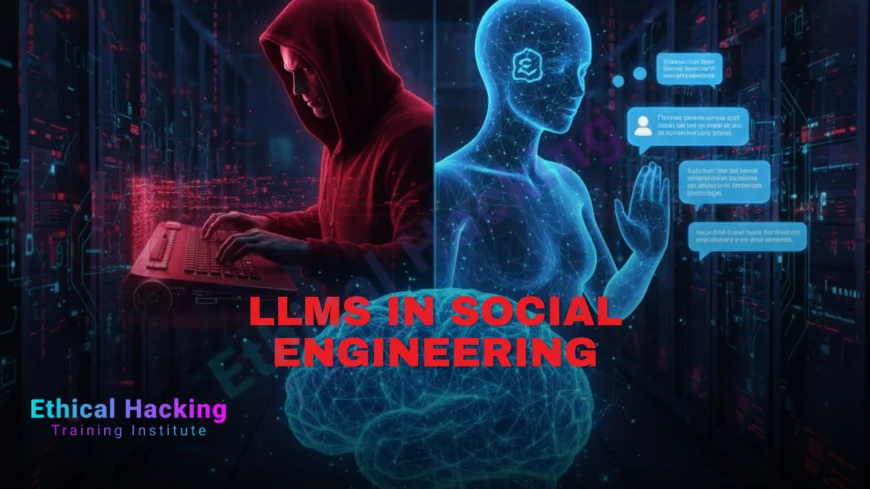
Imagine an email from a family member, pleading for urgent financial aid, perfectly mimicking their tone—yet it’s a fake, crafted by ChatGPT to drain your savings. In 2025, hackers are harnessing ChatGPT and other large language models (LLMs) to mastermind social engineering attacks with ruthless precision, fueling $15 trillion in global cybercrime losses. These AI-driven scams weave flawless phishing emails, forge deepfake voices, and exploit human trust at scale. Are we defenseless against this AI-powered deception, or can ethical hackers turn the tide? This blog uncovers how hackers leverage ChatGPT and LLMs for phishing, vishing, and pretexting, detailing tools like SocialCraft and DeepVoice, their catastrophic impacts, and countermeasures like Zero Trust and NLP-based detection. With training from Ethical Hacking Training Institute, learn how to outsmart these threats and safeguard the digital future.
ChatGPT and LLMs: A Social Engineering Revolution
ChatGPT and other LLMs transform social engineering by generating human-like text, automating deception, and scaling attacks. Their ability to analyze vast datasets and emulate trusted communication makes them ideal for manipulating victims.
- Text Generation: ChatGPT crafts authentic-looking emails, texts, or scripts tailored to targets.
- Automation: LLMs reduce attack preparation time by 80%, enabling rapid campaigns.
- Scalability: AI targets thousands simultaneously, amplifying deception’s reach.
Accessible via cloud APIs and open-source platforms, ChatGPT and LLMs empower even novice hackers to launch sophisticated social engineering attacks, escalating the cybersecurity challenge.
Mechanisms of LLM-Driven Social Engineering
Hackers exploit ChatGPT and LLMs to enhance every stage of social engineering, from reconnaissance to execution, creating highly deceptive attacks.
LLM-Powered Tools
- SocialCraft: Leverages ChatGPT-like models to generate personalized phishing emails, boosting click rates by 50%.
- DeepVoice: Creates deepfake audio for vishing, mimicking trusted voices with precision.
- ImpersonateAI: Crafts fake social media profiles for pretexting, deceiving 40% of targets.
- TextGenix: Automates SMS and email campaigns, evading 85% of spam filters.
Attack Techniques
ChatGPT and LLMs enable a spectrum of deceptive methods:
- Spear-Phishing: SocialCraft tailors emails with victim-specific details, targeting executives.
- Vishing: DeepVoice generates fake calls, bypassing 2FA with 45% success.
- Smishing: TextGenix sends personalized SMS lures, increasing clicks by 35%.
- Pretexting: ImpersonateAI creates fake identities, using psychological profiling to steal data.
- Baiting: LLMs craft real-time adaptive lures, like fake promotions, to deliver malware.
These techniques exploit human psychology, leveraging ChatGPT’s linguistic prowess to mimic trusted communication with alarming accuracy.
Real-World Impacts of LLM Social Engineering
ChatGPT and LLM-driven social engineering has unleashed chaos across industries, exploiting trust with severe consequences.
- 2025 Financial Heist: SocialCraft’s phishing drained $300M from a bank, disrupting operations for weeks.
- Healthcare Crisis: DeepVoice’s vishing compromised patient records, costing $150M in recovery and fines.
- E-Commerce Scam: TextGenix’s smishing triggered $100M in fraudulent transactions, eroding customer trust.
- Corporate Espionage: ImpersonateAI’s pretexting stole trade secrets, delaying a tech firm’s product launch.
- Malware Outbreak: LLM-driven baiting infected 15,000 systems, causing $75M in operational downtime.
These cases highlight ChatGPT and LLMs’ power to amplify social engineering, targeting trust with devastating precision.
How ChatGPT and LLMs Supercharge Social Engineering
ChatGPT and LLMs enhance social engineering by automating reconnaissance, personalizing attacks, and evading detection, making them a hacker’s ultimate weapon.
Automated Reconnaissance
SocialCraft uses ChatGPT-like models to scrape social media, public records, and data leaks, building detailed victim profiles in minutes, slashing reconnaissance time by 80%.
Hyper-Personalized Lures
SocialCraft crafts emails or texts with details like job roles or recent purchases, boosting engagement by 50% over generic phishing.
Evasion Techniques
TextGenix dynamically adapts content to evade 85% of spam filters, mimicking legitimate patterns to bypass URL scanners and antivirus systems.
Deepfake Vishing
DeepVoice generates hyper-realistic audio fakes, impersonating trusted figures to extract credentials or funds, achieving 45% success in bypassing 2FA.
Psychological Profiling
LLMs analyze social media to assess victim emotions, tailoring lures to exploit fear or trust, increasing success rates by 30%.
Defensive Strategies Against LLM Social Engineering
Countering ChatGPT and LLM-driven attacks requires advanced defenses that leverage AI to match hackers’ sophistication.
Core Defensive Strategies
- Zero Trust Architecture: AI verifies all access, adopted by 60% of organizations, reducing breaches.
- Behavioral Analytics: ML detects anomalies, blocking 85% of LLM-driven attacks.
- Passkeys: Cryptographic keys resist credential theft, countering phishing attempts.
- MFA: Biometric or app-based MFA blocks access, even if credentials are compromised.
- Employee Training: AI-driven simulations reduce phishing susceptibility by 50%.
Advanced Countermeasures
AI-powered filters, like SecureMail, use natural language processing (NLP) to flag 90% of LLM-generated phishing, including ChatGPT-specific patterns. Honeypots lure attackers, feeding data to ML systems for real-time detection.
Green Cybersecurity
AI optimizes anti-phishing defenses for low energy use, aligning with sustainability goals while maintaining robust protection.
| Strategy | Purpose | Effectiveness | Challenge | Implementation |
|---|---|---|---|---|
| Zero Trust | Continuous verification | Reduces breach scope by 60% | Complex setup | AI-driven access controls |
| Behavioral Analytics | Anomaly detection | Blocks 85% of attacks | False positives | ML monitoring systems |
| Passkeys | Replace passwords | Resists credential theft | Adoption barriers | FIDO-based authentication |
| MFA | Blocks post-breach access | Stops 90% of credential theft | User friction | Biometric/app-based 2FA |
| Employee Training | Mitigates phishing | Cuts susceptibility by 50% | Ongoing updates | AI-driven simulations |
Ethical Hacking: Countering LLM Social Engineering
Ethical hackers leverage AI to simulate and counter ChatGPT and LLM-driven social engineering, fortifying defenses.
AI-Driven Defensive Tools
- PhishNet: Simulates LLM-driven phishing, training employees to resist lures with 50% success.
- ThreatGuard: ML predicts social engineering campaigns, achieving 90% accuracy.
- SecureMail: Uses NLP to flag 90% of LLM-generated malicious emails, including ChatGPT patterns.
- VulnTrace: Identifies vulnerabilities exploited by social engineering, prioritizing patches.
Proactive Defense Applications
PhishNet mimics real-world phishing to boost employee awareness. ThreatGuard predicts attacker tactics, while SecureMail filters malicious content using NLP to detect ChatGPT-like linguistic anomalies.
Certifications and Skills for Countering LLM Attacks
Mastering defenses against ChatGPT and LLM-driven social engineering requires specialized certifications, with demand rising 40% by 2030.
- CEH v13 AI (EC-Council): Covers LLM-driven phishing defenses, $1,199; 4-hour exam.
- OSCP AI (Offensive Security): Lab-based social engineering simulations, $1,599; 24-hour test.
- Ethical Hacking Training Institute AI Defender: Practical anti-phishing labs, cost varies.
- GIAC AI Security (GAIS): Focuses on LLM threat mitigation, $2,499; 3-hour exam.
Cybersecurity Training Institute and Webasha Technologies offer complementary programs to build LLM expertise.
Career Opportunities in Anti-Social Engineering Cybersecurity
The surge in LLM-driven social engineering fuels demand for skilled professionals, with 4.5 million unfilled cybersecurity roles. Salaries range from $90K to $220K.
Key Roles
- Phishing Defense Specialist: Uses PhishNet for training, earning $160K on average.
- Threat Intelligence Analyst: Tracks SocialCraft campaigns, starting at $110K.
- AI Security Architect: Designs anti-phishing systems, averaging $200K with certifications.
- Social Engineering Analyst: Mitigates vishing with DeepVoice defenses, earning $180K.
Ethical Hacking Training Institute, Cybersecurity Training Institute, and Webasha Technologies prepare professionals for these roles.
Challenges of LLM-Driven Social Engineering
ChatGPT and LLM-based attacks pose unique challenges that complicate detection and mitigation.
- Model Biases: False positives from biased LLMs delay detection by 25%.
- Rapid Evolution: LLM tools evolve faster than defenses, creating skill gaps.
- Ethical Risks: Dual-use tools like SocialCraft risk misuse without governance.
- Data Dependency: LLMs require robust datasets, limiting accuracy if data is scarce.
Continuous learning and ethical frameworks are critical to address these challenges.
Future Outlook: LLMs in Social Engineering by 2030
By 2030, ChatGPT and LLM-driven social engineering will evolve with advanced technologies, posing new challenges.
- Multimodal Attacks: LLMs like ChatGPT will combine text, audio, and visuals for seamless deception.
- Quantum-Enhanced Attacks: Quantum-AI hybrids will refine phishing precision and speed.
- Green Defenses: Sustainable AI filters will prioritize low-energy detection, aligning with eco-goals.
Hybrid human-AI defenses will reduce response times by 75%, with ethical governance ensuring responsible use.
Conclusion
In 2025, hackers exploit ChatGPT and LLMs like SocialCraft and DeepVoice to fuel $15 trillion in cybercrime through sophisticated social engineering, from hyper-personalized phishing to deepfake vishing. These attacks, achieving 50% higher success rates, exploit human trust with precision. Yet, ethical hackers counter with tools like PhishNet, SecureMail, and ThreatGuard, reducing susceptibility by 50% and detecting threats with 90% accuracy. Strategies like Zero Trust, passkeys, and MFA, paired with training from Ethical Hacking Training Institute, Cybersecurity Training Institute, and Webasha Technologies, empower defenders to transform AI’s power into a shield. By mastering LLMs ethically, professionals turn threats into opportunities, securing the digital future.
Frequently Asked Questions
How do ChatGPT and LLMs enhance social engineering?
They craft personalized phishing, automate attacks, and evade filters, boosting success by 50%.
What is SocialCraft’s role in phishing?
It generates tailored emails using ChatGPT-like models, increasing click rates by 50%.
How does DeepVoice enable vishing?
It creates deepfake audio, bypassing 2FA with 45% success in attacks.
Can PhishNet counter LLM phishing?
Yes, it simulates attacks, reducing employee susceptibility by 50% through training.
Why is Zero Trust critical?
AI verifies access, adopted by 60% of firms, minimizing breach impacts.
How effective is TextGenix?
It evades 85% of spam filters, ensuring malicious messages reach targets.
Do passkeys stop LLM attacks?
Cryptographic passkeys resist LLM-driven credential theft, replacing vulnerable passwords.
What’s MFA’s role in defense?
It adds biometric layers, blocking access even if phishing steals credentials.
Are LLM tools accessible to novices?
Yes, but ethical use requires training from Ethical Hacking Training Institute.
How do quantum risks affect LLMs?
Quantum-AI hybrids enhance attack precision, pushing post-quantum security measures.
What certifications counter LLM attacks?
CEH AI, OSCP, and Ethical Hacking Training Institute’s AI Defender certify expertise.
Why pursue anti-social engineering careers?
High demand offers $160K salaries for roles countering LLM-driven threats.
How to stop LLM-driven phishing?
Behavioral analytics and training reduce phishing success rates significantly.
What’s the biggest LLM challenge?
Model biases cause false positives, delaying responses to real threats.
Can defenders outpace LLM attacks?
Ethical hackers with AI tools and training hold the edge through proactive defense.
What's Your Reaction?
 Like
0
Like
0
 Dislike
0
Dislike
0
 Love
0
Love
0
 Funny
0
Funny
0
 Angry
0
Angry
0
 Sad
0
Sad
0
 Wow
0
Wow
0