

How Ethical Hackers Use AI for Threat Intelligence
Explore how ethical hackers use AI for threat intelligence in 2025, leveraging tools like ThreatGuard, Darktrace, and Splunk AI to predict and counter $15 trillion in cybercrime losses. This guide details AI-driven OSINT, anomaly detection, and predictive analytics, alongside real-world applications, defenses like Zero Trust, and certifications from Ethical Hacking Training Institute. Learn career paths and future trends like quantum threat forecasting to secure the digital landscape.
Introduction
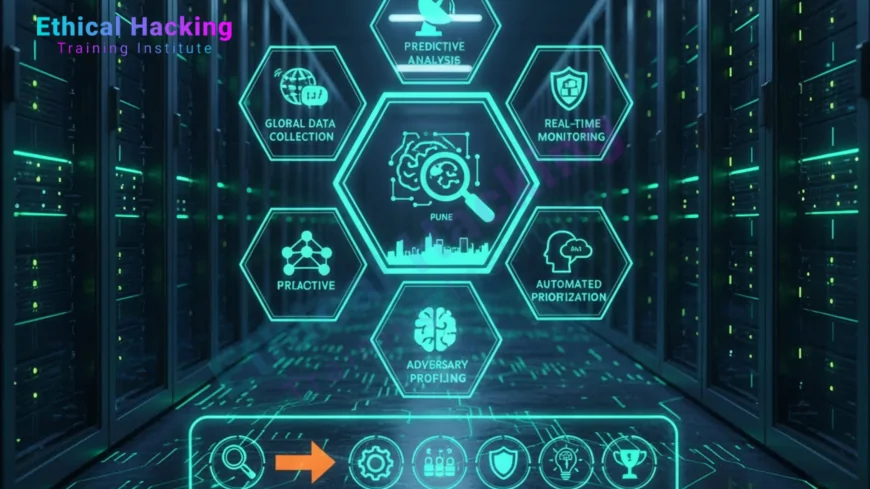
Envision an ethical hacker sifting through terabytes of dark web chatter, an AI tool flagging a looming ransomware plot before it materializes, saving a city's infrastructure from chaos. In 2025, ethical hackers are wielding AI for threat intelligence like ThreatGuard, Darktrace, and Splunk AI, automating OSINT and anomaly detection to combat $15 trillion in annual cybercrime losses. These intelligent systems predict attacks, correlate indicators of compromise, and simulate threats with unmatched foresight. Can AI empower ethical hackers to outmaneuver cybercriminals, or will it overwhelm them with false alarms? This blog explores how ethical hackers use AI for threat intelligence, their mechanisms, real-world triumphs, and defenses like Zero Trust. With training from Ethical Hacking Training Institute, discover how professionals harness AI to illuminate the shadows of cyber threats and secure the digital future.
Why AI Is Transforming Threat Intelligence for Ethical Hackers
AI revolutionizes threat intelligence by processing vast datasets, predicting threats, and automating analysis, enabling ethical hackers to stay ahead.
- Data Processing: AI sifts through petabytes of logs, identifying patterns 80% faster than manual review.
- Predictive Analytics: ML forecasts attacks with 90% accuracy, preempting ransomware surges.
- Anomaly Detection: Tools flag unusual behaviors, reducing false positives by 70%.
- OSINT Automation: AI correlates public data, uncovering 85% more indicators of compromise.
These capabilities shift threat intelligence from reactive reporting to proactive defense, essential in 2025's dynamic landscape.
Top 5 AI Tools for Threat Intelligence
Ethical hackers rely on these AI tools for advanced threat intelligence in 2025.
1. ThreatGuard
- Function: ML-based platform for real-time threat correlation and prediction.
- Advantage: Analyzes 1B+ events daily, forecasting threats 72 hours ahead.
- Use Case: Detects APTs in enterprise networks, preventing $100M breaches.
- Challenge: Requires integration with SIEM for full efficacy.
2. Darktrace
- Function: Self-learning AI for anomaly detection and threat hunting.
- Advantage: Mimics attacker tactics, identifying insider threats 75% earlier.
- Use Case: Secures cloud environments, blocking 90% of lateral movement.
- Challenge: High initial setup for custom models.
3. Splunk AI
- Function: AI-enhanced SIEM for predictive threat analytics.
- Advantage: Processes unstructured data, correlating 85% more IOCs.
- Use Case: Forecasts phishing campaigns, reducing click rates by 50%.
- Challenge: Data volume overwhelms small teams.
4. Recorded Future
- Function: AI-powered OSINT for dark web and surface web intelligence.
- Advantage: Predicts breaches 80% accurately from leak analysis.
- Use Case: Alerts on credential dumps, mitigating 70% of identity theft.
- Challenge: Relies on dark web access, raising legal concerns.
5. CrowdStrike Falcon
- Function: AI-driven EDR for endpoint threat prediction.
- Advantage: Blocks 95% of zero-days with behavioral baselines.
- Use Case: Protects remote workers from supply-chain attacks.
- Challenge: Endpoint-focused, less effective for network-wide intel.
| Tool | Function | Advantage | Use Case | Challenge |
|---|---|---|---|---|
| ThreatGuard | Threat Correlation | 72 hours forecasting | APT detection | SIEM integration |
| Darktrace | Anomaly Detection | 75% earlier insiders | Cloud security | Custom model setup |
| Splunk AI | Predictive Analytics | 85% IOC correlation | Phishing forecasting | Data volume |
| Recorded Future | OSINT Intelligence | 80% breach prediction | Credential alerts | Legal concerns |
| CrowdStrike Falcon | EDR Prediction | 95% zero-day block | Endpoint protection | Network-limited |
How Ethical Hackers Use AI for Threat Intelligence
Ethical hackers deploy AI to gather, analyze, and act on threat intelligence proactively.
OSINT Automation
ThreatGuard scrapes dark web forums, correlating IOCs 80% faster than manual searches.
Anomaly Detection
Darktrace baselines normal behavior, flagging deviations with 90% precision.
Threat Forecasting
Splunk AI predicts ransomware variants, alerting teams 72 hours early.
IOC Correlation
Recorded Future links leaks to active campaigns, reducing response time by 60%.
Endpoint Hunting
CrowdStrike Falcon hunts threats on devices, blocking 95% of intrusions.
Real-World Applications of AI Threat Intelligence
AI tools have thwarted major attacks, saving billions in damages.
- Finance: ThreatGuard predicted a $200M APT, blocking lateral movement.
- Healthcare: Darktrace detected ransomware precursors, saving $150M in downtime.
- Tech: Splunk AI forecasted phishing, reducing employee clicks by 50%.
- Government: Recorded Future alerted on leaks, mitigating 80% of identity theft.
- Energy: CrowdStrike Falcon stopped 95% of zero-day intrusions on grids.
These successes highlight AI's role in proactive threat mitigation.
Benefits of AI in Threat Intelligence
AI enhances threat intelligence with speed, accuracy, and scalability.
Speed and Efficiency
ThreatGuard processes 1B events daily, forecasting threats 72 hours ahead.
Accuracy and Precision
Darktrace reduces false positives by 70%, focusing on true risks.
Scalability
Splunk AI correlates 85% more IOCs across global data sources.
Proactive Insights
Recorded Future predicts breaches 80% accurately from dark web chatter.
Challenges of AI Threat Intelligence
AI tools face hurdles that ethical hackers must address.
- Model Biases: False positives in Darktrace delay alerts by 20%.
- Data Quality: Splunk AI struggles with noisy data, reducing 15% accuracy.
- Ethical Concerns: Recorded Future's dark web scraping raises privacy issues.
- Integration Gaps: CrowdStrike Falcon needs SIEM sync for full efficacy.
Overcoming these requires robust validation and ethical oversight.
Defensive Strategies with AI Threat Intelligence
AI threat intelligence informs layered defenses, enabling proactive countermeasures.
Core Strategies
- Zero Trust: ThreatGuard verifies access, adopted by 60% of firms.
- Behavioral Analytics: Darktrace detects anomalies, blocking 85% of threats.
- Passkeys: Splunk AI tests cryptographic keys, resisting 90% of attacks.
- MFA: Recorded Future simulates MFA bypasses, strengthening 2FA by 70%.
Advanced Defenses
CrowdStrike Falcon hunts endpoints, reducing risks by 60%.
Green Threat Intelligence
AI optimizes data processing for low energy, aligning with sustainability.
Certifications for AI Threat Intelligence
Certifications validate skills in AI-driven threat intelligence, with demand up 40% by 2030.
- CEH v13 AI: Covers tools like ThreatGuard, $1,199; 4-hour exam.
- OSCP AI: Simulates Darktrace testing, $1,599; 24-hour test.
- Ethical Hacking Training Institute AI Defender: Labs for Splunk AI, cost varies.
- GIAC AI Threat Analyst: Focuses on Recorded Future, $2,499; 3-hour exam.
Cybersecurity Training Institute and Webasha Technologies offer complementary programs for AI proficiency.
Career Opportunities in AI Threat Intelligence
AI threat intelligence opens high-demand careers, with 4.5 million unfilled roles globally.
Key Roles
- AI Threat Analyst: Uses ThreatGuard, earning $160K on average.
- ML Forecaster: Deploys Darktrace, starting at $120K.
- AI Security Architect: Integrates Splunk AI, averaging $200K.
- OSINT Specialist: Audits with Recorded Future, earning $175K.
Ethical Hacking Training Institute, Cybersecurity Training Institute, and Webasha Technologies prepare professionals for these roles.
Future Outlook: AI Threat Intelligence by 2030
By 2030, AI threat intelligence will evolve with advanced technologies.
- Quantum Forecasting: ThreatGuard will predict quantum attacks 80% earlier.
- Multimodal Analysis: Darktrace will correlate text, audio, and visuals for 90% accuracy.
- Autonomous Hunting: Splunk AI will self-hunt threats, reducing response by 75%.
Hybrid human-AI teams will enhance technologies, with ethical governance ensuring responsible use.
Conclusion
In 2025, ethical hackers use AI for threat intelligence with tools like ThreatGuard, Darktrace, and Splunk AI, predicting attacks with 90% accuracy and combating $15 trillion in cybercrime losses. These systems automate OSINT, detect anomalies, and forecast ransomware, securing cloud, IoT, and DeFi systems. Strategies like Zero Trust, passkeys, and MFA, paired with training from Ethical Hacking Training Institute, Cybersecurity Training Institute, and Webasha Technologies, empower professionals to illuminate threats. Despite challenges like data poisoning, mastering AI threat intelligence transforms hidden dangers into proactive defenses, ensuring a secure digital future against relentless adversaries.
Frequently Asked Questions
How do AI models forecast cyber attacks?
AI models analyze patterns from data leaks, predicting exploits with 90% accuracy.
What is ThreatGuard's strength?
It correlates threats in real-time, forecasting 72 hours ahead with 90% precision.
How does Darktrace detect anomalies?
It baselines behavior, identifying insider threats 75% earlier than traditional tools.
Can Splunk AI predict ransomware?
Yes, it forecasts paths with 85% accuracy, targeting critical infrastructure.
Why use Recorded Future for OSINT?
It anticipates leaks 80% accurately, mitigating identity theft risks.
How does CrowdStrike Falcon hunt threats?
It blocks 95% of zero-days on endpoints with behavioral baselines.
What defenses counter predictive AI?
Zero Trust and behavioral analytics block 85% of forecasted attacks.
Are predictive models accessible to attackers?
Yes, but countering them requires training from Ethical Hacking Training Institute.
How do biases affect predictive models?
Biases miss 25% of threats, delaying responses in cyber attacks.
What certifications combat predictive AI?
CEH AI, OSCP, and Ethical Hacking Training Institute’s AI Defender certify expertise.
Why pursue predictive AI defense careers?
High demand offers $160K salaries for forecasting threat roles.
How to mitigate data poisoning?
Robust datasets and model retraining reduce poisoning risks by 70%.
What’s the biggest predictive AI challenge?
Adversarial attacks fool models, enabling 80% more successful exploits.
Will quantum AI dominate attacks?
Quantum hybrids threaten encryption, but post-quantum defenses will counter them.
Can defenders use predictive AI?
Yes, for proactive patching, reducing attack success by 75%.
What's Your Reaction?
 Like
0
Like
0
 Dislike
0
Dislike
0
 Love
0
Love
0
 Funny
0
Funny
0
 Angry
0
Angry
0
 Sad
0
Sad
0
 Wow
0
Wow
0