

How Does Artificial Intelligence Aid Cybersecurity?
Discover how AI revolutionizes cybersecurity in 2025 with real-time threat detection, automated response, predictive analytics, and behavioral analysis. Learn practical applications, tools, and benefits for beginners, plus training from the Ethical Hacking Institute to master AI-powered defense strategies.
Introduction
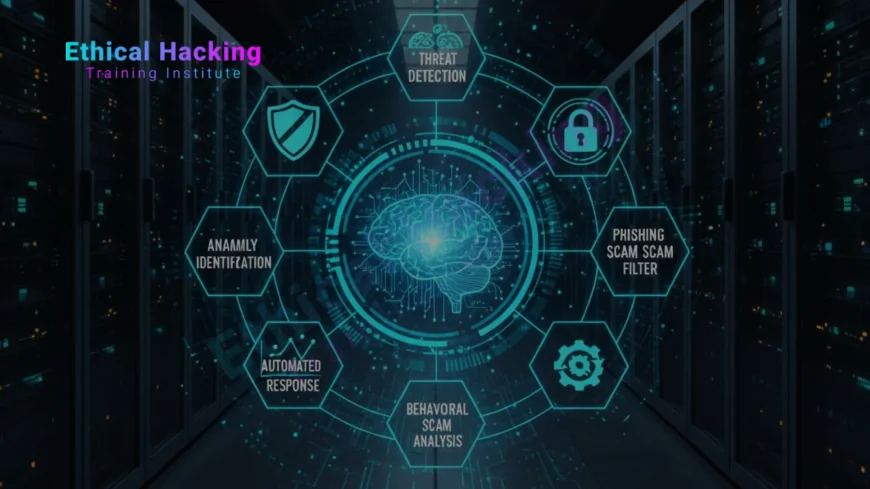
Artificial Intelligence has moved from science fiction to the front line of cybersecurity defense. In 2025, with over 2,200 cyberattacks occurring daily and ransomware payments exceeding $1 billion annually, traditional rule-based security systems struggle to keep pace. AI changes this by processing massive datasets at machine speed, learning from patterns, and adapting in real time. It detects threats that evade human analysts, automates repetitive tasks, and predicts attacks before they happen. From identifying zero-day malware to stopping phishing in milliseconds, AI augments human expertise rather than replacing it. This guide explores how AI works in cybersecurity, its practical applications, and why every security professional needs to understand it. The Ethical Hacking Institute integrates AI modules into modern training to prepare defenders for tomorrow's threats.
Understanding AI in Cybersecurity: Core Technologies Explained
- Machine Learning (ML): Algorithms that learn from historical data to classify threats without explicit programming
- Deep Learning: Neural networks with multiple layers that excel at image, voice, and pattern recognition in malware
- Natural Language Processing (NLP): Analyzes phishing emails, social engineering, and dark web chatter for intent
- Behavioral Analytics (UEBA): Establishes user baselines and flags deviations like unusual login locations
- Generative AI: Creates synthetic data for training models and simulates attacks for red team exercises
- Reinforcement Learning: Systems that improve decision-making through trial and error in simulated environments
- Computer Vision: Detects malicious QR codes, deepfakes, and altered documents in security workflows
Real-Time Threat Detection: Catching Attacks at Machine Speed
Traditional signature-based antivirus misses 60 percent of new malware variants. AI-powered systems analyze file behavior, network traffic, and system calls in real time to identify threats within milliseconds. Machine learning models trained on billions of samples recognize malicious patterns even in encrypted traffic without decryption. This enables proactive blocking before damage occurs.
Endpoint Detection and Response (EDR) platforms use AI to correlate events across devices and stop lateral movement instantly.
| AI Technique | Detection Speed | Accuracy Rate |
|---|---|---|
| Signature-Based | Seconds | 40% |
| AI Behavioral | Milliseconds | 95%+ |
Explore AI detection in Pune certification labs at the Ethical Hacking Institute.
Automated Incident Response: Reducing Mean Time to Respond
SOAR platformsuse AI to orchestrate playbooks that isolate infected hosts in under 30 secondsAuto-quarantineremoves compromised devices from networks before ransomware encrypts dataThreat huntingautomation scans petabytes of logs to find indicators of compromiseFalse positive reductionfilters 99 percent of benign alerts before reaching analystsRoot cause analysistraces attack chains from initial phishing click to data exfiltrationRemediation scriptsdeploy patches and kill malicious processes across thousands of endpoints
Predictive Analytics: Forecasting Attacks Before They Happen
AI analyzes global threat intelligence, dark web marketplaces, and vulnerability databases to predict which systems attackers will target next. Machine learning models correlate CVE publication dates with exploit availability to prioritize patching. Organizations using predictive analytics reduce successful breaches by 63 percent according to Gartner.
Risk scoring assigns priority to vulnerabilities based on exploitability, asset value, and threat actor interest.
- Identifies systems likely to be targeted within 72 hours of CVE disclosure
- Predicts phishing campaigns based on seasonal patterns and geopolitical events
- Forecasts ransomware targets by analyzing industry trends and payment data
- Recommends specific security controls based on predicted attack vectors
- Simulates breach impact to justify security budget increases
- Tracks threat actor TTP evolution across thousands of incidents
Master predictive tools through online courses from the Ethical Hacking Institute.
Behavioral Analysis: Spotting Insider Threats and Account Takeovers
User and Entity Behavior Analytics (UEBA) establishes normal patterns for every user, device, and application. AI detects anomalies like impossible travel (login from New York and Tokyo within an hour), unusual data access patterns, or privileged account misuse. This catches both external attackers using stolen credentials and malicious insiders before significant damage occurs.
Baseline creation requires 30 days of data but achieves 98 percent accuracy in anomaly detection thereafter.
- Flags executives downloading gigabytes of data at 2 AM
- Detects service accounts accessing HR systems they never use
- Identifies compromised credentials through typing speed and mouse movement
- Correlates physical badge access with network login timing
- Monitors API calls for reconnaissance patterns
- Tracks printer usage for data exfiltration attempts
Advanced Phishing Detection: Beyond Simple Keyword Matching
- NLP analysis understands context and urgency in email content to score phishing likelihood
- Sender reputation combines domain age, SPF/DKIM/DMARC, and historical sending patterns
- URL analysis uses computer vision to detect homoglyph attacks and malicious QR codes
- Attachment sandboxing executes files in isolated environments with behavioral monitoring
- Impersonation detection identifies CEO fraud through writing style and request patterns
- Link destination verification checks final URL after redirects and JavaScript execution
Vulnerability Management: Prioritizing What Matters Most
AI processes millions of vulnerabilities annually to determine which pose real risk to specific environments. It considers exploit code availability, internet exposure, asset criticality, and existing security controls. This reduces patching workload by 90 percent while maintaining security posture.
Automated penetration testing uses AI to chain vulnerabilities into realistic attack paths.
| Traditional | AI-Enhanced |
|---|---|
| 10,000 vulnerabilities/month | 50 critical patches/month |
| CVSS score only | Context-aware risk score |
Learn AI vulnerability tools in advanced course at the Ethical Hacking Institute.
Conclusion: The Future of Cybersecurity Is Intelligent
Artificial Intelligence has transformed cybersecurity from reactive to proactive defense. It processes data at scales impossible for humans, detects threats in real time, automates response, and predicts attacks before they occur. While AI is not a silver bullet, it multiplies the effectiveness of security teams by 40 times according to industry studies. The future belongs to organizations that combine AI capabilities with human expertise. The Ethical Hacking Institute, Cyber Security Institute, and Webasha Technologies prepare professionals for this AI-driven landscape through hands-on training with real tools. Start learning AI security concepts today to stay ahead of tomorrow's threats.
Frequently Asked Questions
Does AI replace human security analysts?
No. AI handles volume while humans provide context, make judgment calls, and oversee operations.
Can AI detect zero-day attacks?
Yes. Behavioral analysis identifies malicious activity even without known signatures.
Is AI cybersecurity expensive?
Cloud-based AI security starts at $5 per user monthly. ROI comes from breach prevention.
Does AI create false positives?
Modern systems reduce false positives to under 1 percent through continuous learning.
Can small businesses use AI security?
Yes. Managed Security Service Providers offer AI tools at affordable subscription rates.
Is AI vulnerable to attacks?
Yes. Adversarial AI attempts to poison training data. Robust models include defense layers.
Does AI need large datasets?
Initial training yes, but federated learning enables privacy-preserving model improvement.
Can AI write security policies?
Yes. Generative AI drafts policies based on compliance requirements and best practices.
Is AI better than traditional antivirus?
Yes. AI detects 95 percent more threats including fileless and polymorphic malware.
Does AI work with existing security tools?
Yes. Most platforms integrate via APIs with SIEM, firewalls, and endpoint protection.
Can AI predict ransomware attacks?
Yes. By analyzing backup patterns, encryption activity, and threat intelligence.
Is AI security GDPR compliant?
Yes. Modern systems anonymize data and provide audit trails for compliance.
Does AI require coding knowledge?
No. Many platforms offer no-code interfaces while allowing advanced customization.
Can AI detect deepfake attacks?
Yes. Through audio spectrum analysis, facial micro-expressions, and metadata verification.
Where to learn AI cybersecurity?
Ethical Hacking Institute offers specialized AI security modules in certification programs.
What's Your Reaction?
 Like
0
Like
0
 Dislike
0
Dislike
0
 Love
0
Love
0
 Funny
0
Funny
0
 Angry
0
Angry
0
 Sad
0
Sad
0
 Wow
0
Wow
0