
How Does AI Impact Cybersecurity and Hacking?
Discover how AI transforms cybersecurity in 2025: from supercharging defenses with threat detection to empowering hackers with deepfakes and adaptive malware. Learn both sides, real examples, and how to stay safe.
Introduction: AI – The Double-Edged Sword of Cybersecurity
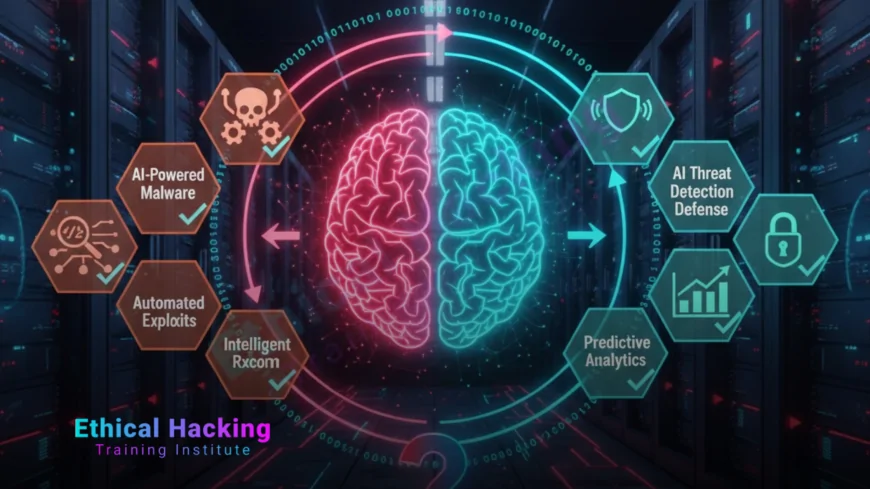
In 2025, artificial intelligence isn't just a buzzword—it's the battlefield. AI helps defenders spot attacks in milliseconds, but it also arms hackers with tools that think, adapt, and deceive like never before.
From AI-generated deepfake videos tricking executives to malware that rewrites itself to avoid antivirus, the game has changed. But AI also powers next-gen firewalls, predicts breaches, and automates security tasks.
This guide explores both sides: how AI strengthens cybersecurity and how it supercharges hacking. With real-world examples and practical insights, you'll understand the risks—and the defenses—shaping digital security today.
AI in Defense: How Security Teams Fight Back
AI isn't just for attackers. It's revolutionizing how we protect systems.
Real-Time Threat Detection
Machine learning analyzes billions of events per second, spotting anomalies humans miss.
- Detects zero-day attacks before signatures exist
- Reduces false positives by 90%
- Used by 78% of security teams in 2025
Automated Incident Response
AI doesn't just detect—it acts. Systems isolate infected devices, block IPs, and patch vulnerabilities automatically.
- Cuts response time from hours to seconds
- Handles 60% of routine incidents without humans
Predictive Analytics
AI forecasts attacks by analyzing global threat data, user behavior, and system weaknesses.
- Prioritizes high-risk vulnerabilities
- Simulates attack paths before they happen
AI in Offense: How Hackers Weaponize Intelligence
Attackers use the same AI tech—and often better—for malicious ends.
AI-Powered Phishing and Social Engineering
Generative AI creates hyper-realistic fake emails, voices, and videos.
- Deepfake CEO calls demanding wire transfers
- AI writes personalized spear-phishing at scale
- Success rate up 300% over traditional phishing
Adaptive Malware
Malware uses AI to evolve and evade detection.
- Changes code signature every infection
- Learns from antivirus behavior
- Polymorphic ransomware seen in 45% of attacks
Automated Vulnerability Discovery
AI scans code faster than any human, finding flaws in seconds.
- Discovers zero-days in open-source libraries
- Powers "fuzzing" tools that crash software
- Used in nation-state cyber weapons
AI-Powered Hacking Tools: Democratizing Attacks
AI lowers the barrier to entry. Even script kiddies can now launch sophisticated attacks.
Tools Available Today
| Tool Type | AI Feature | Impact |
|---|---|---|
| Phishing Kits | Generates custom lures | 1000+ campaigns/hour |
| Password Crackers | Guesses based on user patterns | Cracks 70% faster |
| Recon Tools | OSINT automation | Finds targets in minutes |
Many ethical hackers use AI tools like AI-enhanced Nmap scripts to improve scanning efficiency during authorized tests.
Deepfakes: The New Face of Fraud
AI-generated media blurs reality.
Real Cases
- 2024: $25M stolen via deepfake video call in Hong Kong
- 2025: AI voice clones used in 30% of vishing attacks
- Political deepfakes disrupt elections globally
Defense Tips
- Use code words for sensitive calls
- Verify identity through secondary channels
- Train staff to spot audio/video artifacts
AI in Penetration Testing: The Ethical Side
White-hat hackers use AI to find flaws faster.
Automated Pentesting
- AI maps attack surfaces in hours
- Simulates thousands of exploit paths
- Generates detailed reports with remediation
Red Teaming with AI
- Adversarial AI mimics real attackers
- Tests blue team response effectiveness
- Used by 40% of Fortune 500 security teams
The AI Arms Race: Attack vs Defense
It's a constant battle of AI vs AI.
Attack Wins When
- AI finds novel exploits
- Generates undetectable payloads
- Overwhelms human responders
Defense Wins When
- AI predicts and blocks in real-time
- Automates patching and isolation
- Learns from global attack data
Currently, defenders have the edge with more data and resources—but attackers innovate faster.
AI Governance and Ethics in Cybersecurity
With great power comes great responsibility.
Key Concerns
- AI bias leading to false positives/negatives
- Weaponized AI in cyber warfare
- Lack of transparency in AI decisions
Best Practices
- Human-in-the-loop for critical actions
- Regular AI model auditing
- Ethical AI frameworks (NIST, ISO)
Future Outlook: AI and Quantum Collision
AI + quantum computing = encryption apocalypse?
Coming Threats
- AI-optimized quantum attacks on RSA
- Instant cracking of current encryption
- Race to post-quantum cryptography
Preparation Steps
- Inventory cryptographic assets
- Adopt crypto-agile systems
- Monitor NIST PQC standards
AI Impact Comparison: Defense vs Offense
| Area | Defensive AI | Offensive AI |
|---|---|---|
| Speed | Real-time blocking | Instant payload generation |
| Scale | Monitors millions of endpoints | Targets millions simultaneously |
| Accuracy | 90% threat detection | 70% evasion success |
Conclusion: Master AI or Be Mastered By It
AI is transforming cybersecurity into a high-speed, intelligent battlefield. It empowers defenders with prediction and automation while giving attackers adaptive, scalable weapons.
The winners? Those who understand both sides. Security teams must deploy AI defensively while thinking like AI-enabled attackers. Ethical hackers use AI to find flaws faster, staying one step ahead.
Start today: explore AI security tools, learn prompt engineering for recon, and practice with AI-assisted labs. The future of hacking is intelligent—and it's already here. Many professionals begin with an AI-focused ethical hacking bootcamp to master these dual skills. Stay curious, stay secure.
Frequently Asked Questions
Is AI more helpful for hackers or defenders?
Currently, defenders have more data and resources. But attackers innovate faster with fewer constraints.
Can AI replace human pentesters?
No. AI finds known flaws fast, but humans excel at creative, context-aware exploitation.
Are deepfakes a real business threat?
Yes. $25M+ lost in single incidents. Verify identity beyond video/voice.
How does AI make malware smarter?
It learns from detection patterns and mutates code to stay hidden.
Should I trust AI security decisions?
Never fully. Keep human oversight for critical actions.
Can small businesses use AI security?
Yes. Cloud-based AI tools start at $10/month per user.
Is AI hacking legal?
Only with written permission. AI doesn't change ethics or law.
How to learn AI for ethical hacking?
Start with Python, then machine learning basics. Practice on CTF platforms with AI challenges.
Will quantum + AI break all security?
Not immediately. Transition to post-quantum crypto takes 5-10 years.
Best AI tool for beginners?
Try open-source tools like Snort with ML plugins or Microsoft Sentinel (free tier).
Does AI reduce need for passwords?
No. It enhances them with behavioral biometrics and risk scoring.
Can AI write exploits?
Yes, but they're often noisy and detectable. Human refinement needed.
How to defend against AI phishing?
Multi-channel verification, AI email filters, and employee training.
Is AI making ransomware worse?
Yes. AI targets high-value victims and optimizes encryption speed.
Future of AI in cybersecurity?
Fully autonomous security operations centers vs AI-driven persistent threats.
What's Your Reaction?
 Like
0
Like
0
 Dislike
0
Dislike
0
 Love
0
Love
0
 Funny
0
Funny
0
 Angry
0
Angry
0
 Sad
0
Sad
0
 Wow
0
Wow
0