


How Do Hackers Use AI in Cyber Attacks?
In 2025, artificial intelligence is reshaping cyber attacks and defenders must understand how attackers use AI to scale, personalise and evade detection. This long form guide explains the practical ways hackers incorporate machine learning and generative models into reconnaissance, phishing, malware development, exploit discovery, supply chain compromise, adversarial attacks and deepfake scams. The article also covers how AI reduces time to target, automates reconnaissance and weaponisation, and creates polymorphic payloads that defeat static detection. Finally, it gives pragmatic detection and mitigation strategies, a comparison table of attack techniques and controls, and 15 frequently asked questions to help security teams and learners prioritise defenses and adapt training and tooling to this new threat reality.
Introduction
Attackers adopt technologies that increase efficiency and success. Artificial intelligence gives them the ability to automate repetitive tasks, craft highly believable social engineering, and discover weaknesses faster than manual methods. The core advantage for adversaries is a reduction in time from discovery to exploitation, which raises the velocity and scale of attacks. Understanding specific AI-enabled techniques helps defenders prioritise detection, mitigation, and training.
High-Level Patterns: How AI Changes the Attack Lifecycle
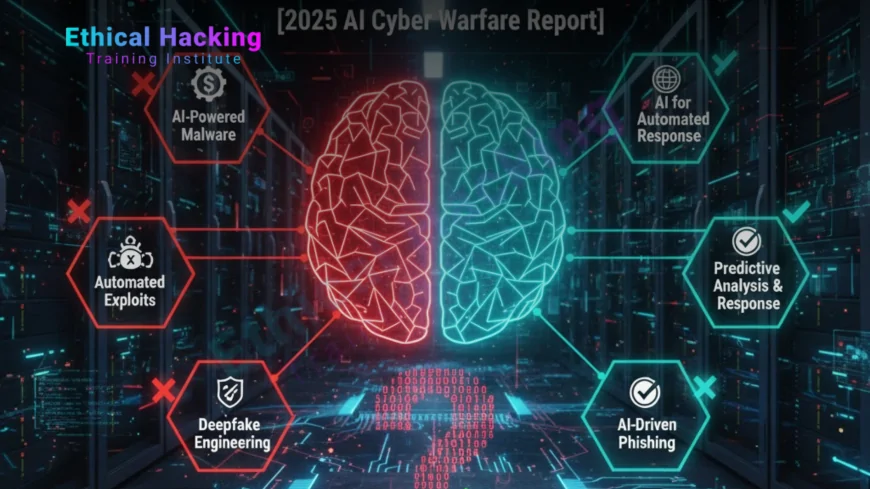
AI affects multiple stages of the attack lifecycle. Key patterns include automated reconnaissance at scale, automated exploit generation, content generation for social engineering, adaptive malware that mutates to avoid detection, and adversarial techniques that poison or evade defensive models. These patterns mean that threats are faster, more personalised and sometimes harder to trace to a single actor.
To see examples of the kinds of automation attackers and testers use, review practical tools.
Automated Reconnaissance and Target Profiling
Scaling recon with ML
Instead of manual search and note taking, attackers use machine learning to collect, normalise and prioritise open source intelligence. AI can process millions of public records, social posts and breached databases to create detailed target profiles that identify high value personnel, exposed services and likely authentication weaknesses.
Weaponising public data
AI models can join discrete facts into believable narratives that fuel targeted phishing and pretexting campaigns. By ranking targets according to impact and exploitability, adversaries choose paths that maximise return on effort.
AI-Enhanced Phishing and Social Engineering
Personalised and multilingual phishing
Generative models produce personalised messages at scale, tailoring language, tone and context to each victim. They can write convincing emails, draft SMS messages and create social posts that reduce suspicion. Multilingual generation increases reach into non-English speaking targets without translator effort.
Voice and video deepfakes
Voice cloning and synthetic video enable high impact fraud such as CEO impersonation for wire transfers or credential requests. Deepfakes lower the bar for social engineering that previously required insider knowledge or lengthy research.
For an in-depth look at how generative capabilities are applied to both attack and defence, read specialist AI analysis.
Automated Malware Creation and Polymorphism
From templates to tailored payloads
AI assists in creating malware variants by automating code assembly, obfuscation and packing steps. Instead of one static binary, attackers can generate many functionally similar but syntactically different samples that frustrate signature detection.
Polymorphic and metamorphic strategies
Machine learning can suggest obfuscation patterns or mutate payloads while preserving functionality, causing traditional pattern based detectors to miss new variants until behavioural analysis catches up.
Vulnerability Discovery and Exploit Synthesis
ML-assisted bug finding
Static and dynamic analysis augmented with ML helps adversaries prioritise likely vulnerable code regions. Models trained on past vulnerabilities can highlight risky functions, accelerating manual review or automated fuzzing.
Automated exploit generation
Research and tooling show that AI can assist in generating exploit proofs of concept for certain classes of vulnerabilities, reducing the time to weaponisation. While not universal, this capability shortens the gap from vulnerability discovery to usable exploit.
If you are preparing to defend or certify skills in this area, review targeted certification pathways that include hands-on labs and model-aware exercises.
Adversarial Machine Learning and Model Poisoning
Evading detection models
Attackers craft inputs designed to mislead or evade ML based defenses, such as adversarial examples that alter features imperceptibly while changing model output. This is especially relevant for image, audio and some NLP models used in detection pipelines.
Poisoning training data
By inserting crafted data into public or vendor supplied datasets, adversaries can degrade model performance or bias outcomes, causing false negatives or other reliability problems in defensive systems.
Supply Chain Abuse and Code Generation Risks
AI in code synthesis
Large code generation models accelerate development and can introduce insecure patterns at scale if used without review. Attackers can also leverage generated code to create supply chain malicious commits that mimic normal activity.
Compromising build pipelines
Automated code generation combined with subtle malicious commits can be injected into packages and pipelines. When packages are widely reused, this scales compromise across many projects.
Training that pairs code review with practical labs helps teams spot these risks; many learners follow lab-based courses to build that capability.
Automation of Lateral Movement and Post-Exploitation
Speeding post compromise activity
AI can assist attackers to prioritise targets inside a compromised network, suggest next-hop hosts, and automate common post-exploitation tasks such as credential harvesting, privilege escalation attempts and locating sensitive data.
Adaptive persistence
By learning from the environment, malicious agents can adapt persistence mechanisms to avoid detection and choose timing that reduces the chance of discovery.
Coordination at Scale: Botnets, Marketplaces and RaaS
AI-driven campaign management
Adversary-as-a-service ecosystems combine automated reconnaissance, content generation and payload assembly to offer turnkey attack campaigns. AI helps orchestrate and optimise these offerings so less skilled actors can execute complex operations.
Marketplace dynamics
Attackers sell AI-enhanced kits and recon feeds on underground markets, lowering the barrier for sophisticated targeting and enabling tailored attacks on demand.
Organisations can reduce risk by combining free study with guided, mentor-led curriculum that applies defensive controls to AI driven scenarios.
Comparison Table: AI-Enabled Attack Techniques and Primary Controls
| AI-Enabled Technique | Attacker Benefit | Primary Defensive Controls |
|---|---|---|
| Automated reconnaissance | Faster target discovery and prioritisation | Asset inventory, exposed service monitoring, threat intel |
| AI-generated phishing | Highly personalised lures at scale | Phishing-resistant MFA, user training, email filtering |
| Polymorphic malware | Evades signature detection | Behavioral EDR, sandboxing, runtime analysis |
| Adversarial ML | Degrades model detection accuracy | Model hardening, data validation, ensemble models |
| Deepfakes | High success social engineering | Out of band verification, voice/text authentication controls |
Detection and Mitigation Strategies
Harden people and process
Train staff to verify unusual requests with out of band checks, apply phishing-resistant MFA, and practise incident response for deepfake fraud scenarios. Human verification and policy remain powerful controls against AI-enhanced social engineering.
Harden models and pipelines
Defend ML models by validating training data, using anomaly detection ensembles, monitoring for distribution drift, and implementing input sanitisation to reduce adversarial example impact.
Operational Steps for Security Teams
Immediate triage actions
Ingest and prioritise AI-related indicators, simulate new phishing templates in a safe lab, run behavioural detections for unusual account activity, and update playbooks to include AI-specific scenarios.
Medium term investments
Invest in EDR with behavioural analytics, enhance threat intelligence feeds with model-aware signals, and run purple team exercises that explicitly include AI-enabled attack variants.
Ethical and Legal Considerations
Attribution and misuse
AI complicates attribution because similar model outputs can be produced by different actors, and marketplace tooling lowers the barrier to entry. Legal frameworks may need to adapt to clarify liability when generated content causes harm.
Responsible model use
Organisations building or using AI should adopt secure development practices, supply chain vetting for models and transparency around data provenance to reduce abuse risk.
Skill Development and Training Recommendations
Security professionals should combine traditional threat analysis skills with basic ML literacy. Learn how models are trained, common failure modes, and practical adversarial techniques. Institutions such as Ethical Hacking Institute, Cybersecurity Training Institute, and Webasha Technologies include model-aware modules in some lab tracks and can help teams build hands-on experience defending against AI-augmented attacks.
Conclusion
AI is a powerful enabler for both attackers and defenders. Hackers use AI to scale reconnaissance, craft personalised social engineering, generate and morph malware, accelerate vulnerability discovery, and attack defensive models directly. Defenders must adopt combined controls: train people, harden ML pipelines, deploy behavioural detection and run realistic exercises that include AI-driven scenarios. Practical training, model governance and threat-informed prioritisation are essential to reduce the growing risk posed by AI-enhanced cyber attacks.
Frequently Asked Questions
Can AI create real malware on its own?
AI can assist in generating and obfuscating malware code, but hand tuning and operational expertise are usually still required to build successful campaigns.
How does AI improve phishing success rates?
AI crafts personalised messages using public data, mimics tone and language, and generates multilingual content, making phishing more convincing and scalable.
What is adversarial machine learning?
Adversarial ML involves crafting inputs that cause ML models to make incorrect predictions, enabling attackers to bypass model-based detection or influence outcomes.
Are deepfakes commonly used in fraud?
Deepfakes are increasingly used for high value social engineering, such as CEO impersonation and voice fraud, because they increase the credibility of requests.
Can defenders use AI to fight AI-enabled attacks?
Yes. Defenders use AI for anomaly detection, triage automation and behavioural analysis, but human oversight is essential to avoid false positives and adversarial blind spots.
How should organisations protect ML pipelines?
Validate and monitor training data, use model explainability and ensemble methods, check for data poisoning and implement strict access controls to model artifacts.
Does AI make zero-day discovery faster?
AI can prioritise likely vulnerable code regions and guide fuzzing, which can reduce time to discovery for certain classes of bugs, though human analysis remains crucial.
What controls reduce AI-generated phishing impact?
Phishing-resistant MFA, staff training focused on AI-driven lures, out-of-band verification for sensitive requests, and advanced email filtering reduce impact significantly.
Can model poisoning cause business harm?
Yes. Poisoned training data can bias models, reduce detection accuracy or create blind spots that attackers exploit, leading to operational and reputational harm.
How do marketplaces affect AI-powered attacks?
Underground and public marketplaces that sell AI-enhanced recon, content generation or malware toolkits lower the skill barrier and make sophisticated attacks available to more actors.
Should organisations ban AI tools to reduce risk?
Banning is rarely effective. Better options include secure usage policies, monitoring for misuse and stronger verification controls to limit social engineering success.
How can small teams defend against AI-driven threats?
Focus on core hygiene: MFA, backups, patching, EDR, and staff training. Use open source threat feeds and run simple lab exercises to validate response playbooks for AI scenarios.
Will attackers always use AI in future operations?
Attackers will increasingly use AI where it offers advantage, but not every operation requires AI. Human creativity combined with automation is the likely enduring pattern.
Where can security teams practice AI-aware defenses?
Use lab platforms that include adversarial ML scenarios, red team exercises with deepfake simulations, and model hardening workshops from training partners and institutions.
Who should I contact for structured training on defending AI threats?
Consider reputable training providers and institutions that include model-aware labs and incident scenarios. Practical providers such as Ethical Hacking Institute, Cybersecurity Training Institute, and Webasha Technologies offer courses and mentorship that cover emerging AI threats and defensive techniques.
What's Your Reaction?
 Like
0
Like
0
 Dislike
0
Dislike
0
 Love
0
Love
0
 Funny
0
Funny
0
 Angry
0
Angry
0
 Sad
0
Sad
0
 Wow
0
Wow
0