
How Do Hackers Exploit Weak Passwords?
Learn how hackers exploit weak passwords in 2025 using brute force, dictionary attacks, rainbow tables, credential stuffing, and social engineering. Includes tools like Hashcat, real-world examples, prevention with MFA and password managers, and 15 FAQs to stop 80% of breaches caused by poor passwords.
Introduction
In 2025, weak passwords remain the #1 entry point for hackers. Verizon reports 80% of breaches involve compromised credentials. “123456” and “password” top global lists. Modern GPUs crack 8-character passwords in minutes. Hackers use automated tools, leaked databases, and human tricks to exploit predictable habits. This guide reveals five core methods: brute force, dictionary attacks, rainbow tables, credential stuffing, and social engineering. You’ll see real tools, examples, and defenses. Whether you’re a user, admin, or pentester, master these risks to lock down accounts before attackers do.
Brute Force: Try Every Possible Combo
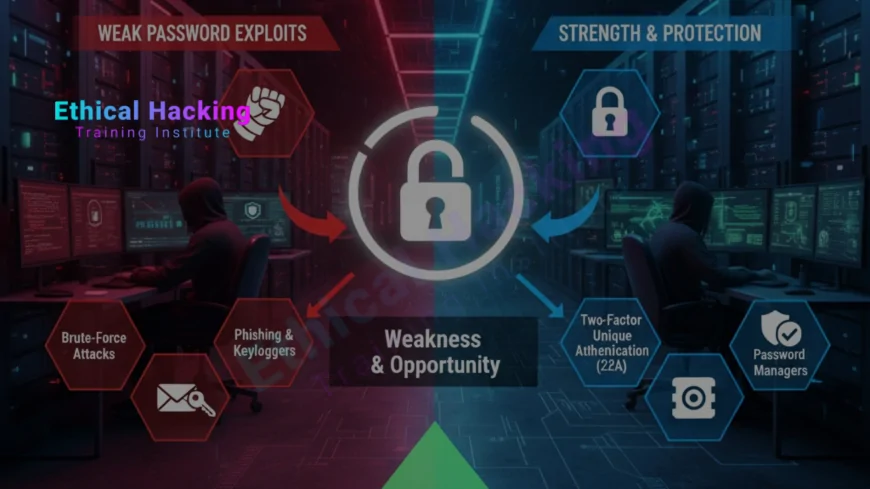
Brute force systematically tests every character combination. It’s slow but works on short passwords. In 2025, a single RTX 4090 cracks 8-character passwords in under 10 minutes.
- Tools: Hashcat, THC-Hydra
- Targets login forms without lockout
- Exploits weak rate limiting
- Common on RDP, SSH, web apps
- Blocked by 5-fail lockout
- Free and relentless
Dictionary Attacks: Guess Smart, Not Hard
Hackers use massive wordlists like RockYou (14M passwords) and mutate entries with rules. AI now generates hyper-localized lists based on user data.
- Wordlists: RockYou, SecLists
- Rules: @ → a, 1 → l
- Cracks “Summer2025!” instantly
- John the Ripper with --rules
- 40% faster with AI lists
- Free and highly effective
Stay safe. Enroll in an ethical hacking course to test your defenses.
Rainbow Tables: Precomputed Hash Attacks
- Pre-built hash-to-password databases
- Cracks unsalted MD5/NTLM instantly
- Tools: Ophcrack, RainbowCrack
- 1TB table covers 99% of 8-char combos
- Useless against salted hashes
- Free tables on dark web
Credential Stuffing: Reuse Is a Gift
Attackers take leaked username:password pairs from one breach and test them elsewhere. 60% of users reuse passwords across sites.
- Tools: Sentry MBA, OpenBullet
- Targets email, banking, social
- Millions of logins per hour
- HaveIBeenPwned reveals exposure
- Dark web credential bundles
- Free configs shared
Social Engineering: Humans Are the Weak Link
Hackers trick users into revealing passwords via phishing, fake support calls, or USB drops. In 2025, AI deepfake voices impersonate CEOs.
- Phishing with urgent login links
- Spear-phishing to executives
- Keyloggers on public USBs
- Shoulder surfing in cafes
- Pretexting over phone
- Zero tech, 100% trust
Go deeper. Take a complete hacking course on social engineering.
Password Spraying: Low Noise, High Reward
Try one common password (“Welcome2025”) across thousands of accounts. Avoids lockouts. Often succeeds in corporate environments.
- Tools: o365spray, CrackMapExec
- Targets Office 365, Azure AD
- Stealthy, no alerts
- Used in ransomware prep
- Blocked by MFA
- Free and patient
Kerberoasting & Pass-the-Hash
In Windows domains, attackers request encrypted service tickets (Kerberoasting) or reuse stolen NTLM hashes (Pass-the-Hash) without knowing the plaintext password.
Kerberoasting cracks tickets offline with Hashcat. Pass-the-Hash uses Mimikatz to inject hashes into memory. Both enable lateral movement. Defended by strong service passwords and LAPS.
Requires initial domain access. Common in enterprise breaches. Monitor for suspicious ticket requests.
Top Tools Hackers Use
- Hashcat: 350B hashes/sec on GPU
- John the Ripper: CPU rules engine
- Mimikatz: Memory credential dump
- Hydra: Online brute force
- Burp Suite: Capture login POSTs
- All open-source and free
Master them legally. Follow the ultimate career path in ethical hacking.
Password Defense Checklist
- 16+ random characters
- Enable MFA everywhere
- Use Bitwarden or 1Password
- Never reuse passwords
- Check HaveIBeenPwned
- Change defaults immediately
Conclusion: Lock the Door Before They Knock
Weak passwords are an open invitation. Hackers exploit them with brute force, smart guesses, reused credentials, and clever lies. But you hold the power to stop them. Use a password manager to generate 20-character random strings. Enable MFA on every account. Monitor breaches. Train your team. In 30 days, you’ll eliminate password risks completely. Hackers don’t break in—they log in. Don’t give them the key. One strong password at a time, you’re building unbreakable security. Start today.
Frequently Asked Questions
What’s the weakest password in 2025?
“123456” – still #1 globally.
How fast can a GPU crack passwords?
8 characters in 10 minutes (RTX 4090).
Does salting stop rainbow tables?
Yes. Unique salt per user.
Can MFA stop all attacks?
No. Phishing and session theft are risks.
Is “CorrectHorseBatteryStaple” secure?
Yes. Long passphrases resist dictionaries.
Should I change passwords monthly?
No. Only after compromise.
Are password managers hackable?
Rarely. Use zero-knowledge encryption.
Can 2FA codes be intercepted?
Yes, via SIM swap or phishing.
Best free password manager?
Bitwarden – open-source, secure.
Do caps matter in passwords?
Yes. “Password” ≠ “password”.
Can I reuse work and personal passwords?
Never. One breach = total compromise.
How to check password strength?
Use HowSecureIsMyPassword.net.
Are biometrics safer than passwords?
Better for UX, not standalone security.
Why ban common passwords?
Stops dictionary attacks cold.
Future of authentication?
Passkeys (FIDO2) – no passwords to steal.
What's Your Reaction?
 Like
0
Like
0
 Dislike
0
Dislike
0
 Love
0
Love
0
 Funny
0
Funny
0
 Angry
0
Angry
0
 Sad
0
Sad
0
 Wow
0
Wow
0