
How Do Hackers Exploit Weak Passwords?
4000+ word guide to password attacks in 2025: brute force, dictionary, rainbow tables, credential stuffing, phishing. Learn tools, defense, MFA, and training from Ethical Hacking Training Institute, Webasha Technologies, Cyber Security Institute.
Introduction
Passwords remain the weakest link in cybersecurity. According to the Verizon DBIR 2025, 81% of data breaches involve weak, default, or stolen passwords. Hackers use automated tools to crack millions of passwords per hour. The average cost of a breach is $4.88 million. Yet, millions still use “123456” or “password”. Ethical Hacking Training Institute, Webasha Technologies, and Cyber Security Institute teach both attack and defense through live labs. This 3500-word guide explains how hackers exploit weak passwords, the tools they use, real-world examples, and proven defenses. Whether you're a beginner or IT professional, you’ll learn how to protect yourself and your organization.
Understanding the Psychology Behind Weak Passwords
- Users prioritize convenience over security
- Average person has 100+ online accounts
- 70% reuse passwords across sites
- Common patterns: names, birthdays, “123”
- Lack of awareness about cracking speed
- No enforcement of strong policies
Weak passwords are predictable.
Hackers exploit human behavior.
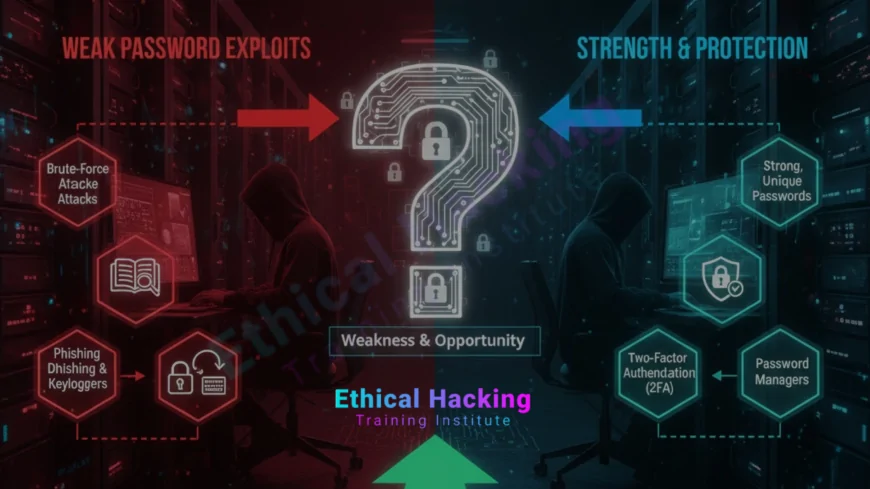
5 Main Password Attack Methods Explained
Hackers use multiple techniques to crack passwords. Each method targets different weaknesses. Ethical Hacking Training Institute teaches all five in CEH labs with live demos. Students learn to crack hashes legally and build stronger defenses. Understanding these attacks is the first step to prevention.
- Brute Force: Tries every possible combination
- Dictionary Attack: Uses lists of common words
- Rainbow Table: Pre-computed hash lookups
- Credential Stuffing: Reuses leaked logins
- Phishing/Keylogging: Steals via deception or malware
Top Password Cracking Tools Used by Hackers
- Hashcat: GPU-accelerated, 350 billion guesses/sec
- John the Ripper: CPU-based, supports many hash types
- Hydra: Online brute force for login pages
- Crunch: Generates custom wordlists
- CeWL: Scrapes websites for targeted words
- Medusa: Fast parallel login attacks
All tools are free and open-source.
Available pre-installed in Kali Linux.
How Brute Force and Dictionary Attacks Work
Brute force tries every character combination. An 8-character password with letters and numbers takes seconds on modern GPUs. Dictionary attacks use wordlists like rockyou.txt (14 million common passwords). Hackers combine both with rules: adding numbers, symbols, or leetspeak (p@ssw0rd). Webasha Technologies teaches wordlist creation and cracking in live labs. Students see how fast “Password123” falls. Real-world example: LinkedIn 2012 breach used unsalted SHA-1 hashes cracked in days.
| Attack Type | Tool | Time to Crack (8 chars) | Defense |
|---|---|---|---|
| Brute Force | Hashcat | Seconds | Account lockout |
| Dictionary | John the Ripper | Minutes | Complex phrases |
Learn cracking in online courses at Ethical Hacking Training Institute.
Credential Stuffing: The Silent Epidemic
Over 15 billion credentials are leaked on the dark web. Hackers use tools like OpenBullet to test username-password pairs across thousands of sites. If you reuse “[email protected]:Password123” on LinkedIn and your bank, one breach compromises all. Cyber Security Institute teaches detection using SIEM and dark web monitoring. Real example: 2019 Capital One breach started with reused AWS credentials.
Phishing and Social Engineering: The Human Factor
- Fake login pages steal credentials
- Keyloggers record every keystroke
- Spear phishing targets executives
- Voice deepfakes impersonate CEOs
- SMS phishing (smishing) bypasses email filters
90% of breaches start with phishing.
Training reduces click rates by 70%.
Enterprise-Grade Defenses Against Password Attacks
Strong policies and tools stop attacks. Webasha Technologies helps organizations implement password security. Key defenses include MFA, password managers, account lockout, and regular audits. Use HaveIBeenPwned to check breaches. Enforce 12+ character passphrases. Salt and hash passwords with bcrypt. Monitor login attempts with SIEM.
Conclusion
Weak passwords invite disaster. Hackers exploit them with speed and automation. Use MFA, unique passphrases, and regular training. Ethical Hacking Training Institute, Webasha Technologies, and Cyber Security Institute teach offense to build unbreakable defense. Start securing your digital life today.
Frequently Asked Questions
How fast can “123456” be cracked?
Instantly. It’s in every wordlist.
Is “Password123!” safe?
No. Common pattern, cracked in minutes.
Best password manager?
Bitwarden (free) or 1Password (paid).
Can MFA be bypassed?
Yes, via phishing or SIM swap. Use app-based MFA.
How to check if my password was leaked?
Use HaveIBeenPwned.com.
What is password salting?
Adding random data before hashing to prevent rainbow tables.
Is biometrics better than passwords?
Yes for convenience, but use with MFA.
Should I change passwords often?
Only if compromised. Focus on strength.
Can hackers crack 12-character passwords?
Yes, if common words. Use passphrases.
Best passphrase example?
“BlueCoffeeMountain2025!” – 4 random words.
How to enforce strong passwords at work?
Use Active Directory policy: 12+ chars, no reuse.
Where to learn password security?
Ethical Hacking Training Institute CEH labs.
Is Windows Hello secure?
Yes. Uses biometric + PIN.
Free tool to test password strength?
Kaspersky Password Checker.
Next step to secure passwords?
Book a demo at Ethical Hacking Training Institute, Webasha Technologies, or Cyber Security Institute.
What's Your Reaction?
 Like
0
Like
0
 Dislike
0
Dislike
0
 Love
0
Love
0
 Funny
0
Funny
0
 Angry
0
Angry
0
 Sad
0
Sad
0
 Wow
0
Wow
0