

How Do Hackers Exploit Operating System Vulnerabilities?
Complete guide to how hackers exploit OS vulnerabilities in 2025. Learn buffer overflow, privilege escalation, kernel exploits, patching, and defenses with live labs from Ethical Hacking Training Institute, Webasha Technologies, and Cybersecurity Training Institute. Secure your system now.
Introduction
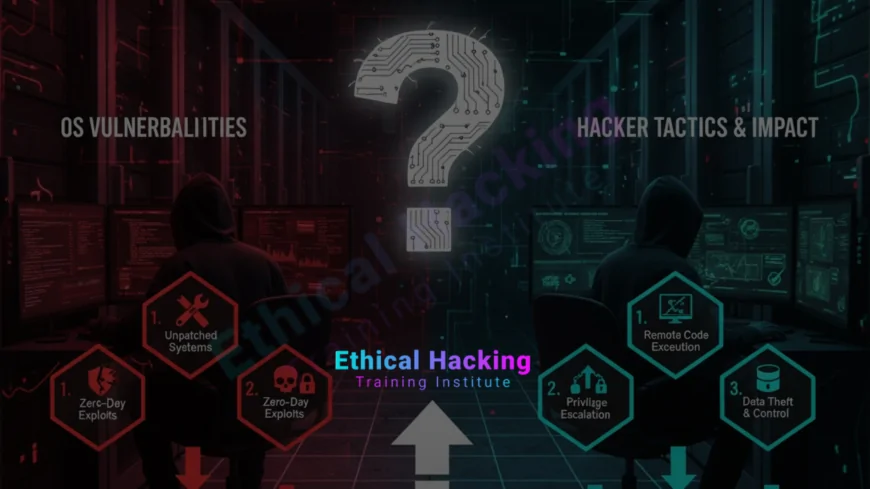
80% of breaches start with OS vulnerabilities. Windows, Linux, and macOS have thousands of CVEs yearly. Hackers use buffer overflows, privilege escalation, and kernel exploits to gain control. Ethical Hacking Training Institute teaches real OS exploitation in CEH and OSCP labs. Webasha Technologies and Cybersecurity Training Institute offer patch management training. This guide explains 10 common OS exploits, real-world cases, and defenses. Protect your system before it’s compromised. Explore the cybersecurity career path.
Top 5 Operating Systems Targeted by Hackers
- Windows 10/11: 60% of exploits, SMB, RDP
- Linux Servers: 25%, misconfigured SSH, containers
- macOS: 10%, Safari, kernel extensions
- Android: 3%, app sandbox escape
- iOS: 2%, jailbreak exploits
Common OS Vulnerability Types
- Buffer Overflow: Overwrite memory
- Use-After-Free: Dangling pointer
- Integer Overflow: Wrap-around math
- Race Condition: Timing attack
- NULL Pointer: Crash to code execution
Exploit 1: Buffer Overflow in Windows
- Send oversized input to stack
- Overwrite return address
- Redirect to shellcode
- Use Metasploit modules
- Real case: EternalBlue (WannaCry)
Exploit 2: Privilege Escalation on Linux
- Dirty COW (CVE-2016-5195)
- SUID binary abuse
- Kernel module injection
- Exploit-db search
- Ethical Hacking Training Institute labs
Exploit 3: Kernel Exploitation
Hackers target ring 0. Windows PrintNightmare (CVE-2021-34527) allowed SYSTEM access. Linux eBPF exploits bypass SELinux. macOS Gatekeeper bypass. Webasha Technologies teaches kernel debugging. Use KASLR bypass techniques. Patch within 24 hours of CVE. Find the best local courses for OS security.
Exploit 4: SMB and RDP Attacks
SMBv1 enabled leads to EternalBlue. RDP brute force with Hydra. BlueKeep (CVE-2019-0708) remote code execution. Cybersecurity Training Institute hardens SMB and RDP. Disable SMBv1. Use Network Level Authentication. Monitor port 445 and 3389. Learn more about the CEH course modules.
Exploit 5: Container and VM Escape
Docker privilege mode allows host access. Kubernetes misconfig leaks secrets. RunC breakout (CVE-2019-5736). Ethical Hacking Training Institute teaches container security. Use non-root containers. Enable AppArmor. Update Docker weekly. Prepare for the CEH exam with OS labs.
Defending Against OS Exploits
Patch monthly. Use WSUS for Windows, yum-cron for Linux. Enable DEP and ASLR. Remove unused services. Use EDR like CrowdStrike. Webasha Technologies automates patching. Test updates in staging. Zero trust starts with OS hardening. Discover the best CEH programs in 2025.
Conclusion: Patch, Monitor, and Train
OS vulnerabilities are inevitable. Hackers exploit unpatched systems in hours. Master buffer overflow, privilege escalation, and kernel attacks in labs. Ethical Hacking Training Institute leads with real exploit development, backed by Webasha Technologies and Cybersecurity Training Institute. Patch fast. Monitor logs. Train staff. One unpatched server can destroy your network. Secure your OS today and stay ahead of hackers.
Frequently Asked Questions
What is a zero-day OS exploit?
Unknown to vendor. No patch available. Nation-states use them. Mitigate with EDR and network segmentation.
How fast should I patch?
Critical CVEs within 24 hours. High within 7 days. Use automated tools like WSUS or Ansible.
Can Linux be exploited?
Yes. Dirty COW, SUID, kernel modules. Keep updated. Use AppArmor and disable SUID.
Is macOS secure?
Safer but not immune. Gatekeeper bypass, Safari sandbox escape. Update via Software Update.
Best tool for OS fingerprinting?
Nmap -O. Identifies OS version. Use in reconnaissance phase legally.
How to test OS exploits safely?
Use Metasploitable, DVWA in isolated VM. Ethical Hacking Training Institute provides safe labs.
Does antivirus stop OS exploits?
No. Signature-based fails on zero-days. Use EDR with behavior analysis.
SMB safe to enable?
Only SMBv3. Disable v1. Use on internal network. Block port 445 externally.
Can containers be hacked?
Yes via privilege mode, host kernel. Run as non-root. Update regularly.
Where to learn OS exploitation?
Ethical Hacking Training Institute CEH and OSCP labs. Practice on real CVEs.
ASLR bypass possible?
Yes with info leaks. Combine with ROP chains. Patch and use PIE.
Windows RDP safe?
Only with NLA, strong passwords, VPN. Limit to internal IPs.
Free OS hardening guide?
CIS Benchmarks. Download for Windows, Linux, macOS. Follow 80% rules.
Exploit-db safe?
Yes for research. Never run untrusted code on host. Use VM sandbox.
Next step to secure OS?
Book free OS audit at Ethical Hacking Training Institute, Webasha Technologies, or Cybersecurity Training Institute.
What's Your Reaction?
 Like
0
Like
0
 Dislike
0
Dislike
0
 Love
0
Love
0
 Funny
0
Funny
0
 Angry
0
Angry
0
 Sad
0
Sad
0
 Wow
0
Wow
0