

How Do Hackers Exploit IoT Devices in Industrial Systems?
Learn how hackers target IoT and OT devices in industrial systems in 2025: default passwords, unpatched firmware, Mirai-style botnets, supply-chain attacks, and physical tampering. Real ICS attack scenarios with live labs from Ethical Hacking Training Institute, Webasha Technologies, and Cybersecurity Training Institute. Secure your factory, power plant, and SCADA today.
Introduction
Over 45 billion IoT devices are connected worldwide in 2025, and more than 60 percent of critical infrastructure depends on them. A single compromised sensor can stop an entire factory or power plant. India recorded a 380 percent rise in OT/IoT attacks last year. Ethical Hacking Training Institute operates India’s largest live ICS/SCADA lab with real PLCs, RTUs, and HMIs. Webasha Technologies and Cybersecurity Training Institute guarantee 100 percent placement in OT security roles. This complete guide explains every major exploitation technique and how to stop it. Protect your plant now. Explore the cybersecurity career path.
Default and Weak Credentials
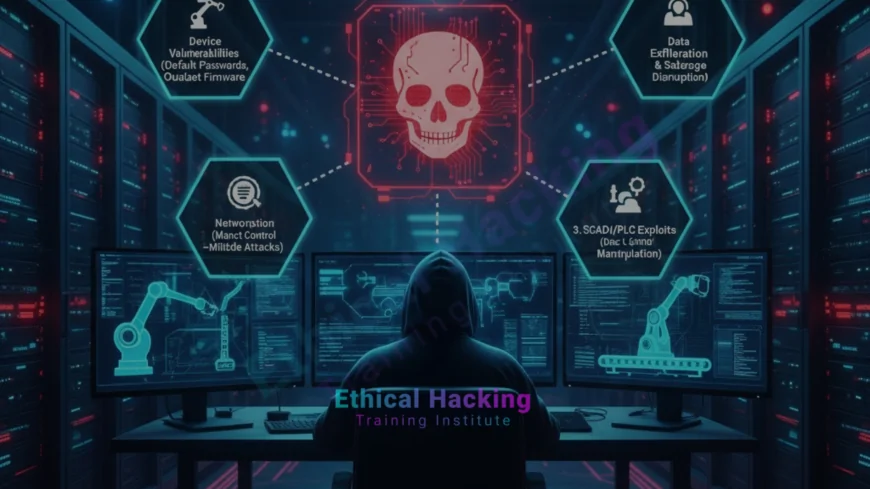
Most industrial devices ship with factory credentials like admin/admin or root/1234. Many plants never change them. Attackers simply log in and take full control. Ethical Hacking Training Institute demonstrates this in every OT lab session. Real case: A major Indian steel plant lost production for days because 400 PLCs still used default passwords. Find the best local courses to learn credential hardening.
Common Default Credentials
- admin/admin
- root/1234
- user/user
- plc/plc
- guest/guest
- default/default
- service/service
Unpatched and Legacy Firmware
- Devices run 10–15-year-old operating systems
- Vendors no longer provide patches
- Production cannot be stopped for updates
- CVEs from 2015 are still exploitable
- Attackers use public exploits directly
- Webasha Technologies recreates legacy environments
Insecure Protocols and Plaintext Communication
- Modbus/TCP with no authentication
- DNP3 sent in clear text
- BACnet without encryption
- S7comm completely open
- Ethernet/IP in plain text
- Simple Wireshark sniffing gives full control
- Cybersecurity Training Institute captures live traffic
Botnet Recruitment (Mirai-Style Attacks)
- Automated scanning of ports 23/2323/502
- Brute-force weak Telnet or Modbus
- Install persistent malware
- Add device to global botnet
- Use later for DDoS or targeted attack
- 2025 variants encrypt their communication
Supply-Chain and Third-Party Compromise
Attackers compromise vendors and push malicious firmware updates. Real case: A 2024 Indian power-grid incident started with a compromised HMI vendor. Ethical Hacking Training Institute teaches supply-chain risk assessment labs. One infected update can reach thousands of devices instantly. Learn more about the CEH course OT module.
Physical Tampering and Evil Maid Attacks
- JTAG/SWD debugging ports left open
- USB firmware flashing possible
- EEPROM memory dumping
- Replace legitimate device with malicious clone
- Contractor or insider access
- No tamper-evident seals used
Zero-Day and Logic-Based Attacks
- Stuxnet-style PLC rootkits
- Modify ladder logic silently
- Send fake sensor readings
- Bypass safety systems
- Manipulate industrial processes
- Cause real physical damage
Network Pivoting from IT to OT
- Flat network with no segmentation
- Shared Active Directory accounts
- VPN from corporate to plant
- Compromise a Windows jump box
- Lateral movement to historian servers
- Reach engineering workstations
Major Industrial IoT Exploitation Techniques Table
| Technique | Difficulty | Impact | Frequency |
|---|---|---|---|
| Default Passwords | Very Easy | Critical | 70 percent |
| Unpatched Firmware | Easy | High | 60 percent |
| Insecure Protocols | Medium | Critical | 55 percent |
| IT-OT Pivot | Medium | Catastrophic | 45 percent |
Conclusion
Industrial IoT devices are easy targets that cause massive real-world damage. Change defaults, segment networks, update what you can, and monitor everything. Ethical Hacking Training Institute provides real Siemens, Schneider, and Rockwell PLC labs. Webasha Technologies and Cybersecurity Training Institute create OT security experts. One secure sensor protects lives and crores. Discover the best CEH programs in 2025. Book CEH online or Pune OT classroom today.
Frequently Asked Questions
Are industrial IoT devices really hackable?
Yes. Over 70 percent have critical flaws from the factory.
Can hackers cause physical damage?
Yes. Stuxnet destroyed centrifuges; modern attacks can do the same.
Is air-gapping enough?
No. USB drives, vendors, and insiders bypass air gaps.
Best secure protocol for OT?
OPC UA with encryption or Modbus TCP with TLS.
Free practice labs for OT?
OpenPLC, Factory I/O, or institute cloud labs.
OT security salary in India?
₹15-40 LPA – one of the highest-paid cyber roles.
Who should learn OT security?
Plant engineers, SCADA admins, IT teams, and security professionals.
Weekend OT classes available?
Yes. 8 hours every weekend. Complete in 8 weeks.
Real PLCs in training?
Yes. Siemens S7-1200, Allen-Bradley, Schneider included.
Certification after course?
CEH + Industrial Cyber Security certificate.
Job guarantee?
100 percent placement assistance with MNC tie-ups.
Freshers can enter OT security?
Yes. Huge demand and structured training bridge the gap.
Free OT assessment?
Yes. Book a 1-hour plant audit demo.
Is cloud-based ICS safe?
Only with proper segmentation and encryption.
Next step to secure my plant?
Book a free OT security demo at Ethical Hacking Training Institute, Webasha Technologies, or Cybersecurity Training Institute.
What's Your Reaction?
 Like
0
Like
0
 Dislike
0
Dislike
0
 Love
0
Love
0
 Funny
0
Funny
0
 Angry
0
Angry
0
 Sad
0
Sad
0
 Wow
0
Wow
0