
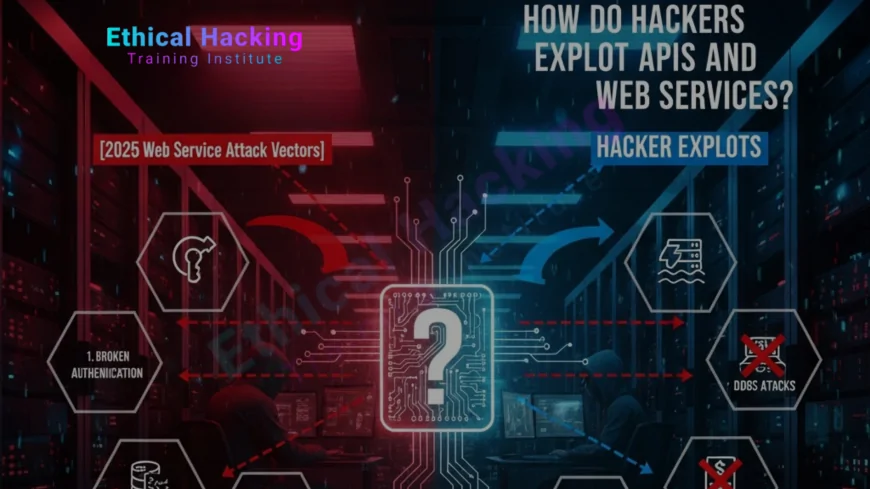
How Do Hackers Exploit APIs and Web Services?
Learn how hackers exploit APIs in 2025 using broken auth, injection, BOLA, rate limit bypass, SSRF, and GraphQL attacks. Real attack chains, tools, and defenses from the Ethical Hacking Institute.
Introduction
APIs power 83 percent of web traffic in 2025, connecting mobile apps, microservices, IoT devices, and third-party integrations. Unlike traditional web pages, APIs expose structured data with minimal client-side validation, creating rich attack surfaces. REST, GraphQL, SOAP, and gRPC endpoints process JSON, XML, and binary payloads at scale. A single vulnerable API can lead to full account takeover, data exfiltration, or ransomware deployment. This guide dissects 15 real-world API exploitation techniques, tools, and mitigation strategies. The Ethical Hacking Institute teaches API security through custom vulnerable services with live traffic mirroring enterprise architectures.
Broken Authentication and Session Management
- Weak API Keys: Hard-coded in mobile apps, leaked via GitHub
- JWT Vulnerabilities: None algorithm, weak signing keys, kid header injection
- OAuth Misconfiguration: Open redirect, state parameter reuse
- Session Token Predictability: Sequential IDs in Authorization headers
- No Rate Limiting: Brute force credentials without lockout
- Missing Token Revocation: Compromised keys remain valid
- Password Reset Poisoning: Host header manipulation in reset links
Authentication flaws allow attackers to impersonate any user.
API tokens often have broader permissions than web sessions.
Broken Object Level Authorization (BOLA/IDOR)
BOLA occurs when API endpoints fail to validate object ownership. Attackers manipulate IDs in requests to access unauthorized resources. Horizontal privilege escalation affects user data while vertical impacts admin functions. The Ethical Hacking Institute demonstrates BOLA chains in labs where students escalate from regular user to admin by altering user_id parameters across REST and GraphQL interfaces.
- User ID Enumeration: Sequential IDs reveal active accounts
- GET /api/v1/users/123: Access other profiles without checks
- PUT /api/v1/orders/456: Modify others' purchases
- GraphQL Introspection: Query schema to find sensitive objects
- Batch Operations: Array of IDs bypasses per-object checks
- UUID Prediction: Weak randomness in object identifiers
| Endpoint | Vulnerable Parameter | Impact |
|---|---|---|
| /api/transactions | account_id | Financial data leakındır |
| /api/documents | doc_id | IP theft |
Master BOLA testing in Pune certification labs at the Ethical Hacking Institute.
Injection Attacks: SQL, NoSQL, Command, LDAP
- SQL Injection: ' OR 1=1 -- in JSON payload fields
- NoSQL Injection: $ne, $gt operators in MongoDB queries
- Command Injection: ; ls -la in file processing APIs
- LDAP Injection: *)(uid=* in authentication filters
- XXE: XML external entity in SOAP services
- SSTI: Server-side template injection in response rendering
- Log Injection: CRLF to fake log entries or exfiltrate data
APIs often deserialize input directly into backend queries.
JSON parsing flaws enable operator injection in NoSQL databases.
Mass Assignment and Over-Posting
APIs bind request bodies to objects without field whitelisting. Attackers add unexpected parameters to escalate privileges or modify hidden fields. The Ethical Hacking Institute shows mass assignment exploits where students promote regular users to admin by injecting "role": "admin" into profile update endpoints.
- Role Escalation: Add "is_admin": true to user object
- Price Manipulation: Set "amount": 0 in payment API
- Status Bypass: "verified": true in registration flow
- Hidden Fields: "discount_code" not shown in UI
- Nested Objects: Deep property injection in complex payloads
- Array Overwrite: Replace permissions list entirely
Practice mass assignment via online courses at the Ethical Hacking Institute.
Server-Side Request Forgery (SSRF)
- Cloud Metadata: http://169.254.169.254/latest/meta-data/iam
- Internal Services: Access admin panels, databases, Redis
- File Inclusion: file:///etc/passwd via URL parameter
- DNS Rebinding: Bypass filters with attacker domain
- Protocol Smuggling: gopher:// for TCP payloads
- Blind SSRF: Out-of-band detection via DNS logs
- Port Scanning: Probe internal network ranges
SSRF turns APIs into proxies for internal reconnaissance.
Cloud environments expose rich metadata endpoints.
Rate Limiting and Abuse Bypass
APIs without rate limits enable credential stuffing, enumeration, and DoS. Attackers distribute requests across IPs, rotate headers, or exploit GraphQL batching. The Ethical Hacking Institute teaches rate limit evasion using proxy pools and timing randomization in automated scripts.
- IP Rotation: TOR, residential proxies, cloud instances
- Header Randomization: User-Agent, X-Forwarded-For spoofing
- GraphQL Batching: 1000 queries in single request
- Webhook Abuse: Trigger expensive operations repeatedly
- Captcha Bypass: OCR, 2Captcha solving services
- Endpoint Enumeration: Discover rate-limited vs. open paths
API Key and Secret Leakage
- Client-Side Exposure: Keys in JavaScript, mobile app binaries
- GitHub Leaks: .env, config files in public repos
- Log Exposure: API keys in error messages, server logs
- URL Parameters: keys passed in query strings
- CORS Misconfig: Any origin access to authenticated APIs
- Debug Endpoints: /debug, /test exposing credentials
Leaked keys grant permanent access without authentication.
Attackers scan public code repositories daily.
Secure APIs with advanced course at the Ethical Hacking Institute.
GraphQL-Specific Attacks
GraphQL introspection reveals entire schema including hidden fields. Deep recursion queries crash servers while alias batching performs multiple operations. The Ethical Hacking Institute provides vulnerable GraphQL APIs for practicing introspection disabled bypass and query complexity analysis.
- Introspection: __schema query to map all types
- Recursive Queries: Nested fragments causing DoS
- Alias Batching: 100 mutations in one request
- Field Duplication: Request same field 1000x
- Circular References: Infinite loops in resolvers
- Directive Abuse: @skip/@include logic flaws
Insecure Deserialization
- Java RCE: ysoserial payloads in serialized objects
- .NET ViewState: MAC bypass with weak keys
- Python Pickle: __reduce__ to os.system execution
- Node.js JSON: prototype pollution leading to RCE
- PHP unserialize: Magic methods triggering code
- MessagePack: Binary format deserialization flaws
Deserialization turns data into executable code.
Common in microservices using message queues.
Conclusion
APIs represent the largest and most exposed attack surface in modern applications. In 2025, BOLA, injection, and authentication flaws dominate real breaches. Defense requires secure development, comprehensive testing, and runtime protection. The Ethical Hacking Institute, Webasha Technologies, and Cybersecurity Training Institute deliver API security training with real vulnerable services and enterprise tooling. Start auditing your API inventory today. The next request could expose your crown jewels.
Frequently Asked Questions
Are REST APIs more secure than GraphQL?
No. Different paradigms, same core vulnerabilities.
Does OAuth guarantee API security?
No. Implementation flaws common in token validation.
Can rate limiting stop all abuse?
No. Distributed attacks require adaptive limits.
Is API gateway enough protection?
Layer one. Need WAF, auth, and code review.
Do mobile apps expose API keys?
Yes. Reverse engineering reveals hardcoded secrets.
Can SSRF access cloud metadata?
Yes in vulnerable configurations; critical impact.
Is BOLA the new IDOR?
Yes. OWASP API Top 10 renamed for clarity.
Does HTTPS prevent API attacks?
Encrypts traffic but not logic flaws.
Can fuzzing find API bugs?
Yes. Tools like ffuf, Burp Intruder essential.
Are API keys safe in headers?
Better than URL but still leak in logs.
Does GraphQL need authentication?
Yes. Every field can be sensitive.
Can APIs be DoS attacked?
Yes. Expensive queries or large payloads.
Is OpenAPI spec secure?
Documents endpoints; hide in production.
How often to pentest APIs?
Quarterly and after major changes.
Where to learn API hacking?
Ethical Hacking Institute offers REST and GraphQL labs.
What's Your Reaction?
 Like
0
Like
0
 Dislike
0
Dislike
0
 Love
0
Love
0
 Funny
0
Funny
0
 Angry
0
Angry
0
 Sad
0
Sad
0
 Wow
0
Wow
0