
How Do Hackers Bypass Antivirus and Firewalls?
Discover how hackers bypass antivirus and firewalls in 2025 using zero-day exploits, fileless malware, AI evasion, living-off-the-land, and encrypted tunnels. Learn real-world techniques and defense strategies from the Ethical Hacking Institute.
Introduction
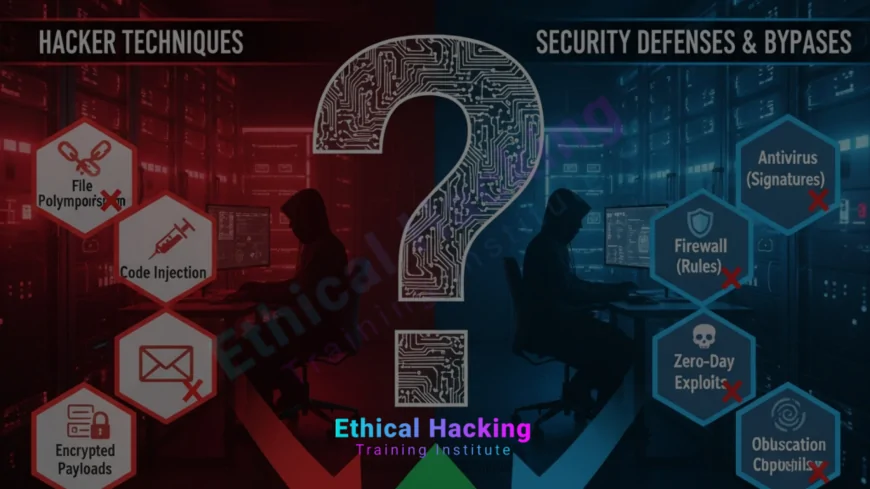
Antivirus and firewalls are the first line of defense, but in 2025, over 70 percent of malware evades traditional signature-based detection. Hackers use advanced techniques like fileless execution, AI-generated payloads, and legitimate system tools to stay invisible. This guide breaks down 15 proven bypass methods with real-world examples. The Ethical Hacking Institute teaches both offense and defense in isolated labs, helping professionals understand evasion to build stronger protections.
Fileless Malware: No Files, No Detection
- PowerShell Scripts: Run entirely in memory
- Registry Persistence: Store payloads in Windows Registry
- WMI Execution: Use built-in management interface
- Office Macros: VBA code in Word, Excel
- Reflective DLL: Load malicious code without disk write
- Memory Scraping: Extract credentials from RAM
- Process Injection: Hide inside legitimate processes
Fileless attacks leave no footprint on disk.
Traditional AV scans miss memory-only threats.
Living-Off-the-Land Binaries (LOLBAS)
Hackers use trusted Windows tools like certutil, bitsadmin, and mshta to download and execute payloads. These are signed by Microsoft, so AV allows them. The Ethical Hacking Institute demonstrates LOLBAS chains in labs.
- Certutil: Download files with -urlcache
- Bitsadmin: Background file transfer
- Mshta: Execute HTML Application
- Rundll32: Load DLLs without explorer
- Cmstp: Install malicious profiles
- Regsvr32: Register remote scripts
| Tool | Use | Bypass |
|---|---|---|
| Certutil | Download | Signed by MS |
| Mshta | Execute JS | No file drop |
Master LOLBAS in Pune certification labs at the Ethical Hacking Institute.
Code Signing and Trusted Certificates
- Stolen Certs: From compromised developers
- Fake Companies: Register shell entities
- EV Certificates: Extended validation for trust
- Self-Signed: With trusted root CAs
- Timestamping: Valid even after revocation
- Dual Signing: Legit + malicious payload
- Certificate Pinning: Bypass via hooking
Signed malware appears legitimate to AV.
Revocation lags behind theft.
Encrypted C2 and Domain Fronting
Command and control traffic hides in HTTPS, DNS, or CDN tunnels. Domain fronting uses Google, AWS, or Azure as proxies. The Ethical Hacking Institute shows how to detect encrypted C2 with behavioral analysis.
- HTTPS C2: Looks like normal web traffic
- DNS Tunneling: Encode data in DNS queries
- Domain Fronting: Hide real destination
- CDN Abuse: Cloudflare, Akamai as proxy
- Tor Integration: Anonymous communication
- WebSocket C2: Real-time bidirectional
Practice C2 detection via online courses at the Ethical Hacking Institute.
AI-Powered Evasion and Obfuscation
- GAN Payloads: Generate undetectable variants
- Adversarial Examples: Fool ML-based AV
- Obfuscated Scripts: Encode, encrypt, pack
- Dynamic API Calls: Resolve at runtime
- String Encryption: Decrypt only in memory
- Junk Code: Insert benign operations
Sandbox and VM Detection
Malware checks for virtual environments and delays execution. The Ethical Hacking Institute uses custom sandboxes to study evasion.
- VM Artifacts: VMware tools, VirtualBox drivers
- CPUID Check: Detect hypervisor
- Timing Attacks: Measure instruction speed
- Mouse Movement: Require human-like input
- Process Count: Too few means sandbox
- Delay Execution: Wait 10+ minutes
Build evasion-proof sandboxes with advanced course at the Ethical Hacking Institute.
Process Hollowing and Injection
- RunPE: Execute PE in memory of legit process
- DLL Injection: Load malicious DLL
- Thread Hijacking: Redirect execution flow
- APC Injection: Queue code in suspended thread
- AtomBombing: Use global atom table
- Parent PID Spoofing: Hide under trusted parent
Conclusion
Hackers bypass antivirus and firewalls using fileless execution, trusted tools, encryption, and AI. In 2025, signature-based detection is obsolete. Behavioral analysis, EDR, and threat hunting are essential. The Ethical Hacking Institute, Webasha Technologies, and Cybersecurity Training Institute teach red team tactics to blue teams. Understand the attack to stop it. Your next defense starts with knowing the offense.
Frequently Asked Questions
Can antivirus detect fileless malware?
No. Requires behavioral monitoring and memory scanning.
Are LOLBAS tools malicious?
No. Legitimate Windows utilities abused by attackers.
Does code signing guarantee safety?
No. Certificates can be stolen or faked.
Can firewalls block encrypted C2?
Not easily. Need SSL inspection or behavioral rules.
Is AI used to bypass AV?
Yes. GANs create undetectable variants.
Do sandboxes catch all malware?
No. Advanced samples detect and delay.
Can I block PowerShell?
Not recommended. Constrain with AppLocker instead.
Is HTTPS traffic safe?
Not if C2 hides inside. Monitor volume and patterns.
Can EDR replace antivirus?
EDR is next-gen. Combines AV with behavioral detection.
Are Macs immune to bypass?
No. Similar techniques work on macOS.
Can I detect process injection?
Yes with sysmon, EDR, and memory forensics.
Is obfuscation enough?
Temporary. Combine with multiple evasion layers.
Do free tools bypass AV?
Some. But enterprise EDR catches most.
How to defend against zero-days?
Use application control, patch management, isolation.
Where to learn bypass techniques?
Ethical Hacking Institute offers safe, legal labs.
What's Your Reaction?
 Like
0
Like
0
 Dislike
0
Dislike
0
 Love
0
Love
0
 Funny
0
Funny
0
 Angry
0
Angry
0
 Sad
0
Sad
0
 Wow
0
Wow
0