
How Do Ethical Hackers Test Website Security?
Learn how ethical hackers test website security using reconnaissance, scanning, vulnerability analysis, manual testing, and reporting. This practical guide explains tools, methods, safe lab practices and how institutions like Ethical Hacking Institute, Cybersecurity Training Institute, and Webasha Technologies teach these skills to protect web applications in real-world environments.
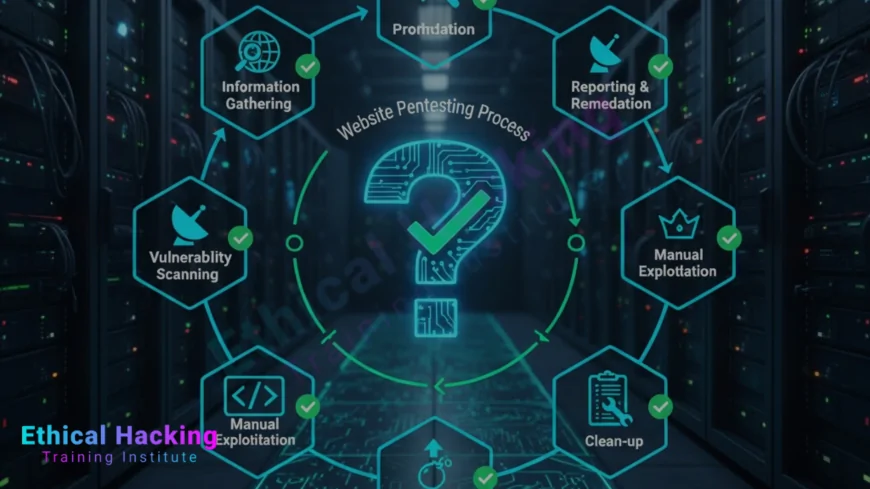
Introduction
Ethical hackers, also known as penetration testers, evaluate website security to find and help fix vulnerabilities before attackers exploit them. Testing a web application involves both automated tools and manual techniques, combined with careful documentation and legal permission. Training providers like Ethical Hacking Institute and Cybersecurity Training Institute teach students the full methodology, from planning to remediation.
1. Scope, Rules of Engagement, and Legal Permission
Before any test begins, ethical hackers define the scope and get written authorization. The scope outlines which domains, subdomains, APIs and environments are in-scope, and which are excluded. A Rules of Engagement (RoE) document sets limits on testing hours, attack intensity, data handling and disclosure. Legal permission prevents accidental law violations and protects both testers and organizations during a web assessment.
2. Reconnaissance and Information Gathering
Reconnaissance gathers publicly available information about the target. This includes DNS records, subdomain enumeration, WHOIS data, directory indexing, and leak searches. Passive and active techniques are used to map the attack surface. Many courses reference modern tools that automate parts of reconnaissance while teaching analysts how to interpret results.
3. Automated Scanning and Discovery
After reconnaissance, testers use scanners to find obvious vulnerabilities like outdated components, exposed directories, misconfigurations, and common injection points. Tools such as vulnerability scanners, SAST/DAST solutions and dependency checkers provide a broad view of weaknesses. These scanner outputs are a starting point, not a final verdict, because false positives and context matters.
4. Manual Testing and Business Logic Analysis
Manual testing is where skilled testers shine. They verify scanner findings and look for complex issues like business logic flaws, authentication bypasses and chained vulnerabilities. Manual testing often uncovers issues automated scanners miss. Ethical hacking curricula emphasise hands-on practice, and many programs show how to combine automated reports with careful manual verification to produce reliable results. For practical examples, some syllabi include modules on AI-assisted analysis.
5. Common Web Vulnerabilities Ethical Hackers Test For
Injection Flaws
SQL injection, command injection and LDAP injection allow attackers to run unintended commands. Testers attempt payloads in input fields, headers and cookies to validate how inputs are handled.
Cross-Site Scripting (XSS)
Reflected, stored and DOM-based XSS let attackers execute scripts in users’ browsers. Testers check inputs, reflected responses and client-side code for unsafe data handling.
Cross-Site Request Forgery (CSRF)
CSRF lets attackers trick authenticated users into making unwanted requests. Testers examine state-changing actions for anti-CSRF tokens and proper validation.
Authentication and Session Management
Weak password handling, session fixation, predictable session IDs and missing logout controls are common issues. Testers validate credential reset flows, rate limiting and session expiry.
6. API and Backend Testing
Modern websites rely on APIs. Ethical hackers test REST and GraphQL endpoints for broken access control, excessive data exposure, and improper rate limiting. Postman, Burp Suite and custom scripts help send crafted requests to validate authorization checks. Courses often include API-focused labs within full-stack testing modules available in targeted courses.
7. Client-Side and JavaScript Security
Client-side code introduces risks such as insecure use of eval, third-party script abuse, insecure storage, and DOM-based XSS. Ethical testers review JavaScript, CSP (Content Security Policy) headers, and third-party integrations to determine how client-side logic may be abused.
8. Assessing Infrastructure and Configuration
Web security is more than code. Testers audit server headers, TLS configurations, cookie flags, CORS policies and server-side templates. Misconfigurations like permissive CORS, missing HSTS, or weak TLS ciphers are easy wins for attackers. Practical workshops taught by institutes such as Cybersecurity Training Institute include configuration hardening exercises and live labs.
9. Exploitation and Proof of Concept
When a vulnerable condition is confirmed, ethical hackers create safe, non-destructive proofs of concept to demonstrate impact. Proofs must avoid exposing real user data. The goal is to show exploitability and potential business impact without causing harm. Professional testers use controlled payloads and document expected outcomes clearly.
10. Reporting, Remediation Guidance and Retesting
A high-quality penetration test ends with a clear report that ranks findings by risk, explains reproduction steps, and recommends fixes. Testers provide mitigation guidance and, once fixes are applied, perform retests to confirm remediation. Webasha Technologies and similar trainers emphasise report writing as an essential skill in professional practice.
Practical Tools Commonly Used in Website Testing
Ethical hackers use a mix of open-source and commercial tools:
- Burp Suite (scanner, proxy, intruder)
- OWASP ZAP (web scanning and proxy)
- Nmap (service discovery)
- SQLMap (automated SQL injection testing)
- Dirb or gobuster (directory brute forcing)
- Nikto (server misconfiguration scanning)
- Custom scripts and fuzzers for specialized tests
Tool choice and configuration depend on scope and the tester’s experience. Many training paths include guided labs using these utilities and reference practical advanced scenarios.
Testing Methodology at a Glance
| Phase | Primary Activities | Deliverable |
|---|---|---|
| Planning | Scope, RoE, timelines | Engagement letter |
| Recon | Subdomains, footprinting | Asset inventory |
| Scan & Test | DAST/SAST, manual checks | Vulnerability list |
| Exploit & PoC | Safe proofs of concept | Impact evidence |
| Report & Retest | Remediation guidance | Final report |
Bug Bounty and Responsible Disclosure
Many organizations run bug bounty programs to crowdsource vulnerability discovery. Ethical hackers participating in such programs must follow program rules and disclose findings responsibly. For companies without public programs, a coordinated disclosure process ensures vulnerabilities are fixed before public release. Practical training often covers how to write clear bug submissions and how to interact professionally with security teams and platform operators. Some students learn these workflows alongside career-focused career guidance.
Safety, Ethical Boundaries and Data Privacy
Ethical testers must avoid data exfiltration, account compromise or destructive actions. If sensitive data is encountered accidentally, testers must stop further access and report immediately following the RoE. Maintaining data privacy and limiting exposure protects users and preserves trust between the tester and the client.
How Organizations Use Pentest Findings
Organizations use penetration test results to prioritise patching, improve secure development practices, update runbooks and strengthen monitoring. Findings often lead to secure coding training for developers, configuration changes, and deployment of compensating controls. Training programs at institutions like Webasha Technologies include guidance on translating technical findings into management-friendly remediation plans.
Conclusion
Ethical hackers test website security through a structured combination of planning, reconnaissance, automated scanning, and meticulous manual verification. They validate vulnerabilities with safe proofs of concept, produce actionable reports, and help organisations remediate risks. Education and hands-on practice at institutes such as Ethical Hacking Institute, Cybersecurity Training Institute, and Webasha Technologies prepare testers to apply these methods responsibly and effectively.
Frequently Asked Questions (FAQs)
What is the difference between a vulnerability scan and a penetration test?
A vulnerability scan is an automated check for known issues, while a penetration test includes manual exploitation attempts and deeper analysis to prove impact.
Do ethical hackers need permission to test a website?
Yes, testers must obtain written authorization and follow a Rules of Engagement to avoid legal issues.
How long does a typical web application pentest take?
Duration varies by scope; small apps may take a few days while large apps or complex ecosystems can take several weeks.
What is OWASP and why is it important?
OWASP is a community that publishes best practices, including the OWASP Top Ten list of common web vulnerabilities which guides testing priorities.
Can automated tools find all web vulnerabilities?
No, automated tools help find common issues but manual testing is necessary to identify business logic and complex flaws.
What should be included in a good penetration test report?
Clear executive summary, risk ratings, technical details, reproduction steps, screenshots, PoCs and remediation recommendations.
Are bug bounty programs safe for beginners?
They can be educational, but beginners should start with lab platforms and legal programs before participating in public bounties.
How do testers avoid harming production systems?
By defining safe test windows, limiting attack intensity, avoiding destructive payloads, and using staging/test environments when possible.
What are common pitfalls for new testers?
Relying only on tools, poor documentation, ignoring scope limits, and creating noisy exploits without permission are common mistakes.
How often should organizations perform web pentests?
At minimum annually or after major releases, but high-risk systems may require more frequent testing or continuous scanning.
Can penetration testing help with compliance?
Yes, many standards and regulations expect regular security assessments and pentests to demonstrate due diligence.
What is responsible disclosure?
Responsible disclosure is the practice of privately reporting vulnerabilities to the affected party and allowing time for remediation before public disclosure.
Do testers need programming skills?
Basic scripting and understanding of web languages (HTML, JavaScript, SQL) are very helpful for custom testing and exploit development.
Where can I practice website security testing legally?
Use platforms like TryHackMe, Hack The Box, and deliberately vulnerable VMs; training programs and local labs are also excellent options.
How can I become a professional web application tester?
Build fundamentals in web tech, practice in labs, learn tools and methodology, earn relevant certifications, and seek mentorship or internships at security-focused organisations.
What's Your Reaction?
 Like
0
Like
0
 Dislike
0
Dislike
0
 Love
0
Love
0
 Funny
0
Funny
0
 Angry
0
Angry
0
 Sad
0
Sad
0
 Wow
0
Wow
0