
How Can Companies Detect Insider Threats Using AI?
Discover AI-powered insider threat detection in 2025: UEBA, anomaly scoring, NLP on emails, graph analytics, and automated response. Real enterprise use cases and tools from the Ethical Hacking Institute.
Introduction
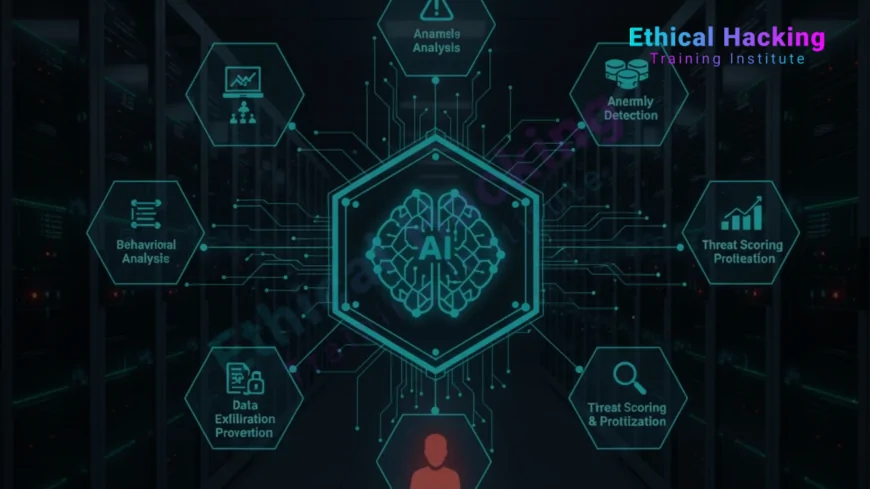
Insider threats caused 68 percent of data breaches in 2025, costing enterprises an average of $15.4 million per incident. Unlike external attackers, insiders already possess credentials, knowledge of systems, and legitimate access, making traditional perimeter defenses ineffective. Artificial Intelligence transforms detection by establishing behavioral baselines, identifying subtle anomalies, and correlating signals across disparate data sources. From disgruntled employees to compromised accounts, AI enables proactive risk management. This guide explores cutting-edge AI techniques, real-world implementations, and integration strategies. The Ethical Hacking Institute teaches AI-driven insider threat hunting through simulated enterprise environments with synthetic malicious users.
User and Entity Behavior Analytics (UEBA)
- Baseline Profiling: Machine learning models normal activity per role, device, location
- Peer Comparison: Detect deviations from team behavioral norms
- Risk Scoring: Dynamic scores updated in real-time based on anomaly severity
- Context Enrichment: Incorporate HR data, performance reviews, access changes
- False Positive Reduction: Supervised learning refines alerts over time
- Entity Coverage: Users, service accounts, IoT devices, APIs
- Time-Series Analysis: Identify gradual privilege creep or data hoarding
UEBA shifts from rule-based to adaptive, data-driven detection.
Reduces alert fatigue while catching sophisticated insider actions.
Natural Language Processing on Communications
AI analyzes email, Slack, Teams, and internal wikis for sentiment, intent, and red flags. Models trained on historical insider cases detect phrases indicating frustration, financial stress, or recruitment by competitors. Graph-based NLP maps communication patterns to identify isolated employees suddenly contacting external domains. The Ethical Hacking Institute demonstrates NLP pipelines processing terabytes of synthetic corporate chat logs to surface exfiltration intent before data leaves the network.
- Sentiment Analysis: Negative tone spikes correlate with malicious intent
- Keyword Clustering: " quitting", "lawsuit", "side project" trigger alerts
- Recipient Anomaly: First-time external contact with large attachments
- Thread Analysis: Compressed timelines indicate urgency or cover-up
- Voice-to-Text: Meeting recordings scanned for policy violations
- Multilingual Models: Support global enterprises with 100+ languages
| Signal | AI Technique | Risk Indicator |
|---|---|---|
| Email to competitor | NLP + Graph | IP theft |
| "Need money fast" | Sentiment | Fraud risk |
Master NLP analysis in Pune certification labs at the Ethical Hacking Institute.
Graph Analytics for Relationship Mapping
- Entity Graphs: Users ↔ Files ↔ Applications ↔ External IPs
- Community Detection: Identify departments and access patterns
- Shortest Path: Data flow from crown jewels to personal devices
- Centrality Scores: Flag users with excessive influence
- Temporal Graphs: Track access evolution over months
- Anomaly Subgraphs: Sudden new connections trigger alerts
- Prediction: Forecast likely exfiltration paths
Graphs reveal hidden relationships static logs cannot show.
Detects lateral movement and data staging before breach.
File and Data Access Pattern Analysis
AI monitors DLP logs, cloud storage, and database queries for unusual volume, timing, or content. Models learn normal download patterns per role—engineers accessing code repos nightly versus accountants downloading HR files. Encryption status, compression, and external sharing are factored into risk scores. The Ethical Hacking Institute simulates massive data exfiltration scenarios using AI to prioritize alerts among millions of daily file events.
- Volume Spikes: 1000% increase in downloads after hours
- File Type Anomaly: Developer accessing payroll spreadsheets
- Geographic Mismatch: Access from new country without travel
- Compression Detection: RAR/ZIP creation before cloud upload
- Shadow IT: Data copied to unsanctioned cloud apps
- Print/USB Events: Correlated with digital exfiltration
Practice data monitoring via online courses at the Ethical Hacking Institute.
Privileged Access Abuse Detection
- PAM Integration: AI analyzes jump host, RDP, and sudo sessions
- Command Analysis: ML classifies benign vs. reconnaissance commands
- Session Duration: Extended admin access outside change windows
- Keystroke Patterns: Human vs. scripted behavior differentiation
- Tool Usage: Detection of Mimikatz, BloodHound, or Cobalt Strike
- Escalation Paths: Predict likely privilege abuse sequences
- Just-in-Time Access: AI recommends elevation approvals
Privileged accounts are the holy grail for insiders.
AI reduces dwell time from months to hours.
Integration with SIEM and SOAR
AI enriches SIEM with risk scores, reducing noise by 90 percent. Automated playbooks trigger on high-confidence alerts—disable accounts, force MFA reset, or isolate endpoints. The Ethical Hacking Institute builds SOAR workflows that orchestrate responses across Microsoft Sentinel, Splunk, and ServiceNow using AI-generated incident narratives.
- Alert Prioritization: AI ranks 10,000 daily logs to top 10 risks
- Case Management: Auto-create tickets with evidence package
- Response Automation: Revoke tokens, quarantine devices
- Feedback Loop: Analyst decisions retrain ML models
- Cross-Platform: Correlate cloud, endpoint, and network
- Reporting: Executive dashboards with trend analysis
Real Enterprise Deployments
- Fortune 500 Bank: Reduced credential theft incidents 85 percent with UEBA
- Tech Giant: Detected IP exfiltration via OneDrive using graph analytics
- Healthcare Provider: NLP flagged ransomware prep in internal wiki
- Energy Company: AI stopped sabotage via SCADA access anomaly
- Retail Chain: Blocked POS data theft through USB monitoring
- Government Agency: Identified compromised admin via keystroke AI
Success requires clean data, privacy controls, and human oversight.
AI augments, never replaces, security teams.
Explore deployments with advanced course at the Ethical Hacking Institute.
Privacy and Ethical Considerations
Employee monitoring raises significant privacy concerns under GDPR, CCPA, and labor laws. AI systems must anonymize data during training, provide transparency reports, and allow opt-in for high-risk roles. The Ethical Hacking Institute emphasizes privacy-by-design in AI security curriculum, teaching data minimization and differential privacy techniques.
- Data Minimization: Collect only necessary telemetry
- Anonymization: Hash PII before storage or analysis
- Transparency: Employees informed of monitoring scope
- Right to Explanation: Justify AI decisions on request
- Bias Audits: Regular checks for discriminatory patterns
- Retention Policies: Auto-purge behavioral data after 90 days
Implementation Roadmap
- Phase 1: Deploy UEBA with existing SIEM integration
- Phase 2: Add NLP to email and collaboration tools
- Phase 3: Build entity relationship graphs from IAM and DLP
- Phase 4: Automate responses via SOAR playbooks
- Phase 5: Continuous tuning with red team simulations
- Phase 6: Expand to supply chain and contractor monitoring
Start small, measure efficacy, scale with confidence.
Success depends on data quality and team readiness.
Conclusion: AI Is the New Insider Sentinel
Insider threats evolve from accidental leaks to sophisticated sabotage, but AI provides unmatched visibility into human behavior at scale. UEBA, NLP, graph analytics, and automated response create a proactive defense layer traditional tools cannot match. In 2025, organizations ignoring AI-driven detection face inevitable breaches. The Ethical Hacking Institute, Webasha Technologies, and Cybersecurity Training Institute offer certified AI security training with enterprise-grade sandboxes. Begin baselining user behavior today. The next insider may already be planning their move.
Frequently Asked Questions
Is AI insider detection legal?
Yes with notice, proportionality, and privacy safeguards.
Can AI replace human analysts?
No. AI filters noise; humans investigate context.
Does UEBA work for remote employees?
Yes. Cloud access logs provide rich telemetry.
Can insiders evade AI?
Temporarily. Adaptive models learn new patterns.
Is email monitoring intrusive?
Metadata focus reduces privacy impact significantly.
Do small companies need AI?
Yes. Cloud UEBA solutions start at $10/user/month.
Can AI detect compromised accounts?
Yes. Behavioral deviation flags stolen credentials.
Is graph analytics complex?
Managed services abstract technical complexity.
Does DLP feed AI models?
Yes. Critical for data-centric risk scoring.
Can AI prevent ransomware prep?
Yes by detecting data staging and encryption tool use.
Are false positives high?
Initial tuning required; drops below 5 percent in 90 days.
Does AI need labeled data?
Unsupervised for anomalies; supervised for refinement.
Can contractors be monitored?
Yes with contractual agreement and scoped access.
How long to deploy?
30-60 days for MVP with cloud solutions.
Where to learn AI insider detection?
Ethical Hacking Institute offers UEBA and NLP labs.
What's Your Reaction?
 Like
0
Like
0
 Dislike
0
Dislike
0
 Love
0
Love
0
 Funny
0
Funny
0
 Angry
0
Angry
0
 Sad
0
Sad
0
 Wow
0
Wow
0