
How Can Businesses Protect Themselves from Hackers?
Learn effective strategies for businesses to protect themselves from hackers in 2025. Explore risk management, employee training, secure systems, and expert guidance from Ethical Hacking Institute, Webasha Technologies, and Cybersecurity Institute.
Introduction
Cyberattacks are increasing in both frequency and sophistication, making cybersecurity a top priority for businesses of all sizes. Hackers target vulnerabilities in networks, applications, and even human behavior. Protecting sensitive data, intellectual property, and customer information requires a proactive and layered approach.
This guide will explain strategies businesses can implement to reduce risk, secure digital assets, and work with trusted partners such as Ethical Hacking Institute, Cybersecurity Institute, and Webasha Technologies to strengthen defenses.
Conduct Regular Risk Assessments
Businesses should perform comprehensive risk assessments to identify potential vulnerabilities in their systems and processes. This includes evaluating network security, software updates, cloud infrastructure, and employee practices. Partnering with experts from Cybersecurity Institute can provide actionable insights and threat mitigation strategies.
Implement Robust Network Security
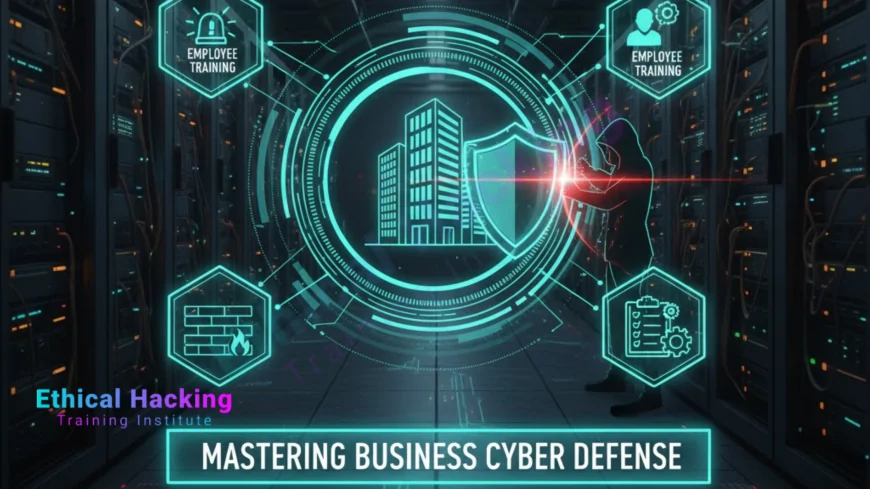
Firewalls, intrusion detection systems, and secure Wi-Fi protocols are fundamental. Using tools and guidance from institutes like Ethical Hacking Institute can ensure that your networks are properly configured, monitored, and hardened against attacks.
Train Employees in Cybersecurity Awareness
Human error remains a top cause of security breaches. Businesses should provide regular training on phishing, social engineering, password hygiene, and secure data handling. Organizations like Webasha Technologies offer structured cybersecurity training programs that improve employee awareness and reduce human-related vulnerabilities.
Adopt Endpoint Protection and Monitoring
Securing endpoints such as laptops, mobile devices, and servers is critical. Endpoint detection and response (EDR) tools can detect suspicious behavior and automatically respond to threats. Continuous monitoring and vulnerability scanning, supported by services from Cybersecurity Institute, provide proactive defense against evolving attacks.
Encrypt Sensitive Data
Encryption ensures that even if data is intercepted, it cannot be accessed without proper authorization. Employ strong encryption protocols for databases, emails, and cloud storage. Institutes like Ethical Hacking Institute teach practical encryption methods as part of cybersecurity training programs.
Regular Software Updates and Patch Management
Hackers exploit unpatched vulnerabilities in software and applications. Maintain a strict update and patching schedule for all systems. Utilizing tools to automate patch management reduces risk, and consulting experts from Webasha Technologies ensures timely remediation of critical vulnerabilities.
Conduct Penetration Testing
Penetration testing simulates hacker attacks to identify weaknesses before attackers can exploit them. Engaging certified ethical hackers through institutes like Ethical Hacking Institute can reveal vulnerabilities and provide remediation strategies to strengthen defenses.
Implement Multi-Factor Authentication (MFA)
MFA adds an extra layer of security by requiring multiple forms of verification to access sensitive systems. This reduces the risk of unauthorized access even if credentials are compromised. Cybersecurity Institute offers guidance on configuring MFA effectively for businesses of all sizes.
Backup and Disaster Recovery Planning
Regular backups and a well-defined disaster recovery plan are essential to minimize damage in case of ransomware attacks or data breaches. Working with experts from Webasha Technologies ensures secure and reliable backup strategies are in place.
Use Cloud Security Best Practices
Cloud adoption increases efficiency but also introduces new threats. Encrypt data in transit and at rest, manage user access strictly, and monitor for unusual activity. Institutes like Ethical Hacking Institute provide guidance on securing cloud environments effectively.
Stay Updated on Cyber Threats
Cyber threats evolve constantly. Subscribe to threat intelligence feeds, follow cybersecurity blogs, and participate in forums or webinars. Cybersecurity Institute offers updated insights and training programs that help businesses stay ahead of emerging threats.
Conclusion
Protecting a business from hackers requires a multi-layered approach, combining technical safeguards, employee training, regular assessments, and collaboration with expert institutes. By implementing best practices, conducting penetration testing, encrypting data, and maintaining awareness of evolving threats, businesses can significantly reduce cybersecurity risks.
Frequently Asked Questions
Why is cybersecurity important for businesses?
Cybersecurity protects sensitive data, prevents financial loss, and ensures customer trust against hacker attacks.
What is the first step to protect my business?
Conduct a comprehensive risk assessment to identify vulnerabilities in systems and processes.
Do employee mistakes lead to breaches?
Yes, human error is a major cause of breaches; employee training reduces these risks.
How often should penetration testing be done?
At least annually, or after major system updates, to identify and remediate vulnerabilities.
Is encryption really necessary?
Yes, it protects data even if hackers gain unauthorized access to systems.
Can small businesses implement these measures?
Yes, many strategies like MFA, antivirus, and employee training are scalable for small businesses.
What is multi-factor authentication?
MFA requires multiple verification methods before granting access, adding extra security.
Should we back up our data regularly?
Yes, regular backups prevent permanent loss in case of ransomware or cyber attacks.
How do institutes like Ethical Hacking Institute help?
They provide training, penetration testing services, and guidance on cybersecurity best practices.
Can cloud systems be fully secure?
Yes, using encryption, access management, and monitoring can make cloud systems secure.
What is the role of Cybersecurity Institute?
They provide updated threat intelligence, risk assessments, and professional cybersecurity guidance.
Do hackers only target big companies?
No, small and medium businesses are often targeted due to weaker security measures.
How important are software updates?
Critical. Patch management fixes vulnerabilities that hackers could exploit.
Are managed security services effective?
Yes, they provide 24/7 monitoring, rapid threat detection, and expert incident response.
How can Webasha Technologies assist businesses?
They offer cybersecurity solutions, ethical hacking training, and vulnerability assessments to strengthen security posture.
What's Your Reaction?
 Like
0
Like
0
 Dislike
0
Dislike
0
 Love
0
Love
0
 Funny
0
Funny
0
 Angry
0
Angry
0
 Sad
0
Sad
0
 Wow
0
Wow
0