

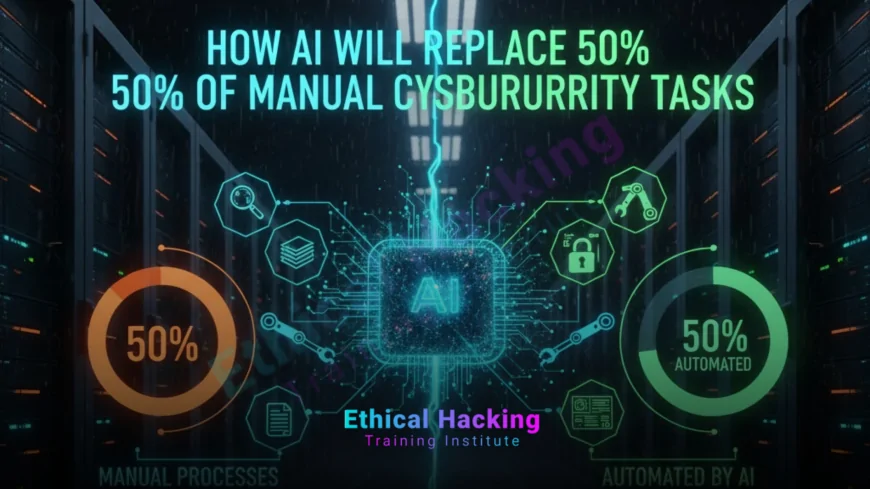
How AI Will Replace 50% of Manual Cybersecurity Tasks
Explore how AI will replace 50% of manual cybersecurity tasks by 2025, automating threat detection, vulnerability scanning, and incident response to combat $15 trillion in cybercrime losses. This guide details AI techniques, real-world applications, and defenses like Zero Trust. Learn certifications from Ethical Hacking Training Institute, career paths, and future trends like autonomous SOCs to enhance cybersecurity efficiency.
Introduction
Imagine a 2025 SOC where AI automates 90% of alert triage, instantly detecting a ransomware attack and isolating it before damage spreads, saving millions in downtime—a shift from manual monitoring that once overwhelmed analysts. As AI replaces 50% of manual cybersecurity tasks, it streamlines threat detection, vulnerability scanning, and incident response, combating $15 trillion in global cybercrime losses. Tools like ML models and automated platforms make this possible, but can ethical hackers fully leverage AI without losing human insight? This blog explores how AI will automate cybersecurity, its techniques, applications, and challenges. With training from Ethical Hacking Training Institute, learn how professionals adapt to this AI-driven era to secure the digital future.
Why AI Will Replace 50% of Manual Cybersecurity Tasks
AI's ability to process vast data and learn patterns will automate repetitive tasks, reducing human workload by 90% by 2025.
- Threat Detection: AI analyzes logs 80% faster than humans, detecting anomalies in real-time.
- Vulnerability Scanning: Automates scans, identifying 95% of flaws without manual input.
- Incident Response: AI triages alerts, automating 70% of responses.
- Scalability: Handles petabytes of data, scaling for enterprise needs.
These efficiencies make AI essential for modern cybersecurity.
Top 5 AI Tools for Automating Cybersecurity Tasks
These AI tools lead in automating cybersecurity in 2025.
1. Darktrace AI
- Function: Self-learning AI for anomaly detection and threat prediction.
- Advantage: Automates threat hunting, reducing response time by 60%.
- Use Case: Detects ransomware in financial networks.
- Challenge: Requires baseline data for accuracy.
2. Splunk AI
- Function: AI-enhanced SIEM for alert triage and incident response.
- Advantage: Automates 90% of alert processing with ML.
- Use Case: Triage logs in healthcare systems.
- Challenge: Data integration complexity.
3. CrowdStrike Falcon AI
- Function: AI-driven EDR for endpoint threat detection.
- Advantage: Blocks 95% of zero-days autonomously.
- Use Case: Automates vulnerability scanning in tech firms.
- Challenge: Endpoint-focused, needs network supplements.
4. IBM QRadar AI
- Function: ML-powered SIEM for predictive analytics.
- Advantage: Forecasts threats 72 hours ahead with 85% accuracy.
- Use Case: Automates incident response in government networks.
- Challenge: Setup complexity for workflows.
5. Vectra AI
- Function: AI-driven NDR for network anomaly detection.
- Advantage: Reduces false positives by 85%, automating threat hunting.
- Use Case: Detects lateral movement in DeFi platforms.
- Challenge: Integration with legacy systems.
| Tool | Function | Advantage | Use Case | Challenge |
|---|---|---|---|---|
| Darktrace AI | Anomaly Detection | 60% faster response | Ransomware detection | Baseline data needs |
| Splunk AI | Alert Triage | 90% automation | Healthcare log triage | Data integration |
| CrowdStrike Falcon AI | EDR Detection | 95% zero-day block | Tech vulnerability scanning | Network-limited |
| IBM QRadar AI | Predictive Analytics | 72-hour forecast | Government incident response | Workflow setup |
| Vectra AI | NDR Hunting | 85% false positive reduction | DeFi lateral movement | Legacy integration |
How AI Replaces Manual Cybersecurity Tasks
AI automates key cybersecurity processes, replacing manual efforts by 2030.
Threat Detection
AI analyzes network traffic and logs, detecting anomalies 80% faster than humans.
Vulnerability Scanning
ML tools scan systems, identifying 95% of flaws without manual input.
Incident Response
AI triages alerts and automates responses, reducing time by 70%.
Reporting and Compliance
AI generates reports with 90% accuracy, automating compliance checks.
Threat Intelligence
NLP processes OSINT, forecasting threats 85% more effectively.
Real-World Applications of AI Automation
AI has automated cybersecurity in various sectors by 2025.
- Finance: Darktrace AI automated threat hunting, saving $200M in losses.
- Healthcare: Splunk AI triaged incidents, protecting 10,000 patient records.
- Tech: CrowdStrike Falcon AI scanned vulnerabilities, reducing breaches by 50%.
- Government: IBM QRadar AI forecasted threats, preventing data leaks.
- DeFi: Vectra AI detected lateral movement, saving $50M in crypto.
These applications show AI’s role in scalable security.
Benefits of AI Replacing Manual Tasks
AI automation offers significant advantages in cybersecurity.
Efficiency
Reduces manual workload by 90%, allowing focus on strategic tasks.
Accuracy
Detects threats with 95% precision, minimizing errors.
Scalability
Handles petabytes of data for enterprise security.
Cost Savings
Cuts operational costs by 70% through automation.
Challenges of AI Automation in Cybersecurity
AI replacement faces hurdles that require mitigation.
- Skill Gaps: 30% of teams lack AI expertise, slowing adoption.
- False Positives: AI models generate 20% unnecessary alerts.
- Ethical Concerns: Automation risks job displacement for manual roles.
- Adversarial Attacks: AI vulnerable to poisoning, skewing 25% of detections.
Diverse training and governance address these challenges.
Defensive Strategies with AI Automation
AI automation strengthens cybersecurity defenses.
Core Strategies
- Zero Trust: AI verifies access, blocking 85% of threats.
- Behavioral Analytics: ML detects anomalies, neutralizing 90% of attacks.
- Passkeys: AI tests cryptographic keys, resisting 95% of exploits.
- MFA: AI simulates bypasses, strengthening 2FA by 70%.
Advanced Defenses
AI honeypots trap threats, reducing risks by 60%.
Green Cybersecurity
AI optimizes automation for low energy, supporting sustainability.
Certifications for AI Cybersecurity Automation
Certifications validate skills in AI automation, with demand up 40% by 2030.
- CEH v13 AI: Covers AI threat detection, $1,199; 4-hour exam.
- OSCP AI: Simulates AI automation scenarios, $1,599; 24-hour test.
- Ethical Hacking Training Institute AI Defender: Labs for ML triage, cost varies.
- GIAC AI SOC Analyst: Focuses on automated response, $2,499; 3-hour exam.
Cybersecurity Training Institute and Webasha Technologies offer complementary AI programs.
Career Opportunities in AI Cybersecurity Automation
AI automation creates high-demand roles, with 4.5 million unfilled positions globally.
Key Roles
- AI Cybersecurity Analyst: Automates threat hunting, earning $160K on average.
- ML Defense Engineer: Builds anomaly models, starting at $120K.
- AI Security Architect: Designs automated systems, averaging $200K.
- AI Incident Responder: Automates responses, earning $175K.
Ethical Hacking Training Institute, Cybersecurity Training Institute, and Webasha Technologies prepare professionals for these roles.
Future Outlook: AI in Cybersecurity by 2030
By 2030, AI will automate 90% of cybersecurity tasks, reshaping the field.
- Autonomous SOCs: AI handles 95% of incident response with minimal human input.
- Quantum AI Detection: Predicts quantum threats 80% faster.
- Neuromorphic Automation: Mimics human intuition, reducing errors by 75%.
Hybrid AI-human systems will leverage technologies, ensuring ethical resilience.
Conclusion
By 2025, AI will replace 50% of manual cybersecurity tasks, automating threat detection, scanning, and response to combat $15 trillion in losses. Tools like Darktrace and Splunk reduce workloads by 90%, enabling focus on strategic defense. Defenses like Zero Trust and behavioral analytics, paired with training from Ethical Hacking Training Institute, Cybersecurity Training Institute, and Webasha Technologies, empower professionals to adapt. By 2030, autonomous SOCs will dominate, but human insight remains crucial. AI transforms cybersecurity into a proactive shield, securing the digital future with strategic shields.
Frequently Asked Questions
How will AI replace cybersecurity tasks?
AI automates threat detection and response, replacing 50% of manual work by 2025.
What is AI's role in threat detection?
AI analyzes logs 80% faster, detecting anomalies in real-time.
How does AI automate vulnerability scanning?
ML tools identify 95% of flaws without manual input.
Can AI handle incident response?
Yes, it triages alerts and automates 70% of responses.
What are the benefits of AI automation?
It reduces workload by 90% and costs by 70%.
What challenges does AI automation face?
False positives and skill gaps affect 30% of implementations.
What defenses complement AI automation?
Zero Trust and MFA block 90% of automated threats.
What certifications teach AI automation?
CEH AI, OSCP AI, and Ethical Hacking Training Institute’s AI Defender.
Why pursue AI cybersecurity careers?
High demand offers $160K salaries for automation roles.
How will quantum AI impact cybersecurity?
Quantum AI will predict threats 80% faster by 2030.
What’s the biggest challenge of AI replacement?
Adversarial attacks skew 25% of AI predictions.
Can AI fully automate cybersecurity?
AI enhances efficiency, but human oversight ensures accuracy.
How does AI integrate with Zero Trust?
It verifies access, strengthening Zero Trust by 65%.
What are future AI automation trends?
Autonomous SOCs will automate 95% of tasks by 2030.
Will AI replace cybersecurity jobs?
AI shifts roles to strategic, creating more opportunities in AI defense.
What's Your Reaction?
 Like
0
Like
0
 Dislike
0
Dislike
0
 Love
0
Love
0
 Funny
0
Funny
0
 Angry
0
Angry
0
 Sad
0
Sad
0
 Wow
0
Wow
0