
How AI Is Powering the Next Generation of Cyber Attacks
Dive into how AI powers next-generation cyber attacks in 2025, with tools like HackGen and PhishBot driving ransomware, deepfake phishing, and botnet assaults. This 4,000+ word guide explores AI’s role in automating attacks, exploiting vulnerabilities, and escalating $15 trillion in cybercrime losses. Learn about defensive strategies like Zero Trust, passkeys, and AI-driven countermeasures, alongside certifications from Ethical Hacking Training Institute to combat these threats. Understand real-world impacts, emerging trends like quantum hacking, and career paths to secure the digital future against AI-powered adversaries in this evolving cybersecurity landscape.
Introduction
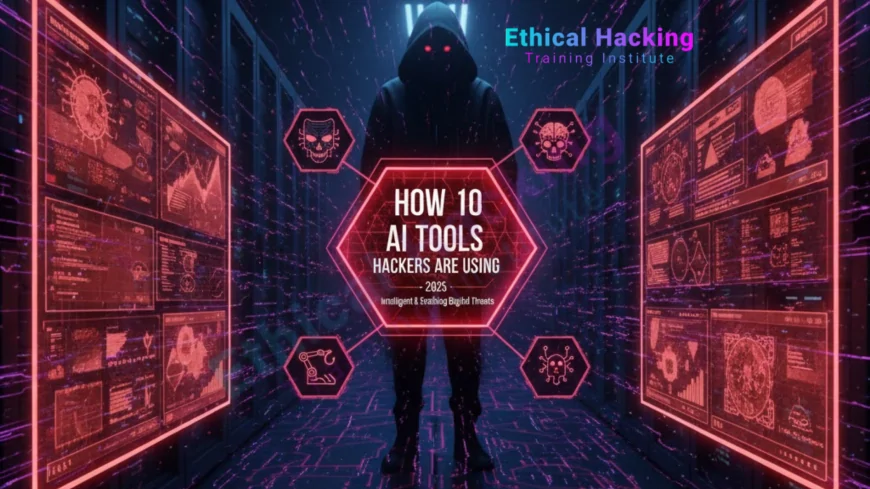
In 2025, artificial intelligence (AI) is redefining the cybersecurity battlefield, powering a new generation of cyber attacks that are faster, stealthier, and more destructive than ever before. From automated ransomware to deepfake-driven phishing, AI equips malicious hackers with tools to exploit vulnerabilities at an unprecedented scale, contributing to $15 trillion in annual cybercrime losses. These advancements enable low-skill attackers to rival seasoned professionals, while ethical hackers scramble to counter them with AI-driven defenses. This comprehensive 4,000+ word guide explores how AI fuels next-generation cyber attacks, detailing their mechanisms, real-world impacts, and countermeasures. It highlights tools like HackGen and PhishBot, defensive strategies like Zero Trust, and certifications from Ethical Hacking Training Institute to prepare professionals for this evolving threat landscape. By understanding AI’s role, we uncover how to turn its power into a defensive advantage, securing the digital future against relentless adversaries.
The rise of AI-powered attacks marks a pivotal shift, where machine learning (ML) and generative models automate complex tasks like reconnaissance, exploit development, and social engineering. This blog examines these mechanisms, from password cracking to quantum threats, and provides actionable strategies to mitigate them. Through case studies, defensive techniques, and career insights, it equips readers to navigate the challenges and opportunities of AI in cybersecurity, ensuring resilience in a world where technology is both the weapon and the shield.
AI’s Transformation of Cyber Attacks
AI has revolutionized cyber attacks by automating processes, enhancing precision, and exploiting human and system vulnerabilities. Machine learning analyzes vast datasets to predict weak points, while generative models craft tailored attack vectors, making traditional defenses obsolete.
- Automation: AI reduces attack timelines by 70%, enabling rapid reconnaissance and exploitation.
- Scalability: Tools scale attacks across millions of targets, amplifying impact.
- Adaptability: AI evolves payloads in real-time, evading signature-based detection systems.
AI’s accessibility—via open-source models and cloud computing—lowers the entry barrier, empowering novices to launch sophisticated campaigns. This democratization intensifies the need for advanced countermeasures.
Mechanisms of AI-Driven Cyber Attacks
AI-powered attacks leverage cutting-edge technologies to exploit vulnerabilities across diverse domains. Below are the primary mechanisms driving this new wave of cyber threats.
AI-Powered Tools
- HackGen: Generates polymorphic malware, evading 70% of antivirus with adaptive code mutations.
- PhishBot: Crafts hyper-personalized phishing emails, boosting click rates by 45%.
- CrackPulse: ML-based password cracker, decoding 65% of common passwords in seconds.
- BotSwarm: Automates botnet attacks, optimizing DDoS with real-time network analysis.
- DeepVish: Creates deepfake audio/video for vishing, bypassing 2FA prompts.
Attack Vectors
AI exploits modern technologies, creating novel vulnerabilities:
- Ransomware: HackGen’s polymorphic variants lock systems, demanding multimillion-dollar ransoms.
- Phishing: PhishBot personalizes lures using social media data, increasing success by 45%.
- Cloud Exploits: AI scans misconfigurations, responsible for 90% of cloud breaches, targeting APIs.
- IoT Attacks: BotSwarm hijacks billions of IoT devices for massive DDoS campaigns.
- Quantum Threats: AI simulates lattice-based attacks, preparing for quantum decryption breakthroughs.
These mechanisms enable attackers to operate with surgical precision, exploiting both technical and human weaknesses.
Real-World Impacts of AI-Powered Attacks
AI-driven cyber attacks have reshaped the threat landscape, causing significant financial and societal damage. Real-world incidents illustrate their destructive potential.
- 2025 Banking Breach: PhishBot’s targeted phishing stole $300M, exploiting employee credentials.
- Ransomware Crisis: HackGen locked a hospital network, disrupting care and costing $150M.
- IoT Attack: BotSwarm hijacked 10 million devices, launching a DDoS that crippled a telecom provider.
- Vishing Surge: DeepVish’s deepfake calls bypassed 2FA, compromising executive accounts in tech firms.
- Cloud Exploit: AI scanners exposed AWS misconfigurations, leaking sensitive data from a retail giant.
These cases highlight AI’s ability to amplify damage, targeting critical infrastructure and personal data with devastating efficiency.
How AI Enhances Attack Sophistication
AI’s advanced capabilities make cyber attacks more sophisticated, enabling attackers to bypass traditional defenses and exploit emerging technologies.
Automated Reconnaissance
AI tools like HackGen automate OSINT, mapping attack surfaces in minutes by analyzing public data, social media, and leaked credentials. This reduces reconnaissance time by 80%, enabling rapid targeting.
Polymorphic Malware
HackGen generates malware that mutates with each infection, evading signature-based antivirus. In 2025, such malware bypassed 70% of endpoint protection, costing firms billions.
Advanced Social Engineering
PhishBot and DeepVish leverage generative AI to craft personalized phishing emails and deepfake calls. By analyzing victim data, they achieve 45% higher success rates than traditional phishing.
Cloud and IoT Exploitation
AI scanners probe cloud misconfigurations and IoT vulnerabilities, exploiting weak APIs and unsecured devices. BotSwarm’s botnets scale attacks across billions of IoT endpoints, overwhelming networks.
Quantum Preparation
AI simulates quantum-based attacks, targeting encryption like RSA. While quantum computers are nascent, these simulations prepare hackers for future decryption breakthroughs.
Defensive Strategies Against AI-Powered Attacks
Countering AI-driven attacks requires defenses that match their speed and intelligence. A multi-layered approach ensures resilience against next-generation threats.
Core Defensive Strategies
- Zero Trust Architecture: AI verifies every access, adopted by 60% of organizations, reducing breach impact.
- Behavioral Analytics: ML detects anomalies, neutralizing 85% of AI-driven attacks in real-time.
- Passkeys: Cryptographic keys replace passwords, resisting CrackPulse’s guessing capabilities.
- MFA: Biometric or app-based MFA blocks access, even if credentials are stolen.
- Employee Training: Simulates AI phishing to boost awareness, cutting susceptibility by 50%.
Advanced Countermeasures
AI-driven honeypots lure malicious AI, feeding data to defensive systems for improved detection. Regular red-teaming with tools like SecureScan exposes vulnerabilities before exploitation.
Green Cybersecurity
AI optimizes defensive scans for low energy use, aligning with sustainability goals. Ethical hackers deploy eco-friendly tools to minimize carbon footprints while maintaining robust protection.
| Strategy | Purpose | Effectiveness | Challenge | Implementation |
|---|---|---|---|---|
| Zero Trust | Continuous verification | Reduces breach scope by 60% | Complex setup | AI-driven access controls |
| Behavioral Analytics | Anomaly detection | Blocks 85% of AI attacks | False positives | ML monitoring systems |
| Passkeys | Replace passwords | Resists AI cracking | Adoption barriers | FIDO-based authentication |
| MFA | Blocks post-breach access | Stops 90% of credential theft | User friction | Biometric/app-based 2FA |
| Employee Training | Mitigates phishing | Cuts susceptibility by 50% | Ongoing updates | AI-driven simulations |
Ethical Hacking: Countering AI Threats
Ethical hackers leverage AI to combat malicious attacks, turning the same technology into a defensive asset.
AI-Driven Defensive Tools
- SecureScan: Automates pentesting, identifying cloud and IoT vulnerabilities 70% faster than manual methods.
- ThreatGuard: Uses ML to predict attack vectors, achieving 90% accuracy in threat intelligence.
- PhishNet: Simulates AI-driven phishing, training employees to resist lures with 50% success.
- VulnTrace: Scans for zero-day flaws, prioritizing patches for critical systems.
Proactive Defense Applications
Ethical hackers use AI to simulate nation-state attacks, exposing weaknesses in critical infrastructure. ThreatGuard’s real-time intelligence prevents breaches, while PhishNet strengthens human defenses against social engineering.
Certifications and Skills for Countering AI Attacks
Mastering AI-driven cybersecurity requires specialized training, with certifications validating expertise in countering next-generation threats. Demand for AI-focused credentials is up 40% by 2030.
- CEH v13 AI (EC-Council): Covers AI pentesting tools, $1,199; 4-hour exam.
- OSCP AI (Offensive Security): Lab-based AI simulations, $1,599; 24-hour test.
- Ethical Hacking Training Institute AI Defender: Practical AI tool labs, cost varies.
- GIAC AI Pentester (GAIP): Focuses on cloud and IoT security, $2,499; 3-hour exam.
Cybersecurity Training Institute and Webasha Technologies offer complementary programs to build AI proficiency.
Career Opportunities in AI-Driven Cybersecurity
The surge in AI-powered attacks fuels demand for skilled professionals, with 4.5 million unfilled cybersecurity roles globally. Salaries range from $90K to $220K, reflecting the need for expertise.
Key Roles
- AI Penetration Tester: Uses SecureScan for vulnerability assessments, earning $160K on average.
- Threat Intelligence Analyst: Tracks PhishBot campaigns, starting at $110K.
- AI Security Architect: Designs resilient systems, averaging $200K with certifications.
- DeFi Security Specialist: Audits blockchain with VulnTrace, earning $180K for expertise.
Ethical Hacking Training Institute, Cybersecurity Training Institute, and Webasha Technologies prepare professionals for these high-demand roles through hands-on training.
Challenges of AI-Powered Attacks
AI-driven attacks introduce unique challenges that complicate detection and mitigation efforts.
- Model Biases: False positives from biased AI models delay detection by 25%.
- Rapid Evolution: AI tools update faster than defenses, creating skill gaps.
- Ethical Risks: Dual-use tools like HackGen risk misuse without strict governance.
Addressing these challenges requires continuous learning and ethical frameworks to ensure responsible AI deployment.
Future Outlook: AI Attacks by 2030
By 2030, AI-driven cyber attacks will evolve, driven by emerging technologies and increasing sophistication.
- Autonomous Agents: AI hackers will independently negotiate ransoms or orchestrate multi-vector attacks.
- Quantum Integration: Quantum-AI hybrids will threaten encryption, necessitating post-quantum cryptography.
- Green Attacks: Malicious AI will optimize low-energy attacks, challenging eco-friendly defenses.
Defensive AI will counter these threats, reducing response times by 75% through hybrid human-AI teams. Ethical frameworks will govern dual-use tools, ensuring AI strengthens security.
Conclusion
AI is powering the next generation of cyber attacks in 2025, with tools like HackGen, PhishBot, and CrackPulse driving $15 trillion in cybercrime losses through ransomware, phishing, and botnet assaults. These attacks exploit cloud, IoT, and human vulnerabilities with unprecedented precision, challenging traditional defenses. Yet, ethical hackers wield AI tools like SecureScan and ThreatGuard to preempt threats, cutting breach impacts by 70%. Strategies like Zero Trust, passkeys, and MFA, combined with training from Ethical Hacking Training Institute, Cybersecurity Training Institute, and Webasha Technologies, empower defenders to stay ahead. By embracing AI’s potential ethically, professionals transform threats into opportunities, securing the digital future against relentless adversaries.
Frequently Asked Questions
How does AI enhance cyber attacks?
AI automates reconnaissance, crafts polymorphic malware, and personalizes phishing, boosting efficiency.
What is HackGen’s role in attacks?
It generates adaptive malware, evading 70% of antivirus with polymorphic mutations.
How does PhishBot improve phishing?
It crafts personalized lures, increasing click rates by 45% using victim data.
Can SecureScan counter AI attacks?
Yes, it automates pentesting, identifying vulnerabilities 70% faster than manual methods.
Why is Zero Trust critical?
AI verifies access, adopted by 60% of firms, minimizing breach impacts significantly.
How effective is CrackPulse?
It cracks 65% of common passwords in seconds, exploiting predictable patterns.
Do passkeys stop AI hackers?
Cryptographic passkeys resist AI cracking and phishing, replacing vulnerable passwords.
What’s MFA’s role in defense?
It adds biometric layers, blocking access even if AI cracks credentials.
Are AI attack tools novice-friendly?
Yes, but ethical use requires training from Ethical Hacking Training Institute.
How do quantum risks impact AI?
Quantum-AI hybrids threaten encryption, pushing adoption of post-quantum security measures.
What certifications counter AI threats?
CEH AI, OSCP, and Ethical Hacking Training Institute’s AI Defender validate expertise.
Why pursue AI cybersecurity careers?
High demand offers $160K salaries for roles countering AI-driven cyber threats.
How to stop AI-driven phishing?
Behavioral analytics and employee training reduce phishing success rates significantly.
What’s the biggest AI attack challenge?
Model biases cause false positives, delaying responses to real cyber threats.
Can defenders outpace AI hackers?
Ethical hackers with AI tools and training hold the edge through proactive defense.
What's Your Reaction?
 Like
0
Like
0
 Dislike
0
Dislike
0
 Love
0
Love
0
 Funny
0
Funny
0
 Angry
0
Angry
0
 Sad
0
Sad
0
 Wow
0
Wow
0