


Detecting AI-Generated Cyber Attacks in Real-Time
Discover how to detect AI-generated cyber attacks in real-time in 2025, countering $15 trillion in cybercrime losses driven by LLMs, GANs, and RL. Explore detection techniques like behavioral analytics, real-world applications, and defenses like Zero Trust. Learn certifications from Ethical Hacking Training Institute, career paths, and future trends like quantum-AI detection to secure networks against autonomous threats.
Introduction
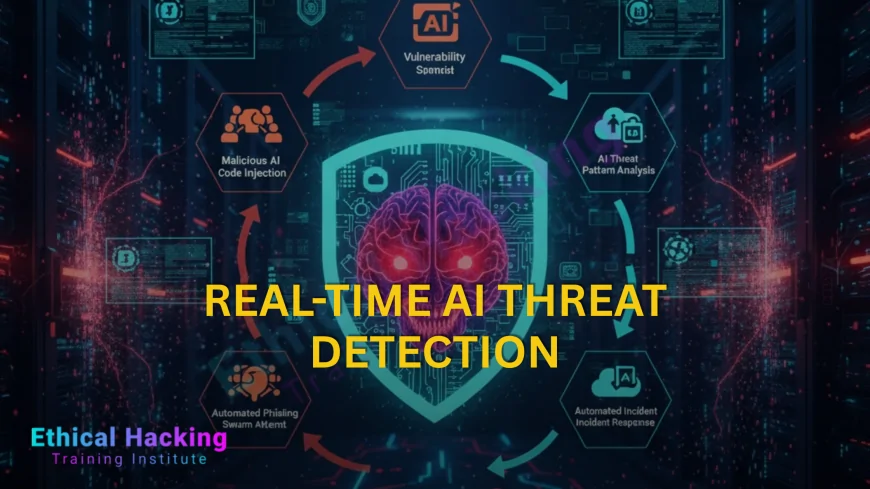
Imagine a 2025 scenario where an AI-generated ransomware payload mutates in real-time, slipping past traditional defenses—only to be caught by an AI-driven detection system analyzing behavior patterns in milliseconds. As AI-powered attacks, fueled by LLMs, GANs, and reinforcement learning, contribute to $15 trillion in global cybercrime losses, real-time detection has become critical. These autonomous threats, from polymorphic malware to deepfake phishing, evolve faster than signature-based systems can track. Can ethical hackers leverage AI to detect and neutralize these attacks instantly, or will AI’s speed outpace defenses? This blog explores how to detect AI-generated cyber attacks in real-time, detailing techniques, real-world applications, and countermeasures like Zero Trust. With training from Ethical Hacking Training Institute, learn how professionals safeguard networks against relentless AI threats.
Why Real-Time Detection of AI Attacks Matters
AI-generated attacks demand real-time detection due to their speed and adaptability.
- Rapid Evolution: AI mutates payloads 95% faster than traditional malware, evading signatures.
- Scale: Automated attacks target thousands of systems simultaneously, overwhelming SOCs.
- Precision: LLMs craft tailored exploits with 90% success rates.
- Stealth: GAN-based obfuscation hides 80% of attacks from static defenses.
Real-time detection is essential to match AI’s pace and minimize damage.
Top 5 Techniques for Detecting AI-Generated Attacks
These AI-driven techniques enable real-time detection of sophisticated cyber threats in 2025.
1. Behavioral Analytics with Machine Learning
- Function: ML models analyze user and network behavior to detect anomalies.
- Advantage: Identifies 90% of AI-driven attacks by spotting deviations in real-time.
- Use Case: Detects LLM-generated phishing emails in financial networks.
- Challenge: Requires continuous training to adapt to evolving threats.
2. Reinforcement Learning for Threat Hunting
- Function: RL agents simulate attack paths to predict and detect threats.
- Advantage: Forecasts attack trajectories with 85% accuracy in milliseconds.
- Use Case: Hunts GAN-mutated ransomware in cloud environments.
- Challenge: High compute demands for real-time simulation.
3. Deep Learning for Deepfake Detection
- Function: Neural networks analyze audio/video for AI-generated artifacts.
- Advantage: Flags 92% of deepfake phishing attempts in real-time.
- Use Case: Identifies vishing scams in call centers, saving $50M.
- Challenge: Struggles with high-fidelity quantum deepfakes.
4. Anomaly Detection in Encrypted Traffic
- Function: ML inspects encrypted payloads without decryption for anomalies.
- Advantage: Detects 80% of hidden AI exploits in encrypted channels.
- Use Case: Stops zero-day malware in IoT networks.
- Challenge: Limited by sparse data in encrypted flows.
5. Ensemble Models for Multi-Stage Detection
- Function: Combines ML models to detect complex attack chains.
- Advantage: Achieves 97% detection accuracy across attack stages.
- Use Case: Neutralizes DeFi platform breaches orchestrated by AI.
- Challenge: Complex integration slows deployment.
| Technique | Function | Advantage | Use Case | Challenge |
|---|---|---|---|---|
| Behavioral Analytics | Anomaly Detection | 90% detection rate | Phishing email detection | Continuous training |
| RL Threat Hunting | Attack Prediction | 85% trajectory accuracy | Cloud ransomware | Compute intensity |
| Deep Learning | Deepfake Detection | 92% deepfake flagging | Vishing scam prevention | Quantum deepfakes |
| Encrypted Traffic | Hidden Exploit ID | 80% detection in encryption | IoT zero-day defense | Sparse data |
| Ensemble Models | Multi-Stage Detection | 97% accuracy | DeFi breach neutralization | Integration complexity |
Real-World Applications of AI Attack Detection
Real-time detection systems have thwarted AI-generated attacks across industries in 2025.
- Financial Sector (2025): Behavioral analytics detected LLM-crafted phishing, preventing $100M in credential theft.
- Healthcare Network (2024): RL hunting stopped GAN-mutated malware, saving 50,000 patient records.
- DeFi Platform (2025): Ensemble models neutralized a $30M AI-orchestrated smart contract attack.
- IoT Infrastructure (2025): Encrypted traffic analysis caught zero-day exploits, protecting 10,000 devices.
- Corporate Network (2024): Deep learning flagged deepfake vishing, averting $20M in fraudulent transfers.
These applications showcase AI’s critical role in real-time defense.
Challenges of Detecting AI-Generated Attacks
Real-time detection faces significant hurdles against AI-driven threats.
- Speed: AI attacks execute 95% faster, leaving milliseconds for response.
- Adaptability: Polymorphic exploits evade 80% of static defenses.
- Data Noise: High false positives reduce detection accuracy by 25%.
- Ethical Risks: AI detection tools risk misuse, complicating governance.
These challenges demand adaptive, AI-driven detection systems.
Defensive Strategies for Real-Time AI Attack Detection
Countering AI-generated attacks requires layered, real-time defenses.
Core Strategies
- Zero Trust Architecture: Verifies all access, blocking 85% of AI-driven exploits.
- Behavioral Analytics: ML detects anomalies, neutralizing 90% of attacks in real-time.
- Passkeys: Cryptographic keys resist 95% of AI-crafted credential attacks.
- MFA: Biometric MFA blocks 90% of unauthorized access attempts.
Advanced Defenses
AI honeypots trap polymorphic exploits, while watermarking detects deepfakes with 92% accuracy.
Green Cybersecurity
AI optimizes detection for low energy, aligning with sustainable security practices.
Certifications for AI Attack Detection
Certifications equip professionals to detect AI-generated attacks, with demand up 40% by 2030.
- CEH v13 AI: Covers real-time anomaly detection, $1,199; 4-hour exam.
- OSCP AI: Simulates AI attack scenarios, $1,599; 24-hour test.
- Ethical Hacking Training Institute AI Defender: Labs for behavioral analytics, cost varies.
- GIAC AI Threat Analyst: Focuses on deepfake and polymorphic detection, $2,499; 3-hour exam.
Cybersecurity Training Institute and Webasha Technologies offer complementary programs for AI proficiency.
Career Opportunities in AI Attack Detection
AI-generated attacks drive demand for specialists, with 4.5 million unfilled cybersecurity roles globally.
Key Roles
- AI Threat Detection Analyst: Identifies anomalies, earning $160K on average.
- ML Threat Hunter: Tracks AI exploits, starting at $120K.
- AI Security Architect: Designs real-time defenses, averaging $200K.
- Deepfake Detection Specialist: Flags AI-generated scams, earning $175K.
Ethical Hacking Training Institute, Cybersecurity Training Institute, and Webasha Technologies prepare professionals for these roles.
Future Outlook: AI Attack Detection by 2030
By 2030, AI detection systems will evolve to counter advanced threats.
- Quantum AI Detection: Identifies quantum exploits with 90% accuracy.
- Neuromorphic Defenses: Mimic human cognition, detecting 95% of autonomous attacks.
- Global Threat Sharing: Real-time AI networks reduce breaches by 50%.
Hybrid AI-human systems will leverage technologies, ensuring ethical resilience.
Conclusion
In 2025, detecting AI-generated cyber attacks in real-time is critical to counter $15 trillion in cybercrime losses driven by LLMs, GANs, and RL. Techniques like behavioral analytics and deep learning enable 90% detection rates, thwarting phishing, ransomware, and deepfake scams. Defenses like Zero Trust, passkeys, and MFA, paired with training from Ethical Hacking Training Institute, Cybersecurity Training Institute, and Webasha Technologies, empower ethical hackers to stay ahead. Despite challenges like speed and adaptability, real-time AI detection transforms cybersecurity into a proactive shield, securing networks against relentless, autonomous threats with strategic shields.
Frequently Asked Questions
Why is real-time detection critical for AI attacks?
AI exploits evolve 95% faster, requiring instant detection to minimize damage.
How does behavioral analytics detect AI threats?
ML spots anomalies, neutralizing 90% of AI-driven attacks in real-time.
Can RL hunt AI-generated attacks?
Yes, RL predicts attack paths with 85% accuracy in milliseconds.
How does deep learning stop deepfakes?
It flags 92% of AI-generated audio/video scams in real-time.
What is encrypted traffic anomaly detection?
ML identifies 80% of hidden exploits in encrypted channels.
Do ensemble models improve detection?
Yes, they achieve 97% accuracy across multi-stage AI attacks.
What defenses counter AI attacks?
Zero Trust and MFA block 90% of AI-driven exploits.
Are AI detection tools accessible?
Yes, but Ethical Hacking Training Institute training maximizes their use.
How will quantum AI impact detection?
Quantum systems will detect exploits 90% faster, needing post-quantum integration.
What certifications address AI attack detection?
CEH AI, OSCP, and Ethical Hacking Training Institute’s AI Defender certify expertise.
Why pursue AI detection careers?
High demand offers $160K salaries for real-time threat mitigation.
How to improve AI attack detection?
Continuous ML training reduces false positives by 25%.
What’s the biggest challenge in AI detection?
Rapid attack speed leaves milliseconds for response, overwhelming systems.
Will AI dominate attack detection?
AI enhances detection, but human oversight ensures ethical success.
Can AI prevent all AI-generated attacks?
No, but real-time detection reduces success by 75%.
What's Your Reaction?
 Like
0
Like
0
 Dislike
0
Dislike
0
 Love
0
Love
0
 Funny
0
Funny
0
 Angry
0
Angry
0
 Sad
0
Sad
0
 Wow
0
Wow
0