
Can I Learn Ethical Hacking Without a Technical Background?
Yes, you can learn ethical hacking with zero tech background! This beginner guide shows non-technical people how to start from scratch: step-by-step roadmap, free resources, and real success stories.
Introduction
You’re a teacher, marketer, or accountant. You’ve never opened a terminal. But you’re fascinated by ethical hacking. The big question: do you need a computer science degree or years of IT experience?
The answer is no. Thousands of non-technical people have successfully transitioned into ethical hacking. They started exactly where you are now, with zero background.
This guide is written for complete beginners. We’ll show you how to go from “what is Linux?” to solving real hacking challenges, step by step. No jargon, no assumptions, just a clear path forward.
Why Non-Technical People Often Excel at Hacking
Surprisingly, your lack of tech background can be an advantage.
The Fresh Perspective Advantage
- You ask “dumb” questions that reveal blind spots
- You think creatively, not constrained by “how it’s always done”
- You’re used to learning new skills from scratch
Success Stories
- Sarah: Former English teacher, now senior pentester at a Big 4 firm
- Rahul: Ex-sales executive, earned $50K in bug bounties in year 1
- Maria: Stay-at-home mom, passed OSCP after 18 months self-study
They all started with no tech knowledge. Their secret? Consistency and the right learning path.
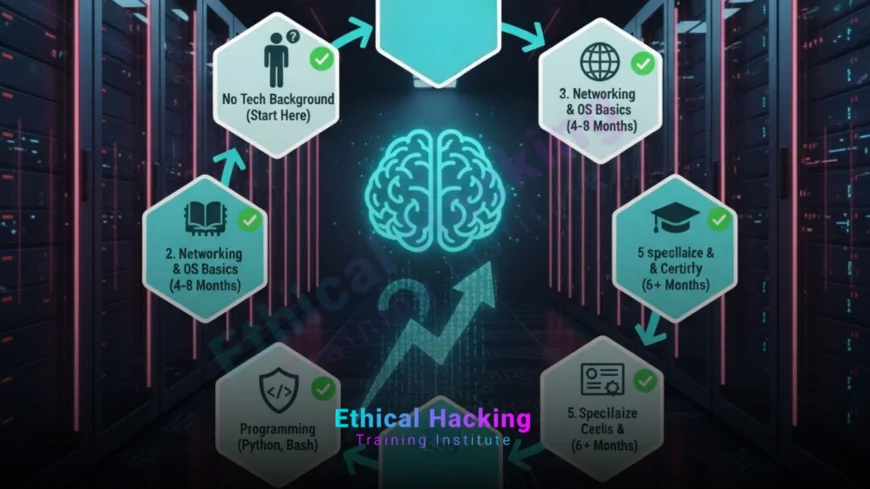
Your Step-by-Step Roadmap (0 to Job-Ready)
Follow this 18-month plan designed for non-tech beginners.
Months 1-3: Computer and Internet Basics
- Week 1-2: Learn computer parts, file systems, how the internet works
- Week 3-6: Master Windows/Linux basics (clicking isn’t enough, learn commands)
- Week 7-12: Understand IP addresses, WiFi, browsers, and how data travels
Goal: Comfortable using a computer beyond social media. Many non-tech learners begin with beginner-friendly CEH courses that assume zero knowledge.
Months 4-6: Linux and Command Line
- Install Ubuntu (easier than Kali for beginners)
- Learn 50 essential commands (ls, cd, grep, etc.)
- Practice daily with OverTheWire Bandit
Months 7-9: Networking Fundamentals
- TCP/IP, DNS, HTTP, ports
- Draw diagrams of how your home router works
- Use Wireshark to see real packets
Months 10-12: Web Technologies
- HTML/CSS basics (how websites are built)
- Understand forms, cookies, sessions
- Try PortSwigger Web Security Academy (free)
Months 13-18: Hacking Tools and Practice
- Switch to Kali Linux
- Master Nmap, Burp Suite, Metasploit
- Solve TryHackMe and HackTheBox beginner rooms
Daily Study Routine for Non-Tech Learners
Even with a full-time job, 2 hours daily works.
60-Minute Power Session
- 10 mins: Review yesterday’s notes
- 30 mins: Watch tutorial video
- 20 mins: Hands-on practice (type, don’t just watch)
Weekend Deep Dives
- 4-6 hours: Complete one full lab or CTF
- Write a simple summary of what you learned
Pro tip: Treat it like learning a language. Daily exposure beats weekend cramming.
Free Resources Designed for Zero Background
These platforms assume you know nothing.
Beginner-Friendly Platforms
- TryHackMe “Pre-Security” path: Starts with computer basics
- Google Cybersecurity Certificate: Free on Coursera
- Professor Messer CompTIA Security+: YouTube series
- NetworkChuck: Fun, visual explanations
Practice Labs
- VirtualBox + Ubuntu VM (free)
- Metasploitable (vulnerable target)
- DVWA (web app for practice)
Programming: Do You Really Need It?
Short answer: eventually yes, but not day one.
Non-Tech Friendly Approach
- Start with Python (easiest language)
- Learn only what you need: variables, loops, functions
- Use “Automate the Boring Stuff” (free book)
- Write your first script in month 6
You don’t need to be a coder. Just understand enough to automate tasks. Many non-tech hackers learn Python in 100 hours total.
Building Confidence Without Overwhelm
Non-tech learners often quit from information overload. Avoid this.
One Skill at a Time Rule
- Week 1: Only Linux commands
- Week 2: Only file navigation
- Don’t touch Nmap until Linux is comfortable
Mindset Shifts
- “I don’t know” is your starting point, not a failure
- Google is your best friend, use it constantly
- Celebrate tiny wins (e.g., first successful ping)
Consider joining an ethical hacker bootcamp designed for career changers with zero experience.
Certifications for Non-Technical Beginners
Start with these to build credibility.
Entry-Level (No Experience Needed)
- CompTIA Security+: 2-3 months study
- Google Cybersecurity Professional Certificate
- eLearnSecurity eJPT
Mid-Level (After 12 Months)
- CEH: Practical focus
- CompTIA PenTest+
Many non-tech learners pass CEH on first try with structured study.
Common Fears and How to Overcome Them
Address these early to stay motivated.
“I’m too old/non-technical”
Reality: 40+ year old career changers succeed daily. Age is irrelevant.
“I’ll never understand networking”
Reality: Draw pictures. Use real-world analogies (postal system for packets).
“What if I break something?”
Reality: Practice in isolated virtual labs. Nothing can harm your real computer.
Job Opportunities for Non-Tech Backgrounds
Companies value diverse perspectives.
Roles Perfect for Career Changers
- Security awareness trainer
- Bug bounty hunter (flexible hours)
- Compliance analyst
- Junior penetration tester
Salary Progression
- Year 1: ₹4-8 lakh (junior roles)
- Year 3: ₹12-20 lakh (mid-level)
- Year 5: ₹25 lakh+ (senior/consultant)
Conclusion
Yes, you can learn ethical hacking without any technical background. It takes longer than someone with IT experience, but the path is well-trodden and proven.
Start today with one simple action: install Ubuntu in a virtual machine. In 30 days, you’ll know more than most people ever will about computers.
Your diverse perspective makes you valuable in cybersecurity. The industry needs thinkers, not just technicians. For flexible learning, many beginners choose to learn ethical hacking online at their own pace. The terminal is waiting, type your first command.
Frequently Asked Questions
How long for a non-tech person to learn ethical hacking?
18-24 months to job-ready. 6-12 months for basic proficiency.
Do I need math skills?
Basic arithmetic for subnetting. No calculus required.
Can I learn at 40+ years old?
Yes. Many successful hackers start in their 40s and 50s.
Is coding mandatory from day one?
No. Start with Linux and networking. Add Python in month 6.
What if I hate command line?
You’ll grow to love it. Start with GUI tools, transition slowly.
Can I practice safely at home?
Yes. Use virtual machines. Never test systems without permission.
Are online courses enough?
Yes, if they include hands-on labs. Supplement with free platforms.
Will employers hire non-tech backgrounds?
Yes, with certifications and practical portfolio. Focus on soft skills too.
How to explain career switch in interviews?
Highlight transferable skills: problem-solving, attention to detail, learning ability.
Can I freelance without experience?
Start with bug bounties after 12 months. Build reputation gradually.
Is ethical hacking stressful for beginners?
Challenging but rewarding. Break learning into tiny daily tasks.
Do I need expensive courses?
No. Free resources suffice for first year. Invest in structured course later.
How to stay motivated?
Join beginner Discord communities. Share weekly progress. Celebrate small wins.
What’s the first tool I should learn?
Linux terminal. Everything else builds on it.
Can I learn part-time?
Yes. 10 hours/week = job-ready in 2 years. Consistency is key.
What's Your Reaction?
 Like
0
Like
0
 Dislike
0
Dislike
0
 Love
0
Love
0
 Funny
0
Funny
0
 Angry
0
Angry
0
 Sad
0
Sad
0
 Wow
0
Wow
0