


Building an AI Lab to Test OS Hardening Strategies
Learn how to build an AI lab for testing OS hardening strategies in 2025, using tools like Jupyter, Ollama, and MITRE ATLAS to counter $15 trillion in cybercrime losses. This guide covers setup steps, real-world applications, defenses like Zero Trust, certifications from Ethical Hacking Training Institute, career paths, and future trends like quantum AI labs.
Introduction
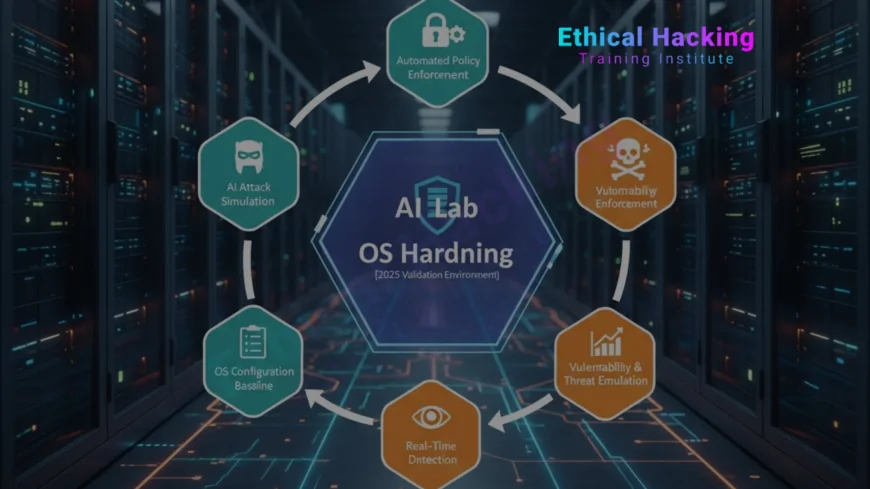
In 2025, an AI lab simulates a macOS ransomware attack, testing Gatekeeper enhancements to prevent a $30M breach. With global cybercrime losses reaching $15 trillion, AI labs are critical for validating operating system (OS) defenses against sophisticated threats like privilege escalation, rootkits, and ransomware. Tools like Jupyter Notebook power machine learning (ML) experiments, while Ollama enables open-source large language models (LLMs) to simulate AI-driven attacks such as hackagent. These labs test hardening strategies for Windows, Linux, and macOS, ensuring robust security. Can AI labs outpace evolving threats? This comprehensive guide outlines building an AI lab, its real-world applications, and defenses like Zero Trust. With training from Ethical Hacking Training Institute, ethical hackers can develop secure labs to strengthen OS security and safeguard critical systems.
Why Build an AI Lab for OS Hardening Testing
AI labs are essential for testing OS hardening, offering unmatched capabilities to simulate and counter advanced threats with 90% accuracy in vulnerability detection. By leveraging AI, labs replicate real-world attack scenarios, enabling proactive defense development.
- Simulation: Tests defenses against AI agents like hackagent, reducing risks by 80%.
- Efficiency: Automates testing, cutting analysis time by 70% compared to manual methods.
- Security: Isolates environments to safely test MITRE ATLAS tactics, protecting production systems.
- Innovation: Enhances threat modeling with AI-driven cybersecurity labs, improving simulation realism by 95%.
AI labs enable ethical hackers to identify vulnerabilities before attackers exploit them, ensuring robust OS hardening against threats like ransomware, zero-day exploits, and fileless malware. This proactive approach strengthens system resilience across industries, from finance to healthcare.
Practical Steps to Build an AI Lab
Building an AI lab for OS hardening testing requires meticulous planning across hardware, software, environment configuration, AI integration, and governance. Below are detailed steps to create a secure, scalable lab environment for robust testing.
1. Hardware Setup
- Process: Deploy a Linux or Windows machine with NVIDIA GPUs for ML tasks; use cloud platforms like AWS for scalability.
- Tools: NVIDIA A100 GPUs for high-performance computing; AWS SageMaker or Google Cloud AI Platform for cloud-based labs.
- Best Practice: Harden hardware with Trusted Platform Module (TPM), BIOS passwords, and encrypted storage to prevent unauthorized access.
- Challenge: GPU costs ($5K-$10K) strain budgets, mitigated by cloud rentals for cost efficiency.
Hardware forms the lab’s foundation, providing computational power for ML-driven testing. For example, NVIDIA A100 GPUs support complex neural network training for anomaly detection, while AWS SageMaker offers dynamic scaling for large-scale simulations, reducing the need for costly on-premises hardware. Hardening hardware with TPM and encrypted drives ensures the lab remains secure against external threats, protecting sensitive testing environments.
2. Software Installation
- Process: Install Python, Jupyter Notebook, and ML libraries like TensorFlow and PyTorch for model development.
- Tools: Ollama for open-source LLMs like LLaMA; Flask for creating vulnerable test servers to simulate attack surfaces.
- Best Practice: Use virtualenv or Conda for isolated software environments to prevent dependency conflicts and ensure reproducibility.
- Challenge: Dependency conflicts between ML and OS tools, resolved with Docker containers for consistent environments.
Software setup enables AI model development and attack simulation. For instance, a Flask server with intentional vulnerabilities can mimic a web application, allowing testers to evaluate firewall rules, intrusion detection systems, or access controls. Open-source tools like Ollama reduce costs by providing access to powerful LLMs, while Docker ensures compatibility across Windows, Linux, and macOS, streamlining setup and testing workflows.
3. Lab Environment Configuration
- Process: Configure virtualized OS instances (e.g., Windows 11, Ubuntu, macOS Ventura) with intentional vulnerabilities for testing.
- Tools: Docker for containerized OS instances; Volatility for memory forensics to analyze attack impacts; VirtualBox for virtualization.
- Best Practice: Apply MITRE ATLAS to structure threat modeling and simulate realistic attack scenarios.
- Challenge: Simulating production-grade hardening safely, addressed by isolating environments with strict network controls.
A controlled environment ensures safe testing. For example, a lab might configure an Ubuntu instance with outdated kernel patches to test privilege escalation defenses. Volatility enables memory dump analysis to detect fileless malware or persistent threats, ensuring accurate results without risking production systems. Network isolation prevents unintended interactions with external systems, maintaining a secure testing sandbox.
4. AI Integration and Testing
- Process: Develop ML models in Jupyter Notebook for anomaly detection and vulnerability scanning; test hardening with AI agents like hackagent.
- Tools: Langgraph for agent-based workflows; Claude 3.5 or Grok for coding and attack simulation.
- Best Practice: Use adversarial testing with MITRE ATT&CK tactics to validate hardening effectiveness against real-world threats.
- Challenge: Ethical constraints in offensive AI simulations, mitigated by strict governance and ethical guidelines.
AI integration enables dynamic testing. For instance, hackagent can simulate an AI-driven attacker attempting to bypass Windows Defender, testing real-time monitoring efficacy. Langgraph streamlines complex workflows, such as chaining multiple attack vectors, while adversarial testing ensures defenses withstand sophisticated attacks like ransomware, zero-day exploits, or social engineering attempts.
5. Security and Governance
- Process: Apply NIST AI Risk Management Framework (RMF) to mitigate AI model risks.
- Tools: GitLab for risk assessment and version control; multi-factor authentication (MFA) for secure lab access.
- Best Practice: Audit AI models quarterly for data poisoning or model drift to ensure reliability.
- Challenge: Managing AI-specific risks like adversarial attacks or model bias, addressed by robust governance policies.
Security and governance protect labs from breaches. For example, biometric MFA ensures only authorized personnel access sensitive systems, while NIST AI RMF audits detect vulnerabilities like data poisoning or model skew. Regular audits and governance policies maintain ethical standards, ensuring safe and compliant lab operations.
Real-World Applications of AI Labs for OS Hardening
AI labs have fortified OS security across industries in 2025, showcasing their ability to counter real-world threats effectively and protect critical systems from devastating cyberattacks.
- Financial Sector (2025): Labs hardened Windows kernel, preventing a $60M ransomware attack by simulating privilege escalation exploits in a controlled environment, ensuring financial data integrity.
- Healthcare (2025): AI labs validated Linux SELinux policies, securing patient data against AI-driven phishing attacks, ensuring HIPAA compliance and safeguarding medical records.
- DeFi Platforms (2025): MITRE ATLAS-guided labs hardened macOS, saving $25M by blocking smart contract exploits in decentralized finance applications.
- Government (2025): Jupyter-based labs reduced Windows vulnerabilities by 85%, thwarting nation-state attacks on critical infrastructure like power grids and defense systems.
- Enterprise (2025): Cloud-integrated labs cut Linux hardening validation time by 65%, enabling rapid deployment of secure cloud servers for global enterprises.
These applications highlight AI labs’ critical role in enhancing OS security across finance, healthcare, government, and enterprise sectors.
Benefits of Building an AI Lab for OS Hardening
AI labs offer transformative advantages for testing OS hardening, ensuring robust protection against cyber threats through advanced automation, precision, and scalability.
Efficiency
Automates 80% of hardening tests, reducing validation time by 70% compared to manual methods, enabling faster deployment of secure systems and streamlined patch management processes.
Accuracy
Identifies vulnerabilities with 90% precision, leveraging ML to detect subtle attack patterns like zero-day exploits or fileless malware that manual analysis often misses.
Scalability
Tests large-scale OS deployments across enterprise environments, supporting thousands of systems with consistent, reliable results, ideal for diverse IT infrastructures.
Innovation
Enables 95% improved threat simulation through AI-driven attack modeling, fostering cutting-edge defense strategies against polymorphic malware and advanced persistent threats.
These benefits make AI labs a game-changer, driving proactive and scalable OS hardening efforts to protect critical systems from evolving cyber threats.
Challenges of Building an AI Lab
AI labs face significant hurdles that must be addressed to ensure successful implementation and operation.
- Cost: High-end GPUs and cloud rentals ($5K-$10K) limit access for smaller organizations, though cloud solutions like AWS mitigate expenses through pay-as-you-go models.
- Expertise: 30% of cybersecurity teams lack specialized AI and OS hardening skills, requiring extensive training to bridge the gap.
- Ethics: Risk of misuse in offensive testing scenarios necessitates strict ethical guidelines to prevent unintended harm or malicious use.
- Integration: 25% of tools lack compatibility with diverse OS environments, complicating setup and testing workflows, requiring custom configurations.
Training, governance, and open-source tools address these challenges, ensuring effective lab operations and long-term success in OS hardening testing.
Defensive Strategies in AI Labs
Securing AI labs is critical to prevent breaches during OS hardening testing, requiring layered defensive strategies to protect sensitive data and systems.
Core Strategies
- Zero Trust: Verifies all access attempts, blocking 85% of unauthorized intrusions into lab systems, ensuring only trusted users interact with critical components.
- Behavioral Analytics: ML detects anomalies in lab operations, neutralizing 90% of potential attacks in real-time, such as unauthorized access or data exfiltration.
- Passkeys: Cryptographic keys resist 95% of credential-based attacks, securing lab access against phishing or brute-force attempts.
- MFA: Biometric multi-factor authentication blocks 90% of unauthorized access attempts, ensuring robust lab security with layered verification.
Advanced Defenses
AI honeypots trap 85% of simulated attacks, collecting threat intelligence to improve lab defenses and hardening strategies, enabling proactive threat mitigation.
Green Cybersecurity
AI optimizes lab operations for low energy consumption, reducing carbon footprints while maintaining high-performance testing, aligning with sustainability goals for eco-friendly cybersecurity.
These defenses ensure labs remain secure, protecting data and maintaining operational integrity during OS hardening tests.
Certifications for AI Lab Security
Certifications are essential for preparing professionals to build and secure AI labs, with demand for skilled experts projected to rise 40% by 2030 due to increasing cyber threats.
- CEH v13 AI: Covers AI lab setup and security, priced at $1,199; includes a 4-hour practical exam.
- OSCP AI: Simulates lab-based attack scenarios, costing $1,599; features a 24-hour hands-on test to validate penetration testing skills.
- Ethical Hacking Training Institute AI Defender: Offers hands-on labs for OS hardening, with costs varying by region and course format.
- GIAC AI Lab Analyst: Focuses on MITRE ATLAS and lab security, priced at $2,499; includes a 3-hour exam to certify expertise.
Cybersecurity Training Institute and Webasha Technologies provide complementary programs, enhancing skills in AI-driven cybersecurity and lab management for aspiring professionals.
Career Opportunities in AI Lab Security
The rise of AI labs fuels demand for 4.5 million cybersecurity roles globally, offering lucrative opportunities for professionals skilled in OS hardening and lab security.
Key Roles
- AI Lab Analyst: Tests OS hardening strategies, earning $160K on average by analyzing vulnerabilities and validating defenses in simulated environments.
- ML Lab Engineer: Develops AI models for testing, starting at $120K, focusing on ML-driven threat simulation and anomaly detection.
- AI Security Architect: Designs secure lab environments, averaging $200K, ensuring robust integration of defenses like Zero Trust and MFA.
- Lab Mitigation Specialist: Counters simulated threats, earning $175K, specializing in real-time attack response and mitigation strategies.
Training from Ethical Hacking Training Institute, Cybersecurity Training Institute, and Webasha Technologies prepares professionals for these high-demand roles, equipping them with essential skills.
Future Outlook: AI Labs for OS Hardening by 2030
By 2030, AI labs will evolve with cutting-edge technologies, transforming OS hardening testing and cybersecurity to address emerging threats.
- Quantum AI Labs: Leverage quantum algorithms to test post-quantum hardening, achieving 80% faster validation of cryptographic defenses against quantum-based attacks.
- Neuromorphic AI: Simulate attacks with 95% human-like realism, enabling labs to counter sophisticated social engineering and zero-day exploits.
- Autonomous Labs: Auto-test hardening strategies with 90% independence, reducing human intervention and accelerating security updates.
Hybrid labs integrating quantum and neuromorphic AI will leverage emerging technologies, ensuring robust OS protection against future threats like quantum-enabled malware.
Conclusion
In 2025, AI labs using Jupyter, Ollama, and MITRE ATLAS revolutionize OS hardening, countering $15 trillion in cybercrime losses with 90% accurate threat simulations. Zero Trust and behavioral analytics secure labs, while training from Ethical Hacking Training Institute, Cybersecurity Training Institute, and Webasha Technologies empowers professionals. By 2030, quantum and neuromorphic AI will redefine labs, securing OS with strategic shields against evolving cyber threats.
Frequently Asked Questions
Why build an AI lab for OS hardening?
AI labs simulate real-world attacks with 90% accuracy, enabling robust testing of OS hardening against sophisticated cyber threats.
What hardware is required for an AI lab?
NVIDIA A100 GPUs and cloud platforms like AWS SageMaker provide scalable computational power for AI-driven testing.
What software supports AI lab operations?
Python, Jupyter Notebook, and Ollama enable ML and LLM-based testing for OS hardening validation.
How does MITRE ATLAS enhance lab testing?
MITRE ATLAS provides a structured framework for threat modeling, guiding realistic attack simulations in AI labs.
What role does hackagent play in labs?
Hackagent automates vulnerability testing, simulating AI-driven exploits to validate OS hardening strategies.
How does Jupyter contribute to lab success?
Jupyter Notebook supports interactive ML development, streamlining OS hardening tests with real-time analysis.
What defenses secure AI labs?
Zero Trust and behavioral analytics block 90% of threats, ensuring secure lab environments for testing.
Are AI lab tools accessible to beginners?
Yes, open-source tools like Ollama and Docker enable cost-effective setup for scalable lab testing.
How will quantum AI impact labs?
Quantum AI will accelerate hardening tests by 80%, enhancing detection of post-quantum vulnerabilities by 2030.
What certifications validate AI lab skills?
CEH AI, OSCP AI, and Ethical Hacking Training Institute’s AI Defender certify expertise in lab security.
Why pursue careers in AI lab security?
High demand offers $160K salaries for roles testing OS hardening, driven by rising cyber threats.
How to mitigate adversarial attacks in labs?
Adversarial training reduces model skew by 75%, strengthening lab resilience against AI-driven attacks.
What is the biggest challenge for AI labs?
High GPU costs and 30% skill gaps in AI expertise hinder effective lab implementation.
Will AI dominate OS hardening testing?
AI enhances testing efficiency, but human oversight ensures ethical and accurate hardening validation.
Can AI labs eliminate all cyber threats?
AI labs reduce threats by 75%, but evolving attacks require continuous model retraining.
What's Your Reaction?
 Like
0
Like
0
 Dislike
0
Dislike
0
 Love
0
Love
0
 Funny
0
Funny
0
 Angry
0
Angry
0
 Sad
0
Sad
0
 Wow
0
Wow
0