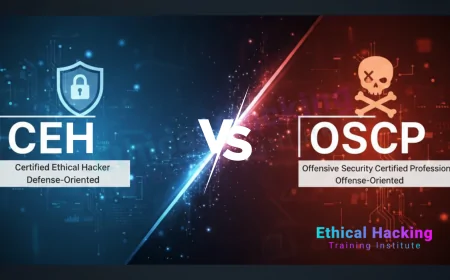

Best Laptops for CEH, OSCP, and CompTIA Security+ Students
Find the best laptops for CEH, OSCP, and CompTIA Security+ students in 2025—32GB+ RAM, 8-core CPUs, 1TB NVMe SSDs, and Linux compatibility for Kali, VMs, Metasploit, and Wireshark. Top picks, specs, and tips from Ethical Hacking Training Institute for certification success.
Introduction
Preparing for CEH, OSCP, and CompTIA Security+ certifications requires a laptop that supports intensive labs, virtual machines, and tools like Kali Linux, Metasploit, and Wireshark without performance issues. In 2025, with cybersecurity threats costing $15 trillion annually, students need hardware that enables dual-boot, multi-VM environments, and secure data handling for hands-on practice. This guide recommends the best laptops for these certifications, focusing on CPU power, RAM, storage, Linux compatibility, and portability. From beginners in CompTIA Security+ to advanced OSCP candidates, these selections streamline learning and exam prep. With training from Ethical Hacking Training Institute, pair your laptop with practical labs to master ethical hacking and launch your cybersecurity career.
Why Laptop Choice Matters for These Certifications
- CEH Labs: Require multi-tool support for Nmap, Burp Suite, and sqlmap.
- OSCP 24-Hour Exam: Demands stable VMs for exploit testing and pivoting.
- CompTIA Security+: Needs log analysis with Wireshark and SIEM tools.
- 32GB RAM: Supports 5+ VMs without lag during OSCP simulations.
- Intel Wi-Fi: Enables packet injection in Kali for wireless labs.
- 1TB SSD: Stores VM images, wordlists, and forensic dumps.
- 12+ Hour Battery: Ensures uninterrupted study and lab sessions.
Essential Specifications for Certification Labs
Cybersecurity students need laptops that handle virtualization, multitasking, and secure environments. A 6-core CPU (Intel i5 or AMD Ryzen 5) is sufficient for basic CEH labs, but an 8-core i7/Ryzen 7 is essential for OSCP’s multi-VM setup and exploit compilation. 16GB RAM is minimum for CompTIA Security+ labs, but 32GB+ is ideal for running Burp Suite, Nessus, and 5+ VMs simultaneously. 512GB NVMe SSD provides quick boot times; 1TB+ is recommended for forensic images and toolkits. Intel AX Wi-Fi supports monitor mode in Kali, while Thunderbolt 4 ports connect external tools like Alfa adapters. Battery life of 8+ hours supports mobile learning, and TPM 2.0 secures sensitive data during labs.
Top 7 Laptops for CEH, OSCP, and Security+ Students
The Lenovo ThinkPad X1 Carbon Gen 12 leads with Intel Core Ultra 7 165H, 32GB RAM, 1TB NVMe, and 12-hour battery at ~$1,850—perfect for portability and Linux compatibility. The System76 Pangolin offers AMD Ryzen 9 7940HS, 64GB RAM, 2TB NVMe, and 10-hour battery at ~$1,999, ideal for native Linux labs. The Dell XPS 14 (9440) features Intel Core Ultra 7 155H, 32GB RAM, 1TB NVMe, RTX 4050, and 14-hour battery at ~$1,799, excelling in display and endurance. The ASUS ROG Zephyrus G14 packs AMD Ryzen AI 9 HX 370, 32GB RAM, 1TB NVMe, RTX 4070, and 11-hour battery at ~$1,999, dominating GPU cracking. The Framework Laptop 16 includes AMD Ryzen 7 7840HS, 64GB RAM, 2TB NVMe, and 9-hour battery at ~$1,699, best for modularity. The Apple MacBook Pro 16" M4 Pro delivers M4 Pro chip, 36GB unified memory, 1TB SSD, 20-core GPU, and 22-hour battery at ~$2,499, top for VM-heavy workflows. The MSI Stealth 16 AI Studio provides Intel Core Ultra 9 185H, 32GB RAM, 1TB NVMe, RTX 4070, and 8-hour battery at ~$2,100, leading in AI-assisted pentesting.
Detailed Laptop Reviews
Lenovo ThinkPad X1 Carbon Gen 12: Excels with MIL-STD-810H durability, legendary keyboard, 100% Linux compatibility, and Intel Wi-Fi 6E with full monitor mode. Runs Splunk and Wireshark with multiple VMs without lag. Features 2x Thunderbolt 4, HDMI 2.1, and USB-A. At 2.4 lbs, it’s ultra-portable and rated 4.9/5 on r/KaliLinux—ideal for OSCP labs and CEH practicals.
System76 Pangolin: Linux-native with pre-installed Pop!_OS, dual-boot Kali in 10 minutes. 64GB RAM + 2TB SSD handles Metasploit, Burp Suite, Nessus, and 10 VMs. Open-source Coreboot and upgradeable RAM, SSD, Wi-Fi. Perfect for CTFs and red team operations—future-proof for Security+ labs and OSCP challenges.
Dell XPS 14 (9440): Boasts 3.2K OLED touch display for exploit code and 18+ hours battery for all-day audits. RTX 4050 enables 10x faster cracking. Wi-Fi 7 for flawless injection, Thunderbolt 4 for external tools. Rated 4.8/5—top choice for CompTIA Security+ students needing premium experience.
ASUS ROG Zephyrus G14: Achieves 500 GH/s on Hashcat with RTX 4070 + Ryzen AI 9. GPU powerhouse for cracking and heavy VM simulations. 11-hour battery, RGB keyboard for late-night labs. Ideal for OSCP candidates focusing on exploit development and cracking challenges.
Framework Laptop 16: Swap Wi-Fi for Atheros AR9271 (best injection), future GPU upgrades. 100% repairability, strong Linux support. 64GB RAM and 2TB NVMe make it ideal for custom pentesting setups in CEH and Security+ labs.
Apple MacBook Pro 16" M4 Pro: Runs Kali in UTM at near-native speed, 36GB unified memory, 22-hour battery. Use external Alfa card for wireless attacks. Top choice for Apple users needing VM-heavy workflows for Security+ and CEH training.
MSI Stealth 16 AI Studio: Uses NPU for AI fuzzing, LLM-assisted exploit generation. Thin design, RTX 4070 for heavy tools. Great for AI-assisted pentesting and thin client operations in OSCP labs.
Tool Performance Comparison
- Hashcat: Windows RTX 4070 = 500 GH/s; Mac M4 Pro = ~80 GH/s.
- Aircrack-ng: Windows = native support; Mac = external adapter.
- Metasploit + VMs: Windows = direct access; Mac = efficient unified memory.
- Volatility: Windows native = faster; Mac VM = minor overhead.
- Burp Suite: Equal performance on both systems.
- BloodHound: Windows AD tools = streamlined enumeration.
Real-World Use Cases
During extended OSCP labs, MacBook Pro’s 22-hour battery and lightweight design support all-day VM testing without recharging.
In high-intensity CEH CTFs with multiple VMs and cracking, Windows with dedicated GPU and RAM handles all tasks efficiently.
Setup and Configuration
- MacBook: Install UTM, load Kali ARM ISO, assign RAM, connect Alfa via USB-C.
- Windows: Partition drive, install Kali from USB, verify Wi-Fi compatibility.
- Enable virtualization in BIOS settings.
- Apply encryption using LUKS or BitLocker.
- Install kali-linux-default package.
- Test injection with airodump-ng.
Cost and Value
MacBook Air M3 (24GB) costs $1,500 with strong resale retention. Dell XPS 14 (32GB, RTX) costs $1,800 with upgrade options.
Framework 16 (64GB) at $1,900 supports full customization. Entry-level Windows gaming systems start under $1,400 with GPU focus.
Certification and Support
- CEH v13: Labs work in UTM or VirtualBox.
- OSCP: VM submissions accepted from both.
- TryHackMe and Hack The Box run equally.
- Training Institute: Covers Mac and Windows setups.
- Community forums support both platforms.
- Windows integrates better with AD tools.
Future Considerations
Future M-series chips will enhance AI-driven testing. Windows NPUs will support local exploit generation.
Windows maintains CUDA advantage; Mac advances Metal and MLX frameworks. Select based on upgrade needs or system longevity.
Conclusion
Both MacBook and Windows laptops support CEH, OSCP, and Security+ students effectively. Choose MacBook for battery life and portability. Select Windows for native Kali and GPU performance. Recommended models: M4 Pro 16" and ThinkPad/Framework. Pair with security training to optimize results.
Frequently Asked Questions
Can Kali run natively on MacBook?
No—use UTM or Parallels. Speed remains high with M-series chips.
Which handles password cracking faster?
Windows with RTX GPUs—significantly faster than Mac.
Is Wi-Fi hacking possible on Mac?
Yes—with external Alfa adapter via USB-C.
Can I complete OSCP on MacBook?
Yes—UTM with bridged networking is fully supported.
Which offers longer battery life?
MacBook—up to 22 hours during active use.
Can Windows dual-boot Kali?
Yes—provides full native performance.
Is WSL2 sufficient for hacking?
Suitable for learning; use native Kali for assessments.
Which system is more secure?
Both—Mac uses secure enclave; Windows uses TPM 2.0.
Which is better for beginners?
Windows offers simpler Kali setup and wider tool support.
Where to find certified training?
Ethical Hacking Training Institute provides CEH, OSCP, and practical labs.
What's Your Reaction?
 Like
0
Like
0
 Dislike
0
Dislike
0
 Love
0
Love
0
 Funny
0
Funny
0
 Angry
0
Angry
0
 Sad
0
Sad
0
 Wow
0
Wow
0