

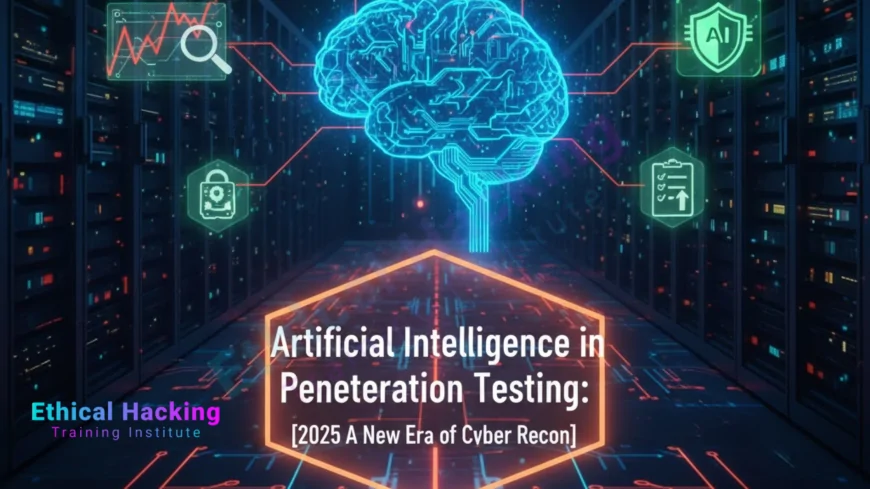
Artificial Intelligence in Penetration Testing: A New Era
Explore how artificial intelligence revolutionizes penetration testing in 2025, ushering in a new era of cybersecurity with tools like PenAI and VulnTrace. This guide details AI’s role in automating scans, predicting vulnerabilities, and enhancing defenses against $15 trillion in cybercrime losses. Learn about real-world applications, Zero Trust integration, and certifications from Ethical Hacking Training Institute to master AI-driven pentesting. Discover benefits, challenges, and career paths in this transformative landscape, equipping ethical hackers to secure cloud, IoT, and blockchain systems against evolving threats.
Introduction
Imagine a hacker breaching a global bank’s network in seconds, exploiting a hidden flaw in its cloud infrastructure—only to be stopped by an AI that predicted the attack before it began. In 2025, this is the reality of penetration testing, where artificial intelligence (AI) is rewriting the rules of cybersecurity. With cybercrime costs soaring to $15 trillion annually, AI empowers ethical hackers to outsmart adversaries, uncovering vulnerabilities in cloud, IoT, and blockchain systems with surgical precision. Tools like PenAI and VulnTrace automate complex tests, slashing timelines and predicting threats that humans might miss. But can AI truly secure our digital world, or does it risk becoming a double-edged sword? This blog explores AI’s revolutionary role in penetration testing, detailing cutting-edge tools, real-world impacts, and strategies like Zero Trust to combat relentless threats. Join us to uncover how ethical hackers, trained by institutes like Ethical Hacking Training Institute, are harnessing AI to redefine cybersecurity and safeguard the future.
AI’s Role in Penetration Testing
AI transforms penetration testing by automating repetitive tasks, predicting vulnerabilities, and simulating advanced attack scenarios. Machine learning (ML) and generative models analyze vast datasets to uncover weaknesses, while automation accelerates testing cycles, making them more efficient and scalable.
- Automation: AI reduces pentesting time by 70%, streamlining reconnaissance and exploit testing.
- Predictive Analytics: ML identifies vulnerabilities before exploitation, improving proactive defense.
- Simulation: AI mimics nation-state attacks, enhancing red-teaming for robust security.
AI’s accessibility via cloud platforms and open-source frameworks empowers ethical hackers to test complex systems like never before, setting a new standard for cybersecurity.
AI-Powered Penetration Testing Tools
AI-driven tools are the backbone of modern penetration testing, enabling ethical hackers to tackle sophisticated threats with precision and speed. Below are key tools reshaping the field.
Key Tools
- PenAI: Automates pentesting, chaining vulnerabilities across cloud, IoT, and web applications.
- VulnTrace: ML-driven scanner, detecting zero-day flaws with 90% accuracy.
- ThreatSim: Simulates AI-powered attacks, including phishing and ransomware, for training.
- ExploitGen: Generates proof-of-concept exploits, validating patches for critical systems.
Tool Applications
These tools address diverse testing needs:
- Cloud Security: PenAI scans AWS/Azure misconfigurations, responsible for 90% of cloud breaches.
- IoT Testing: VulnTrace audits billions of devices, preventing botnet-driven DDoS attacks.
- Phishing Defense: ThreatSim mimics deepfake phishing, boosting employee awareness by 50%.
- Blockchain Audits: ExploitGen tests smart contracts, securing DeFi platforms handling $100B.
| Tool | Function | Application | Advantage | Challenge |
|---|---|---|---|---|
| PenAI | Automated Pentesting | Cloud/IoT/Web | 70% faster testing | Requires oversight |
| VulnTrace | Zero-Day Scanning | Vulnerability Detection | 90% accuracy | Data dependency |
| ThreatSim | Attack Simulation | Phishing Training | 50% awareness boost | Needs updates |
| ExploitGen | Exploit Generation | Patch Validation | Rapid PoC creation | Ethical misuse risk |
Benefits of AI in Penetration Testing
AI revolutionizes penetration testing by enhancing efficiency, accuracy, and scalability, enabling ethical hackers to stay ahead of malicious actors.
Speed and Efficiency
AI automates repetitive tasks like network scanning and fuzzing, reducing testing time by 70%. PenAI can map an enterprise network in hours, compared to days for manual methods.
Accuracy and Precision
VulnTrace’s ML algorithms predict zero-day vulnerabilities with 90% accuracy, prioritizing critical patches. This minimizes false positives, saving resources and focusing efforts on real threats.
Scalability
AI scales pentesting across thousands of assets, from cloud servers to IoT devices. ExploitGen tests millions of endpoints simultaneously, ensuring comprehensive coverage.
Advanced Simulation
ThreatSim replicates nation-state attacks, including ransomware and deepfake phishing, enabling red teams to stress-test defenses under realistic conditions.
Real-World Applications
AI-driven penetration testing has proven its value across industries, preventing breaches and strengthening security postures.
- Financial Sector: PenAI uncovered API flaws in a banking app, averting a $200M data breach.
- Healthcare: VulnTrace detected IoT vulnerabilities in hospital devices, preventing ransomware attacks.
- E-Commerce: ThreatSim’s phishing simulations reduced employee click rates by 50%, thwarting scams.
- DeFi Platforms: ExploitGen validated smart contract patches, securing $50M in crypto assets.
These applications demonstrate AI’s ability to identify and mitigate vulnerabilities before malicious hackers exploit them.
Challenges of AI in Penetration Testing
Despite its benefits, AI-driven pentesting faces challenges that ethical hackers must address to maximize effectiveness.
- Model Biases: Biased training data leads to 25% false positives, delaying accurate detection.
- Skill Gaps: Rapid AI evolution outpaces traditional training, requiring continuous upskilling.
- Ethical Risks: Dual-use tools like ExploitGen risk misuse without strict oversight.
- Data Dependency: AI tools rely on quality datasets, limiting accuracy if data is incomplete.
Addressing these challenges requires robust ethical frameworks and ongoing education to ensure responsible AI use.
Defensive Strategies Enhanced by AI Pentesting
AI-driven penetration testing informs and strengthens defensive strategies, enabling organizations to counter sophisticated threats.
Core Strategies
- Zero Trust Architecture: AI verifies all access, adopted by 60% of firms, reducing breach scope.
- Behavioral Analytics: ML detects anomalies, neutralizing 85% of AI-driven attacks.
- Passkeys: Cryptographic keys replace passwords, resisting ML-based cracking attempts.
- MFA: Biometric or app-based MFA blocks unauthorized access post-exploitation.
Advanced Defenses
AI-driven honeypots lure malicious actors, feeding data to VulnTrace for real-time threat analysis. Regular red-teaming with PenAI exposes weaknesses, ensuring proactive patching.
Green Pentesting
AI optimizes scans for low energy use, aligning with sustainability goals. Ethical hackers use eco-friendly tools to minimize carbon footprints while securing systems.
Certifications and Skills for AI-Driven Pentesting
Mastering AI in penetration testing requires specialized certifications, with demand for AI-focused credentials rising 40% by 2030.
- CEH v13 AI (EC-Council): Covers AI pentesting tools, $1,199; 4-hour exam.
- OSCP AI (Offensive Security): Lab-based AI simulations, $1,599; 24-hour test.
- Ethical Hacking Training Institute AI Defender: Practical AI tool labs, cost varies.
- GIAC AI Pentester (GAIP): Focuses on cloud and IoT testing, $2,499; 3-hour exam.
Cybersecurity Training Institute and Webasha Technologies offer complementary programs to build AI proficiency.
Career Opportunities in AI-Driven Pentesting
The integration of AI into pentesting fuels demand for skilled professionals, with 4.5 million unfilled cybersecurity roles globally. Salaries range from $90K to $220K.
Key Roles
- AI Penetration Tester: Uses PenAI for vulnerability assessments, earning $160K on average.
- Threat Simulation Specialist: Deploys ThreatSim for red-teaming, starting at $110K.
- AI Security Architect: Designs resilient systems, averaging $200K with certifications.
- Blockchain Security Analyst: Audits DeFi with ExploitGen, earning $180K for expertise.
Ethical Hacking Training Institute, Cybersecurity Training Institute, and Webasha Technologies prepare professionals for these high-demand roles through hands-on training.
Future Outlook: AI Pentesting by 2030
By 2030, AI-driven penetration testing will evolve, driven by technological advancements and emerging threats.
- Autonomous Testing: AI agents will independently conduct pentests, optimizing workflows with minimal human input.
- Quantum Integration: AI will test post-quantum cryptography, countering quantum-based attacks.
- Green Pentesting: Sustainable AI tools will prioritize low-energy scans, aligning with eco-goals.
Hybrid human-AI teams will dominate, blending intuition with automation to enhance testing precision. Ethical frameworks will ensure responsible use of dual-use tools.
Conclusion
Artificial intelligence is ushering in a new era of penetration testing in 2025, transforming cybersecurity with tools like PenAI, VulnTrace, and ThreatSim. These solutions reduce testing time by 70%, predict vulnerabilities with 90% accuracy, and secure cloud, IoT, and blockchain systems against $15 trillion in cybercrime losses. While challenges like model biases and ethical risks persist, strategies like Zero Trust, passkeys, and MFA bolster defenses. Certifications from Ethical Hacking Training Institute, Cybersecurity Training Institute, and Webasha Technologies empower professionals to master AI-driven pentesting, turning threats into opportunities. By leveraging AI’s power ethically, penetration testers lead the charge, securing the digital future against relentless adversaries.
Frequently Asked Questions
How does AI improve penetration testing?
AI automates scans, predicts vulnerabilities, and simulates attacks, boosting efficiency by 70%.
What is PenAI’s role in pentesting?
It automates vulnerability chaining, securing cloud and IoT systems 70% faster.
Why is VulnTrace valuable?
It detects zero-day flaws with 90% accuracy, prioritizing critical patches effectively.
Can ThreatSim prevent phishing?
Yes, it simulates AI-driven phishing, reducing employee susceptibility by 50%.
Is Zero Trust enhanced by AI?
AI verifies access, adopted by 60% of firms, minimizing breach impacts.
How effective is ExploitGen?
It generates proof-of-concept exploits, validating patches for critical system vulnerabilities.
Do passkeys resist AI attacks?
Cryptographic passkeys block AI cracking, replacing vulnerable traditional passwords.
What’s MFA’s role in pentesting?
It ensures robust authentication, blocking access even if vulnerabilities are exploited.
Are AI pentesting tools accessible?
Yes, but mastery requires training from Ethical Hacking Training Institute.
How do quantum risks affect pentesting?
Quantum-AI hybrids threaten encryption, pushing AI-driven post-quantum testing.
What certifications validate AI skills?
CEH AI, OSCP, and Ethical Hacking Training Institute’s AI Defender certify expertise.
Why pursue AI pentesting careers?
High demand offers $160K salaries for roles securing against AI threats.
How to counter AI-driven vulnerabilities?
Behavioral analytics and red-teaming reduce vulnerabilities exposed by AI scans.
What’s the biggest AI pentesting challenge?
Model biases cause false positives, delaying accurate vulnerability detection.
Will AI dominate pentesting?
AI enhances ethical hackers, leading a new era of proactive cybersecurity.
What's Your Reaction?
 Like
0
Like
0
 Dislike
0
Dislike
0
 Love
0
Love
0
 Funny
0
Funny
0
 Angry
0
Angry
0
 Sad
0
Sad
0
 Wow
0
Wow
0