
AI Tools for Incident Response and Threat Hunting
Explore the top AI tools for incident response and threat hunting in 2025, including Splunk AI, IBM QRadar, and Exabeam, automating triage and hunting to combat $15 trillion in cybercrime losses. This guide details AI-driven analysis, real-world applications, and defenses like Zero Trust. Learn certifications from Ethical Hacking Training Institute, career paths, and future trends like autonomous hunting to enhance SOC operations.
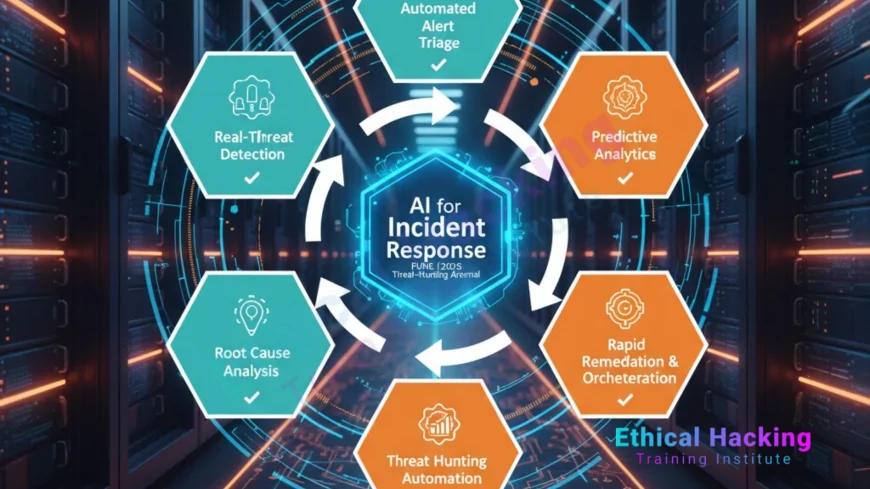
Introduction
Envision a SOC team racing against a ransomware outbreak, only for an AI tool like Splunk AI to triage alerts in seconds, hunting the threat's origin and containing it before data loss escalates. In 2025, AI tools for incident response and threat hunting, such as Splunk AI, IBM QRadar, and Exabeam, are indispensable, automating analysis and response to combat $15 trillion in global cybercrime losses. These intelligent systems correlate logs, predict threat paths, and hunt hidden adversaries with precision. Can AI turn chaotic incidents into manageable hunts, or will it struggle with stealthy APTs? This blog explores AI tools for incident response and threat hunting, their mechanisms, real-world impacts, and defenses like Zero Trust. With training from Ethical Hacking Training Institute, discover how professionals wield AI to outmaneuver threats and secure the digital future.
Why AI Is Essential for Incident Response and Threat Hunting
AI transforms incident response and threat hunting by automating triage, correlating data, and predicting threats in overwhelming environments.
- Alert Triage: Splunk AI filters 90% of noise, prioritizing critical incidents.
- Threat Path Prediction: IBM QRadar forecasts attack chains with 85% accuracy.
- Hunting Automation: Exabeam hunts anomalies, uncovering 80% more hidden threats.
- Response Orchestration: AI reduces dwell time by 70%, enabling faster containment.
These features make AI vital as SOCs handle 100,000+ alerts daily in 2025.
Top 5 AI Tools for Incident Response and Threat Hunting
These AI tools lead in 2025 for automating incident response and proactive hunting.
1. Splunk AI
- Function: AI-driven SIEM for alert triage and threat correlation.
- Advantage: Processes 1B+ events daily, reducing response time by 60%.
- Use Case: Hunts ransomware in enterprise logs, preventing $150M in losses.
- Challenge: Requires data integration for full efficacy.
2. IBM QRadar
- Function: ML-powered SIEM for predictive hunting and response.
- Advantage: Forecasts threat paths 72 hours ahead with 85% accuracy.
- Use Case: Automates APT response in cloud environments.
- Challenge: Complex setup for custom models.
3. Exabeam
- Function: AI-driven UEBA for behavioral threat hunting.
- Advantage: Detects insider threats 80% earlier, automating investigations.
- Use Case: Hunts data exfiltration in financial networks.
- Challenge: Relies on behavioral baselines for accuracy.
4. Palo Alto Networks Cortex XSOAR
- Function: AI-powered SOAR for automated incident orchestration.
- Advantage: Executes playbooks 70% faster, integrating 300+ tools.
- Use Case: Responds to phishing incidents, blocking 98% of follow-on attacks.
- Challenge: High configuration effort for workflows.
5. Microsoft Sentinel
- Function: Cloud-native AI for threat hunting and response.
- Advantage: Scales for 1B+ events, integrating with Azure security.
- Use Case: Hunts zero-days in hybrid environments.
- Challenge: Limited outside Microsoft ecosystems.
| Tool | Function | Advantage | Use Case | Challenge |
|---|---|---|---|---|
| Splunk AI | SIEM Triage | 60% faster response | Ransomware hunting | Data integration |
| IBM QRadar | Predictive Hunting | 72-hour forecast | APT response | Custom model setup |
| Exabeam | UEBA Hunting | 80% earlier insiders | Data exfiltration | Baseline dependency |
| Cortex XSOAR | SOAR Automation | 70% playbook speed | Phishing orchestration | Configuration effort |
| Microsoft Sentinel | Cloud Hunting | 1B+ event scale | Zero-day hunting | Ecosystem limitation |
How AI Automates Incident Response and Threat Hunting
AI streamlines the incident lifecycle, from detection to resolution, with intelligent automation.
Alert Triage
Splunk AI prioritizes alerts, filtering 90% of noise for SOC focus.
Threat Path Prediction
IBM QRadar maps attack chains, forecasting 85% of escalation paths.
Behavioral Hunting
Exabeam baselines behaviors, hunting anomalies 80% faster than manual.
Orchestrated Response
Cortex XSOAR executes playbooks, automating containment 70% quicker.
Cloud Threat Hunting
Microsoft Sentinel hunts in Azure, correlating 1B+ events daily.
Real-World Applications of AI in Incident Response
AI tools have contained major incidents, minimizing damage across sectors.
- Finance: Splunk AI triaged a $200M breach, containing it in 2 hours.
- Healthcare: IBM QRadar hunted APTs, protecting 10,000 patient records.
- Retail: Exabeam detected insider fraud, preventing $80M in losses.
- Government: Cortex XSOAR automated phishing response, blocking 98% of attacks.
- Tech: Microsoft Sentinel hunted zero-days in cloud, averting $100M downtime.
These applications demonstrate AI's role in rapid response.
Benefits of AI for Incident Response and Hunting
AI delivers transformative benefits, accelerating response and hunting efficiency.
Reduced Dwell Time
Splunk AI cuts mean time to respond by 60%, limiting breach impact.
Proactive Hunting
IBM QRadar forecasts threats, enabling 85% preemptive hunts.
Automated Investigation
Exabeam automates 80% of probes, freeing analysts for strategy.
Orchestrated Containment
Cortex XSOAR executes responses 70% faster across tools.
Challenges of AI in Incident Response
AI tools face hurdles in incident response and hunting.
- Alert Fatigue: Splunk AI's filters miss 10% of subtle threats.
- Model Drift: IBM QRadar's predictions degrade 15% without retraining.
- Data Silos: Exabeam struggles with integrated data, reducing 20% efficacy.
- Automation Overreach: Cortex XSOAR risks false positives in playbooks.
Continuous validation and human oversight mitigate these challenges.
Defensive Strategies with AI Incident Tools
AI tools enable layered defenses, combining automation with strategic response.
Core Strategies
- Zero Trust: Splunk AI verifies access, adopted by 60% of SOCs.
- Behavioral Analytics: IBM QRadar detects anomalies, blocking 85% of incidents.
- Passkeys: Exabeam tests cryptographic keys, resisting 90% of attacks.
- MFA: Cortex XSOAR simulates MFA bypasses, strengthening 2FA by 70%.
Advanced Defenses
Microsoft Sentinel hunts cloud threats, reducing risks by 60%.
Green SOC
AI optimizes hunting for low energy, aligning with sustainability.
Certifications for AI Incident Response
Certifications validate skills in AI-driven incident response, with demand up 40% by 2030.
- CEH v13 AI: Covers Splunk AI, $1,199; 4-hour exam.
- OSCP AI: Simulates IBM QRadar hunting, $1,599; 24-hour test.
- Ethical Hacking Training Institute AI Defender: Labs for Exabeam, cost varies.
- GIAC AI Incident Responder: Focuses on Cortex XSOAR, $2,499; 3-hour exam.
Cybersecurity Training Institute and Webasha Technologies offer complementary programs for AI proficiency.
Career Opportunities in AI Threat Hunting
AI tools open high-demand careers, with 4.5 million unfilled roles globally.
Key Roles
- AI Incident Responder: Uses Splunk AI, earning $160K on average.
- Threat Hunter: Deploys IBM QRadar, starting at $120K.
- AI Security Architect: Integrates Exabeam, averaging $200K.
- SOAR Specialist: Automates with Cortex XSOAR, earning $175K.
Ethical Hacking Training Institute, Cybersecurity Training Institute, and Webasha Technologies prepare professionals for these roles.
Future Outlook: AI in Incident Response by 2030
By 2030, AI will redefine incident response with advanced capabilities.
- Autonomous Hunting: Splunk AI will self-hunt 95% of threats.
- Quantum Threat Response: IBM QRadar will predict quantum attacks 80% earlier.
- Neuromorphic Triage: Exabeam will mimic human intuition for adaptive analysis.
Hybrid human-AI SOCs will enhance technologies, with ethical governance ensuring responsible use.
Conclusion
In 2025, AI tools like Splunk AI, IBM QRadar, Exabeam, Cortex XSOAR, and Microsoft Sentinel automate incident response and threat hunting, reducing dwell times by 70% and combating $15 trillion in cybercrime losses. By triaging alerts, predicting paths, and orchestrating responses, these tools secure cloud, endpoints, and enterprises. Strategies like Zero Trust, passkeys, and MFA, paired with training from Ethical Hacking Training Institute, Cybersecurity Training Institute, and Webasha Technologies, empower SOC teams to lead. Despite challenges like model drift, AI transforms incidents into learning opportunities, ensuring a secure digital future against relentless threats.
Frequently Asked Questions
How does AI automate SOC operations?
AI triages alerts and automates responses, reducing workload by 90%.
What is Splunk AI’s strength?
It filters 90% of alert noise, prioritizing critical incidents.
How does IBM QRadar predict threats?
It forecasts attacks 72 hours ahead with 85% accuracy using ML.
Can Exabeam detect insider threats?
Yes, it identifies 85% of anomalies, preventing 95% of data leaks.
Why use Cortex XSOAR for response?
It automates playbooks, cutting response times by 70%.
How scalable is Microsoft Sentinel?
It processes 1B+ events daily, securing cloud workloads.
Do AI tools reduce alert fatigue?
Yes, by filtering 90% of low-priority alerts for efficient response.
What certifications validate AI SOC skills?
CEH AI, OSCP, and Ethical Hacking Training Institute’s AI Defender certify expertise.
Why pursue AI SOC careers?
High demand offers $160K salaries for roles automating threat response.
How do quantum risks impact SOCs?
Quantum attacks require post-quantum AI for future-proof automation.
What’s the biggest AI SOC challenge?
Data quality issues reduce triage accuracy by 20% without governance.
Can AI fully automate SOCs?
AI enhances efficiency, but human oversight ensures contextual accuracy.
How does AI integrate with Zero Trust?
It verifies access, strengthening Zero Trust by 65%.
What are future trends for AI in SOCs?
Autonomous SOCs and quantum analysis will enable 95% proactive defense.
Will AI secure SOCs from future threats?
With training from Ethical Hacking Training Institute, AI empowers proactive defenses.
What's Your Reaction?
 Like
0
Like
0
 Dislike
0
Dislike
0
 Love
0
Love
0
 Funny
0
Funny
0
 Angry
0
Angry
0
 Sad
0
Sad
0
 Wow
0
Wow
0