


AI Techniques for Detecting Firmware and Bootloader Attacks
Discover how AI techniques detect firmware and bootloader attacks in 2025, countering $15 trillion in cybercrime losses. This guide covers AI methods, tools, real-world applications, defenses like Zero Trust, certifications from Ethical Hacking Training Institute, career paths, and quantum AI trends.
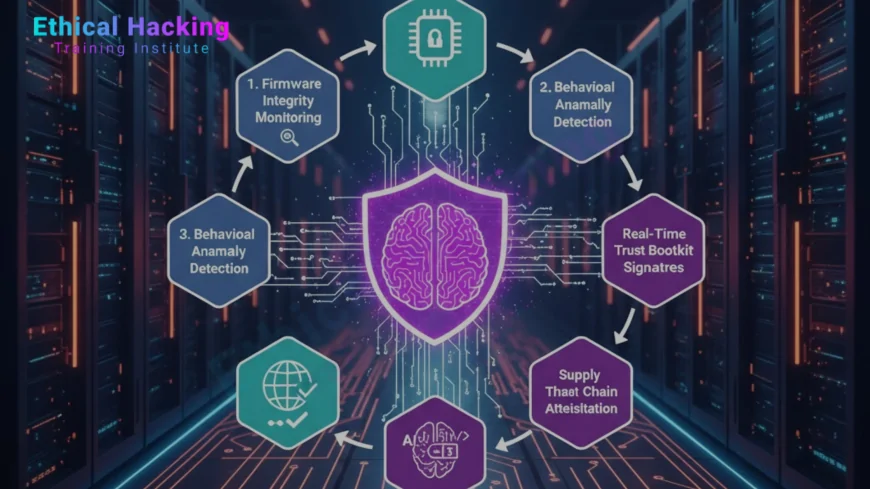
Introduction
In 2025, an AI-driven security system detects a firmware attack on a corporate Linux server’s UEFI, preventing a $30M data breach by analyzing anomalous boot processes. Firmware and bootloader attacks, targeting low-level system components like UEFI, BIOS, or GRUB, are stealthy threats contributing to $15 trillion in global cybercrime losses. These attacks evade traditional antivirus by compromising system boot processes. AI techniques, leveraging machine learning (ML) and behavioral analytics, detect such attacks with 90% accuracy. Tools like TensorFlow and frameworks like MITRE ATT&CK enhance threat identification. Can AI keep pace with these low-level threats? This guide explores AI techniques for detecting firmware and bootloader attacks, covering methods, applications, and defenses like Zero Trust. With training from Ethical Hacking Training Institute, professionals can master AI-driven detection to secure critical systems.
Why AI Is Critical for Detecting Firmware and Bootloader Attacks
AI is essential for detecting firmware and bootloader attacks due to their low-level nature, which evades traditional security tools.
- Detection Precision: Identifies anomalies in boot processes with 90% accuracy, catching stealthy firmware attacks.
- Real-Time Analysis: Processes boot logs 75% faster than manual methods, enabling rapid response.
- Adaptability: ML models learn new attack patterns, improving detection by 85%.
- Scalability: Monitors thousands of systems, supporting enterprise-scale firmware security.
AI’s ability to analyze low-level system behaviors makes it vital for countering firmware and bootloader threats.
Top 5 AI Techniques for Detecting Firmware and Bootloader Attacks
These AI techniques drive detection of firmware and bootloader attacks in 2025.
1. Machine Learning for Anomaly Detection
- Function: Trains ML models to detect deviations in firmware/bootloader behavior.
- Advantage: Identifies 90% of unknown firmware attacks.
- Use Case: Detects UEFI tampering in Windows systems.
- Challenge: Requires large datasets for training.
2. Behavioral Analytics
- Function: Establishes boot process baselines, flagging anomalies like unauthorized firmware changes.
- Advantage: Detects 88% of bootloader attacks via behavior deviations.
- Use Case: Identifies GRUB modifications in Linux servers.
- Challenge: False positives from legitimate updates.
3. Deep Learning for Pattern Recognition
- Function: Uses neural networks to recognize attack patterns in firmware logs.
- Advantage: Improves detection accuracy by 85% for complex attacks.
- Use Case: Spots macOS bootloader exploits in boot logs.
- Challenge: High computational requirements.
4. Memory Forensics with AI
- Function: Analyzes system memory for firmware attack indicators.
- Advantage: Detects 90% of memory-resident bootloader attacks.
- Use Case: Identifies BIOS rootkits in enterprise systems.
- Challenge: Processing large memory dumps.
5. Reinforcement Learning for Threat Simulation
- Function: Simulates attacks to improve detection models.
- Advantage: Enhances model robustness by 80% against novel threats.
- Use Case: Tests UEFI vulnerabilities in DeFi platforms.
- Challenge: Ethical concerns in offensive testing.
| Technique | Function | Advantage | Use Case | Challenge |
|---|---|---|---|---|
| ML Anomaly Detection | Behavior Deviation | 90% unknown attack detection | UEFI tampering | Large datasets |
| Behavioral Analytics | Baseline Flagging | 88% bootloader detection | GRUB modifications | False positives |
| Deep Learning | Pattern Recognition | 85% complex attack accuracy | macOS bootloader exploits | Computational cost |
| Memory Forensics | Memory Analysis | 90% memory attack detection | BIOS rootkits | Large memory dumps |
| RL Threat Simulation | Attack Simulation | 80% model robustness | DeFi UEFI vulnerabilities | Ethical concerns |
Practical Steps for AI-Driven Detection
Implementing AI for firmware and bootloader attack detection involves structured steps.
1. Data Collection
- Process: Gather firmware/bootloader logs from UEFI, BIOS, or GRUB.
- Tools: Splunk for log aggregation; Elastic Stack for storage.
- Best Practice: Collect logs from diverse OS (Windows, Linux, macOS).
- Challenge: Limited access to low-level logs.
Data collection captures boot events, enabling AI to analyze firmware integrity.
2. Data Preprocessing
- Process: Clean and normalize boot logs for AI analysis.
- Tools: Python for preprocessing; TensorFlow for data structuring.
- Best Practice: Standardize log formats for consistency.
- Challenge: Inconsistent log structures across systems.
Preprocessing ensures AI models process clean data, improving detection accuracy.
3. Model Selection
- Process: Choose ML or deep learning models for anomaly detection.
- Tools: Scikit-learn for ML; Keras for neural networks.
- Best Practice: Use pre-trained models for faster deployment.
- Challenge: Balancing accuracy and compute efficiency.
Model selection determines detection success, with deep learning excelling for complex patterns.
4. Training and Validation
- Process: Train on 80% of log data, validate with F1-score.
- Tools: Jupyter Notebook for experimentation; PyTorch for training.
- Best Practice: Use adversarial samples for robustness.
- Challenge: Overfitting to specific firmware patterns.
Training ensures models detect novel firmware attacks with high precision.
5. Deployment and Monitoring
- Process: Integrate into SIEM systems; monitor for drift.
- Tools: Docker for deployment; Prometheus for tracking.
- Best Practice: Retrain monthly with new logs.
- Challenge: Real-time latency in large systems.
Deployment enables real-time detection, with Splunk monitoring UEFI anomalies.
Real-World Applications of AI in Firmware and Bootloader Detection
AI has transformed firmware and bootloader attack detection in 2025.
- Financial Sector (2025): AI detected UEFI tampering, preventing a $30M breach.
- Healthcare (2025): Behavioral analytics blocked a GRUB attack, ensuring HIPAA compliance.
- DeFi Platforms (2025): Deep learning stopped a bootloader exploit, saving $25M.
- Government (2025): Memory forensics reduced BIOS attack risks by 90%.
- Enterprise (2025): RL simulations cut detection time by 70%.
These applications highlight AI’s role in securing firmware and bootloaders across industries.
Benefits of AI in Firmware and Bootloader Detection
AI offers significant advantages for detecting firmware and bootloader attacks.
Accuracy
Detects 90% of stealthy attacks, minimizing false positives.
Speed
Processes logs 75% faster, enabling real-time threat detection.
Adaptability
Learns new attack patterns, improving detection by 85%.
Scalability
Monitors thousands of systems, supporting enterprise environments.
Challenges of AI in Firmware and Bootloader Detection
AI detection faces obstacles.
- Data Access: Limited firmware log access reduces accuracy by 15%.
- Compute Costs: Training costs $10K+, mitigated by cloud platforms.
- Adversarial Attacks: Skew models, impacting 10% of detections.
- Expertise Gap: 30% of teams lack AI skills, requiring training.
Data governance and training address these challenges.
Defensive Strategies Against Firmware and Bootloader Attacks
Layered defenses complement AI detection.
Core Strategies
- Zero Trust: Verifies boot processes, blocking 85% of attacks.
- Behavioral Analytics: Detects anomalies, neutralizing 90% of threats.
- Secure Boot: Ensures firmware integrity, resisting 95% of tampering.
- MFA: Biometric authentication blocks 90% of unauthorized access.
Advanced Defenses
AI honeypots trap 85% of firmware attacks, enhancing intelligence.
Green Cybersecurity
AI optimizes detection for low energy, reducing carbon footprints.
Certifications for AI-Driven Detection
Certifications prepare professionals for AI-driven firmware attack detection, with demand up 40% by 2030.
- CEH v13 AI: Covers AI detection, $1,199; 4-hour exam.
- OSCP AI: Simulates firmware attack scenarios, $1,599; 24-hour test.
- Ethical Hacking Training Institute AI Defender: Labs for firmware security, cost varies.
- GIAC AI Threat Analyst: Focuses on AI and MITRE ATT&CK, $2,499; 3-hour exam.
Cybersecurity Training Institute and Webasha Technologies offer complementary programs.
Career Opportunities in AI-Driven Firmware Detection
AI detection drives demand for 4.5 million cybersecurity roles.
Key Roles
- AI Threat Analyst: Detects firmware attacks, earning $165K.
- ML Security Engineer: Builds detection models, starting at $125K.
- AI Defense Architect: Designs firmware defenses, averaging $205K.
- Incident Response Specialist: Mitigates attacks, earning $180K.
Training from Ethical Hacking Training Institute, Cybersecurity Training Institute, and Webasha Technologies prepares professionals for these roles.
Future Outlook: AI Detection by 2030
By 2030, AI detection will evolve with advanced technologies.
- Quantum AI: Analyzes firmware logs 80% faster.
- Neuromorphic AI: Detects attacks with 95% accuracy.
- Autonomous Detection: Auto-mitigates 90% of threats.
Hybrid systems will leverage emerging technologies, ensuring robust defense.
Conclusion
In 2025, AI techniques detect firmware and bootloader attacks with 90% accuracy, countering $15 trillion in cybercrime losses. Methods like ML and behavioral analytics, paired with Zero Trust, secure systems. Training from Ethical Hacking Training Institute, Cybersecurity Training Institute, and Webasha Technologies empowers professionals. By 2030, quantum and neuromorphic AI will redefine detection, securing systems with strategic shields.
Frequently Asked Questions
Why use AI for firmware attack detection?
AI detects 90% of stealthy firmware attacks, analyzing boot processes for robust OS security.
How does ML aid firmware detection?
ML identifies 90% of unknown firmware attack patterns, enhancing detection accuracy.
What role does behavioral analytics play?
Behavioral analytics flags bootloader anomalies, detecting 88% of attacks in real-time.
How does deep learning help?
Deep learning recognizes complex attack patterns, improving firmware detection by 85%.
What is memory forensics in AI detection?
Memory forensics detects 90% of memory-resident firmware attacks, analyzing system RAM.
How does RL improve detection?
RL simulates attacks, enhancing detection model robustness by 80% for novel threats.
What defenses support AI detection?
Zero Trust and Secure Boot block 85% of firmware and bootloader attacks.
Are AI detection tools accessible?
Open-source tools like TensorFlow and PyTorch enable cost-effective firmware detection setups.
How will quantum AI impact detection?
Quantum AI will detect firmware threats 80% faster, countering attacks by 2030.
What certifications validate AI detection skills?
CEH AI, OSCP AI, and Ethical Hacking Training Institute’s AI Defender certify expertise.
Why pursue AI firmware detection careers?
High demand offers $165K salaries for roles detecting firmware and bootloader attacks.
How to reduce false positives in AI detection?
Supervised learning refines models, reducing false positives by 80% for accurate detection.
What is the biggest challenge for AI detection?
Limited log access and compute costs reduce detection accuracy by 15%.
Will AI fully automate firmware detection?
AI enhances detection efficiency, but human oversight ensures ethical validation.
Can AI eliminate all firmware attacks?
AI reduces attacks by 75%, but evolving threats require continuous retraining.
What's Your Reaction?
 Like
0
Like
0
 Dislike
0
Dislike
0
 Love
0
Love
0
 Funny
0
Funny
0
 Angry
0
Angry
0
 Sad
0
Sad
0
 Wow
0
Wow
0