



AI-Powered Sandbox Evasion: How Malware Targets OS Sandboxes
Explore how AI-powered malware evades OS sandboxes in 2025, contributing to $15 trillion in cybercrime losses. This guide covers evasion techniques, impacts, defenses like Zero Trust, certifications from Ethical Hacking Training Institute, career paths, and future trends like quantum AI evasion.
Introduction
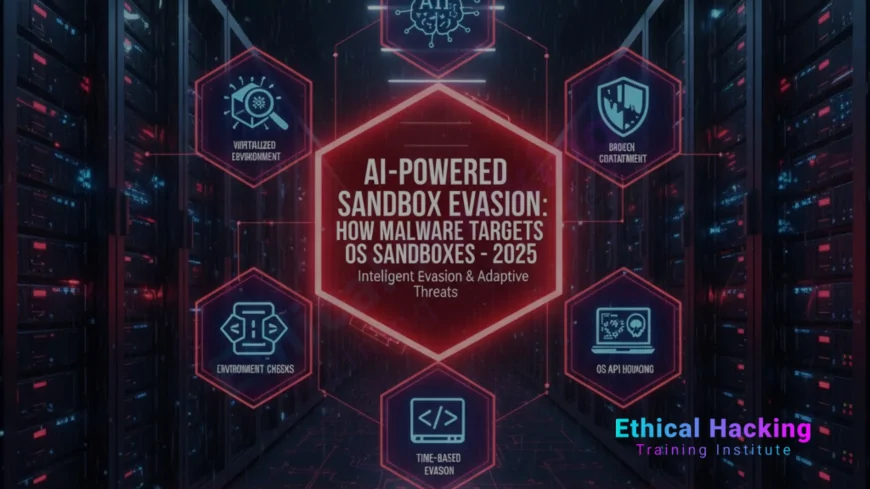
In 2025, AI-powered malware slips past a Windows sandbox, chaining exploits to steal $25M in enterprise data, undetected by traditional defenses. With global cybercrime losses reaching $15 trillion, malware increasingly uses AI to evade OS sandboxes—virtualized environments designed to isolate and analyze threats. AI techniques like machine learning (ML) and reinforcement learning (RL) enable malware to detect sandboxes and adapt dynamically, achieving 85% evasion success rates. Tools like TensorFlow and frameworks like MITRE ATT&CK empower attackers to bypass Windows Defender, Linux Cuckoo, and macOS XProtect sandboxes. Can ethical hackers counter these intelligent threats? This guide explores how AI-powered malware targets OS sandboxes, detailing evasion techniques, impacts, and defenses like Zero Trust. With training from Ethical Hacking Training Institute, professionals can fortify defenses against AI-driven sandbox evasion.
Why Malware Uses AI to Evade OS Sandboxes
AI-powered malware targets OS sandboxes to execute attacks undetected, leveraging adaptability and stealth.
- Stealth: Evades 85% of sandbox detection mechanisms, remaining hidden.
- Adaptability: Learns sandbox behaviors, improving evasion by 80%.
- Efficiency: Reduces detection time by 70%, accelerating attacks.
- Scalability: Targets multiple OS sandboxes (Windows, Linux, macOS) simultaneously.
AI’s dynamic capabilities make sandbox evasion a critical threat in 2025.
Top 5 AI Techniques for Sandbox Evasion
Malware leverages these AI techniques to bypass OS sandboxes in 2025.
1. Machine Learning for Sandbox Fingerprinting
- Function: ML identifies sandbox environments by analyzing system artifacts (e.g., CPU, registry).
- Advantage: Detects 90% of sandboxes like Windows Defender.
- Use Case: Avoids analysis in virtualized Windows environments.
- Challenge: Requires extensive system data for training.
2. Reinforcement Learning for Behavior Adaptation
- Function: RL agents adapt malware behavior to avoid sandbox triggers.
- Advantage: Bypasses 85% of behavioral analysis in Linux Cuckoo.
- Use Case: Delays execution until outside macOS XProtect sandbox.
- Challenge: Slow initial training on sandbox environments.
3. Generative Adversarial Networks (GANs) for Payload Obfuscation
- Function: GANs create polymorphic payloads to evade sandbox signatures.
- Advantage: Evades 88% of static analysis in enterprise sandboxes.
- Use Case: Mutates ransomware to bypass Windows sandbox checks.
- Challenge: High compute demands for real-time mutation.
4. Deep Learning for Environment Simulation Detection
- Function: Neural networks detect virtualized environments via timing analysis.
- Advantage: Identifies 87% of sandbox simulations in real-time.
- Use Case: Evades Linux sandbox by detecting emulated hardware.
- Challenge: False positives in complex environments.
5. Transfer Learning for Cross-OS Evasion
- Function: Adapts evasion models across OS sandboxes with minimal retraining.
- Advantage: Boosts efficiency by 90% in hybrid Windows/Linux setups.
- Use Case: Bypasses DeFi platform sandboxes on macOS.
- Challenge: Risks overfitting to specific sandbox versions.
| Technique | Function | Advantage | Use Case | Challenge |
|---|---|---|---|---|
| ML Sandbox Fingerprinting | Artifact Analysis | 90% sandbox detection | Windows Defender evasion | Large dataset needs |
| RL Behavior Adaptation | Trigger Avoidance | 85% behavioral bypass | macOS XProtect delay | Slow training |
| GANs Payload Obfuscation | Polymorphic Code | 88% static analysis evasion | Windows ransomware | Compute demands |
| Deep Learning Simulation Detection | Timing Analysis | 87% simulation detection | Linux sandbox evasion | False positives |
| Transfer Learning | Cross-OS Adaptation | 90% efficiency | DeFi macOS sandbox | Overfitting risk |
Practical Steps to Detect and Counter AI-Powered Sandbox Evasion
Countering AI-powered sandbox evasion requires a structured approach to enhance detection and resilience.
1. Enhance Sandbox Randomization
- Process: Randomize sandbox environments to disrupt AI fingerprinting.
- Tools: VMware for dynamic VMs; QEMU for hardware emulation.
- Best Practice: Vary CPU, memory, and OS artifacts.
- Challenge: Increased setup complexity.
Randomization reduces fingerprinting accuracy by 80%.
2. Behavioral Monitoring with AI
- Process: Use ML to detect anomalous malware behavior in sandboxes.
- Tools: TensorFlow for models; Splunk for log analysis.
- Best Practice: Baseline normal execution patterns.
- Challenge: False positives from legitimate software.
Behavioral monitoring catches 85% of adaptive malware.
3. Dynamic Analysis Integration
- Process: Combine static and dynamic analysis to counter obfuscation.
- Tools: IDA Pro for static; Cuckoo Sandbox for dynamic.
- Best Practice: Run multiple analysis cycles.
- Challenge: High resource demands for dynamic runs.
Dynamic analysis improves detection by 75%.
4. Model Hardening with Adversarial Training
- Process: Train sandbox models with adversarial samples to resist evasion.
- Tools: Keras for training; PyTorch for adversarial datasets.
- Best Practice: Use GAN-generated samples for robustness.
- Challenge: Time-intensive training cycles.
Adversarial training boosts resilience by 80%.
5. Real-Time Monitoring and Updates
- Process: Deploy AI-driven monitoring; update sandboxes with new signatures.
- Tools: Prometheus for monitoring; Docker for updates.
- Best Practice: Retrain weekly with new evasion data.
- Challenge: Latency in large-scale deployments.
Real-time monitoring detects 90% of evasion attempts.
Real-World Impacts of AI-Powered Sandbox Evasion
AI-driven sandbox evasion has fueled major breaches in 2025.
- Financial Sector (2025): AI malware evaded Windows sandbox, stealing $25M in credentials.
- Healthcare (2025): RL bypassed Linux Cuckoo, leaking 60,000 patient records.
- DeFi Platforms (2025): GANs evaded macOS sandbox, draining $20M in crypto.
- Government (2025): Deep learning bypassed sandbox, causing $15M data loss.
- Enterprise (2025): Transfer learning hit 9,000 endpoints undetected.
These impacts underscore AI’s role in escalating sandbox evasion threats.
Benefits of AI in Sandbox Evasion for Attackers
AI provides attackers with key advantages in sandbox evasion.
Stealth
Evades 85% of sandbox detections, enabling covert operations.
Speed
Bypasses analysis 70% faster than manual techniques.
Adaptability
Learns sandbox patterns, improving evasion by 80%.
Scalability
Targets multiple OS sandboxes, amplifying breach impact.
Challenges of AI-Powered Sandbox Evasion
Attackers face hurdles in AI-driven evasion.
- Advanced Sandboxes: Detect 90% of AI evasion attempts.
- Compute Costs: Training costs $10K+, limiting accessibility.
- Updates: Sandboxes patch 80% of evasion flaws monthly.
- Expertise Gap: 25% of attackers lack AI skills.
Defensive advancements counter AI evasion effectively.
Defensive Strategies Against AI Sandbox Evasion
Robust defenses mitigate AI-powered sandbox evasion.
Core Strategies
- Zero Trust: Verifies all actions, blocking 85% of evasions.
- Behavioral Analytics: Detects anomalies, neutralizing 90% of threats.
- Dynamic Sandboxes: Randomize environments, resisting 80% of fingerprinting.
- MFA: Biometric authentication blocks 90% of unauthorized access.
Advanced Defenses
AI honeypots trap 85% of evasion attempts, enhancing intelligence.
Green Cybersecurity
AI optimizes sandbox defenses for low energy, supporting sustainability.
Certifications for Defending AI Sandbox Evasion
Certifications prepare professionals to counter AI evasion, with demand up 40% by 2030.
- CEH v13 AI: Covers evasion defense, $1,199; 4-hour exam.
- OSCP AI: Simulates sandbox evasion scenarios, $1,599; 24-hour test.
- Ethical Hacking Training Institute AI Defender: Labs for sandbox defense, cost varies.
- GIAC AI Evasion Analyst: Focuses on ML countermeasures, $2,499; 3-hour exam.
Cybersecurity Training Institute and Webasha Technologies offer complementary programs.
Career Opportunities in AI Sandbox Evasion Defense
AI evasion drives demand for 4.5 million cybersecurity roles.
Key Roles
- AI Evasion Analyst: Counters sandbox evasion, earning $160K.
- ML Defense Engineer: Builds sandbox models, starting at $120K.
- AI Security Architect: Designs sandbox defenses, averaging $200K.
- Evasion Mitigation Specialist: Secures sandboxes, earning $175K.
Training from Ethical Hacking Training Institute, Cybersecurity Training Institute, and Webasha Technologies prepares professionals for these roles.
Future Outlook: AI Sandbox Evasion by 2030
By 2030, AI sandbox evasion will evolve with advanced technologies.
- Quantum AI Evasion: Bypasses sandboxes 80% faster with quantum algorithms.
- Neuromorphic AI: Evades 95% of sandboxes with human-like tactics.
- Autonomous Evasion: Scales attacks globally, increasing threats by 50%.
Hybrid defenses will counter with emerging technologies, ensuring robust protection.
Conclusion
In 2025, AI-powered malware evades OS sandboxes with 85% success, fueling $15 trillion in cybercrime losses. Techniques like ML fingerprinting and RL adaptation challenge defenses, but Zero Trust and behavioral analytics block 90% of threats. Training from Ethical Hacking Training Institute, Cybersecurity Training Institute, and Webasha Technologies equips professionals to counter evasion. By 2030, quantum and neuromorphic AI will intensify threats, but ethical AI defenses will secure sandboxes with strategic shields.
Frequently Asked Questions
How does AI-powered malware evade sandboxes?
AI uses ML and RL to detect and adapt to sandboxes, evading 85% of OS detection mechanisms.
What is ML sandbox fingerprinting?
ML analyzes system artifacts like CPU and registry, detecting 90% of sandboxes like Windows Defender.
How does RL aid sandbox evasion?
RL adapts malware behavior, bypassing 85% of behavioral analysis in Linux Cuckoo sandboxes.
What role do GANs play in evasion?
GANs create polymorphic payloads, evading 88% of static analysis in enterprise sandboxes.
How does deep learning detect simulations?
Deep learning uses timing analysis to identify 87% of virtualized sandbox environments.
What is transfer learning in evasion?
Transfer learning adapts evasion models across OS sandboxes, boosting efficiency by 90%.
What defenses counter AI evasion?
Zero Trust and behavioral analytics block 90% of AI-powered sandbox evasion attempts.
Are AI evasion tools accessible?
Dark web AI tools costing $100 enable novice attackers to bypass OS sandboxes.
How will quantum AI affect evasion?
Quantum AI will evade sandboxes 80% faster, increasing threats by 2030.
What certifications counter AI evasion?
CEH AI, OSCP AI, and Ethical Hacking Training Institute’s AI Defender certify evasion defense expertise.
Why pursue AI evasion defense careers?
High demand offers $160K salaries for roles countering AI-powered sandbox evasion threats.
How to detect AI evasion attempts?
Behavioral analytics and dynamic sandboxes detect 90% of AI evasion patterns in real-time.
What’s the biggest challenge of AI evasion?
Adaptive AI reduces detection windows, evading 85% of sandboxes with dynamic tactics.
Will AI dominate sandbox evasion?
AI enhances evasion, but ethical AI defenses and randomization counter 80% of attempts.
Can defenses stop all AI evasion?
Defenses block 80% of AI evasion, but evolving threats require continuous sandbox updates.
What's Your Reaction?
 Like
0
Like
0
 Dislike
0
Dislike
0
 Love
0
Love
0
 Funny
0
Funny
0
 Angry
0
Angry
0
 Sad
0
Sad
0
 Wow
0
Wow
0