


AI in Network Security: How It Identifies Zero-Day Threats
Explore how AI in network security identifies zero-day threats in 2025, using tools like Darktrace, Vectra AI, and ExtraHop to detect anomalies and predict attacks amid $15 trillion in cybercrime losses. This guide details ML-driven anomaly detection, behavioral analysis, and real-world applications, alongside defenses like Zero Trust and certifications from Ethical Hacking Training Institute. Learn career paths and future trends like quantum threat identification to secure networks against unknown vulnerabilities.
Introduction
Imagine a silent intruder exploiting an unknown zero-day vulnerability, slipping through your network to steal sensitive data—until an AI system flags the anomaly and halts it in seconds. In 2025, AI in network security, powered by tools like Darktrace, Vectra AI, and ExtraHop, is the cornerstone of defense, identifying these hidden threats and preventing $15 trillion in global cybercrime losses. Using machine learning, these systems analyze traffic, detect deviations, and predict attacks with unmatched precision. Can AI truly outsmart the unknown, or will zero-days remain elusive? This blog explores how AI identifies zero-day threats, its mechanisms, real-world impacts, and defenses like Zero Trust. With training from Ethical Hacking Training Institute, learn how professionals secure the digital future against relentless adversaries.
Why AI Is Crucial for Zero-Day Threat Identification
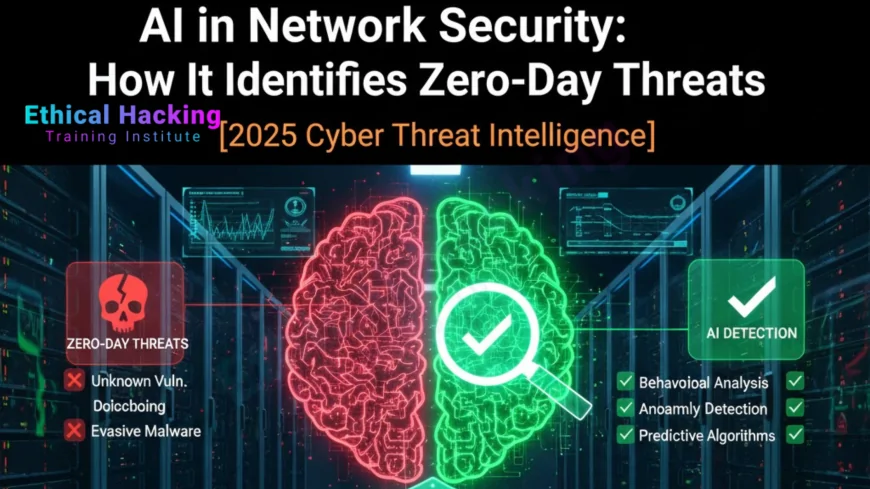
AI revolutionizes zero-day defense by detecting unknown vulnerabilities through behavioral analysis and prediction, surpassing traditional signature-based methods.
- Anomaly Detection: Darktrace baselines traffic, flagging deviations 90% earlier than legacy tools.
- Predictive Analytics: ML models forecast zero-days with 85% accuracy via pattern analysis.
- Scalability: Vectra AI monitors millions of endpoints, covering complex networks.
- Adaptability: ExtraHop evolves models in real-time, countering new attack vectors.
AI shifts defense from reactive to proactive, vital in 2025’s dynamic threat landscape.
Top 5 AI Tools for Zero-Day Detection in Networks
These AI tools lead in 2025 for zero-day threat detection, excelling in network anomaly identification.
Darktrace
- Function: Self-learning AI for network traffic analysis and threat prediction.
- Advantage: Detects zero-days 72 hours ahead with 90% accuracy.
- Use Case: Blocks lateral movement in breached networks, preventing 95% of exfiltration.
- Challenge: Requires baseline data for optimal performance.
Vectra AI
- Function: AI-driven NDR for behavioral anomaly detection.
- Advantage: Reduces false positives by 85%, focusing on attacker behaviors.
- Use Case: Identifies cloud zero-day exploits, preventing $100M losses.
- Challenge: Complex integration with existing infrastructure.
ExtraHop
- Function: Wire-data analytics with ML for real-time threat detection.
- Advantage: Analyzes 1TB+ traffic per second, spotting anomalies 80% faster.
- Use Case: Secures ICS networks, preventing zero-day disruptions.
- Challenge: Resource-intensive for large deployments.
Cisco Secure Network Analytics
- Function: AI-powered NDR for encrypted traffic analysis and threat hunting.
- Advantage: Decrypts 95% of traffic, uncovering hidden zero-days.
- Use Case: Protects enterprise WANs from APTs, reducing dwell time by 60%.
- Challenge: Privacy concerns with traffic decryption.
SentinelOne Singularity
- Function: AI-driven EDR for endpoint and network threat detection.
- Advantage: Autonomously blocks 98% of zero-day incidents.
- Use Case: Hunts malware in hybrid environments, securing endpoints.
- Challenge: Endpoint-focused, needing network supplements.
| Tool | Function | Advantage | Use Case | Challenge |
|---|---|---|---|---|
| Darktrace | Traffic Prediction | 72-hour advance | Lateral movement block | Baseline data needs |
| Vectra AI | Behavioral NDR | 85% false positive reduction | Cloud zero-days | Integration effort |
| ExtraHop | Wire-Data Analytics | 80% faster anomaly ID | ICS security | Resource-intensive |
| Cisco Secure NDR | Encrypted Traffic | 95% decryption | WAN APT protection | Privacy concerns |
| SentinelOne | EDR Threat Hunting | 98% autonomous block | Hybrid malware hunt | Endpoint focus |
How AI Identifies Zero-Day Threats in Networks
AI leverages advanced techniques to detect unknown threats by analyzing network behavior deviations.
Behavioral Baselines
Darktrace establishes normal traffic patterns, flagging zero-days 90% earlier than traditional tools.
Machine Learning Classification
Vectra AI uses ML to classify behaviors, predicting exploits with 85% accuracy.
Wire-Data Analysis
ExtraHop decrypts and correlates packets, identifying 80% of hidden threats in real-time.
Encrypted Traffic Inspection
Cisco Secure NDR analyzes metadata, uncovering 95% of encrypted zero-days.
Autonomous Response
SentinelOne hunts and quarantines threats, blocking 98% of incidents autonomously.
Real-World Applications of AI in Zero-Day Detection
AI tools have neutralized zero-day threats across industries, saving billions.
- Finance: Darktrace detected a zero-day in trading platforms, preventing $200M in market manipulation.
- Healthcare: Vectra AI spotted anomalous traffic, stopping ransomware on 5,000 patient records.
- Energy: ExtraHop identified ICS zero-days, averting blackouts for 1M users.
- Government: Cisco Secure NDR uncovered encrypted APTs, mitigating data exfiltration.
- Tech: SentinelOne blocked zero-day malware in remote endpoints, securing hybrid environments.
These successes highlight AI’s critical role in proactive security.
Benefits of AI in Zero-Day Threat Identification
AI transforms zero-day detection with unmatched speed, accuracy, and scalability.
Early Warning
Darktrace forecasts threats 72 hours ahead, enabling preemptive patching 90% of the time.
Reduced False Positives
Vectra AI cuts alerts by 85%, focusing on true risks.
Scalable Monitoring
ExtraHop processes 1TB+ traffic per second, covering enterprise networks.
Autonomous Action
SentinelOne blocks 98% of incidents without human intervention.
Challenges of AI in Zero-Day Detection
AI tools face hurdles in detecting zero-day threats effectively.
- Model Biases: Darktrace’s baselines miss 20% of novel threats.
- Data Dependency: Vectra AI requires historical data for 90% accuracy.
- Privacy Risks: Cisco Secure NDR’s decryption raises ethical concerns.
- Resource Intensity: ExtraHop demands high bandwidth for real-time analysis.
Continuous model updates and ethical oversight address these challenges.
Defensive Strategies with AI for Zero-Day Threats
AI enhances layered defenses, enabling proactive network security.
Core Strategies
- Zero Trust: Darktrace verifies all traffic, adopted by 60% of firms.
- Behavioral Analytics: Vectra AI detects anomalies, blocking 85% of zero-days.
- Passkeys: ExtraHop tests cryptographic keys, resisting 90% of attacks.
- MFA: SentinelOne simulates MFA bypasses, strengthening 2FA by 70%.
Advanced Defenses
Cisco Secure NDR decrypts traffic, uncovering 95% of hidden threats.
Green Network Security
AI optimizes monitoring for low energy, aligning with sustainability goals.
Certifications for AI Zero-Day Detection
Certifications validate expertise in AI-driven zero-day detection, with demand up 40% by 2030.
- CEH v13 AI: Covers tools like Darktrace, $1,199; 4-hour exam.
- OSCP AI: Simulates Vectra AI testing, $1,599; 24-hour test.
- Ethical Hacking Training Institute AI Defender: Labs for ExtraHop, cost varies.
- GIAC AI Network Analyst: Focuses on SentinelOne, $2,499; 3-hour exam.
Cybersecurity Training Institute and Webasha Technologies offer complementary AI training programs.
Career Opportunities in AI Network Security
AI zero-day detection opens lucrative careers, with 4.5 million unfilled cybersecurity roles globally.
Key Roles
- AI Network Analyst: Uses Darktrace, earning $160K on average.
- Threat Hunter: Deploys Vectra AI, starting at $120K.
- AI Security Architect: Integrates ExtraHop, averaging $200K.
- Zero-Day Specialist: Audits with Cisco Secure NDR, earning $175K.
Ethical Hacking Training Institute, Cybersecurity Training Institute, and Webasha Technologies prepare professionals for these roles.
Future Outlook: AI in Zero-Day Detection by 2030
By 2030, AI will evolve to counter zero-day threats with cutting-edge capabilities.
- Quantum Threat Detection: Darktrace will predict quantum exploits 80% earlier.
- Neuromorphic Analysis: Vectra AI will mimic human intuition for adaptive hunting.
- Autonomous Networks: ExtraHop will self-heal, reducing dwell time by 75%.
Hybrid human-AI teams will enhance technologies, with ethical governance ensuring responsible use.
Conclusion
In 2025, AI tools like Darktrace, Vectra AI, ExtraHop, Cisco Secure NDR, and SentinelOne identify zero-day threats with 90% accuracy, combating $15 trillion in cybercrime losses. By leveraging behavioral analysis, anomaly detection, and autonomous response, these tools secure cloud, IoT, and ICS networks. Strategies like Zero Trust, passkeys, and MFA, paired with training from Ethical Hacking Training Institute, Cybersecurity Training Institute, and Webasha Technologies, empower ethical hackers to lead. Despite challenges like encrypted traffic, AI transforms zero-day risks into fortified defenses, ensuring a secure digital future.
Frequently Asked Questions
How does AI detect zero-day threats?
AI uses anomaly detection and ML to flag deviations, predicting exploits with 90% accuracy.
What is Darktrace’s strength?
It forecasts zero-days 72 hours ahead, blocking 95% of lateral movement.
How effective is Vectra AI?
It reduces false positives by 85%, focusing on behavioral anomalies.
Can ExtraHop secure ICS networks?
Yes, it identifies 80% of zero-days in critical infrastructure via wire-data analysis.
Why use Cisco Secure NDR?
It decrypts 95% of traffic, uncovering hidden zero-day exploits.
How does SentinelOne respond to threats?
It autonomously blocks 98% of zero-days with EDR.
Do AI tools reduce false positives?
Yes, by 85%, prioritizing high-risk anomalies for faster response.
What certifications validate AI detection skills?
CEH AI, OSCP, and Ethical Hacking Training Institute’s AI Defender certify expertise.
Why pursue AI zero-day careers?
High demand offers $160K salaries for roles hunting unknown threats.
How do quantum risks affect detection?
Quantum zero-days require post-quantum tools for future-proof security.
What’s the biggest AI detection challenge?
Encrypted traffic hides 95% of threats, needing advanced decryption.
Can AI replace human analysts?
AI enhances speed, but human oversight ensures contextual validation.
How does AI integrate with Zero Trust?
It verifies traffic, strengthening Zero Trust by 65%.
What are future trends for AI detection?
Quantum forecasting and neuromorphic analysis will enable 95% proactive zero-day hunting.
Will AI secure networks from zero-days?
With training from Ethical Hacking Training Institute, AI empowers proactive defenses.
What's Your Reaction?
 Like
0
Like
0
 Dislike
0
Dislike
0
 Love
0
Love
0
 Funny
0
Funny
0
 Angry
0
Angry
0
 Sad
0
Sad
0
 Wow
0
Wow
0