
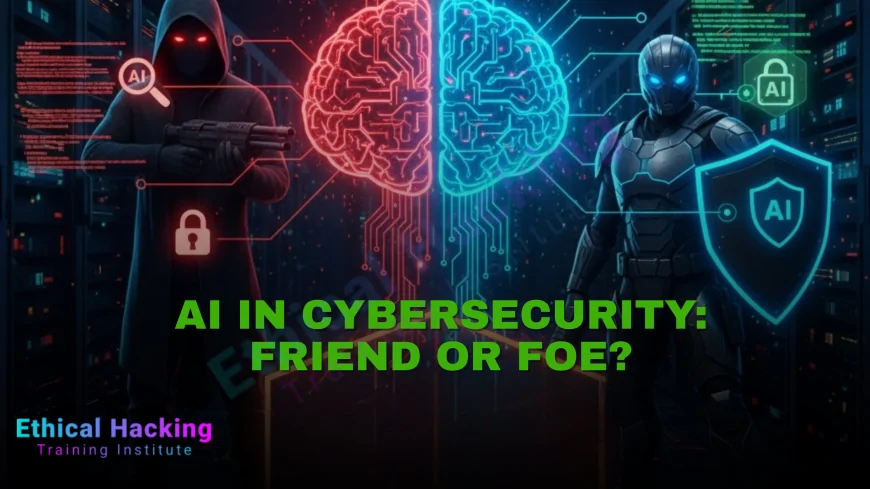
AI in Cybersecurity: Friend or Foe?
Discover AI’s dual role in cybersecurity for 2025, as both a powerful ally and a dangerous threat. Tools like SecureAI defend against $15 trillion in cybercrime, while HackBot fuels phishing and ransomware. This guide explores AI’s benefits in penetration testing, threat detection, and Zero Trust, alongside risks like deepfake attacks. Learn about certifications from Ethical Hacking Training Institute, real-world impacts, and career paths to navigate this landscape. Uncover whether AI is a friend or foe in securing the digital future against evolving cyber threats.
Introduction
Imagine a world where an AI detects a cyber attack before it strikes, saving a hospital from ransomware chaos—yet the same technology crafts a phishing email so convincing it fools a CEO into leaking sensitive data. In 2025, artificial intelligence (AI) stands at the heart of cybersecurity, a double-edged sword that empowers both defenders and attackers. With cybercrime costing $15 trillion annually, AI tools like SecureAI fortify systems with predictive precision, while malicious tools like HackBot amplify phishing, ransomware, and botnet assaults. Is AI the ultimate guardian of our digital world, or a Pandora’s box unleashing new threats? This blog dives into AI’s dual role, exploring its transformative benefits in penetration testing and threat detection, its risks in enabling sophisticated attacks, and strategies like Zero Trust to tip the balance. Through real-world cases, defensive tactics, and training from Ethical Hacking Training Institute, we uncover whether AI is a friend or foe in securing the future.
AI’s Dual Nature in Cybersecurity
AI’s versatility makes it both a powerful ally and a formidable threat in cybersecurity. Machine learning (ML) and generative models enhance efficiency for defenders and attackers, reshaping the digital battlefield.
- Automation: AI slashes task times by 70%, from pentesting to attack execution.
- Adaptability: ML evolves in real-time, bypassing or strengthening defenses dynamically.
- Dual-Use: Tools like HackBot serve both ethical red-teaming and malicious exploits.
AI’s accessibility via cloud platforms and open-source models democratizes its use, amplifying both defensive and offensive capabilities.
AI as a Friend: Empowering Defenders
AI equips ethical hackers and cybersecurity professionals with tools to preempt and mitigate threats, transforming defense strategies.
Defensive AI Tools
- SecureAI: Automates penetration testing, chaining vulnerabilities for cloud and IoT audits.
- ThreatGuard: ML-driven anomaly detection, reducing breach response time by 70%.
- PhishNet: Simulates phishing attacks, cutting employee susceptibility by 50%.
- VulnTrace: Identifies zero-day flaws with 90% accuracy, prioritizing critical patches.
Defensive Applications
AI enhances cybersecurity across domains:
- Penetration Testing: SecureAI identifies weaknesses 70% faster, securing complex systems.
- Threat Intelligence: ThreatGuard predicts attack vectors with 90% accuracy.
- User Training: PhishNet simulates deepfake phishing, boosting awareness.
- Blockchain Security: VulnTrace audits DeFi smart contracts, protecting $100B in assets.
AI as a Foe: Empowering Attackers
Malicious hackers leverage AI to scale and refine attacks, exploiting vulnerabilities with unprecedented precision.
Malicious AI Tools
- HackBot: Generates polymorphic ransomware, evading 70% of antivirus software.
- PhishCraft: Crafts personalized phishing emails, boosting click rates by 45%.
- DeepLure: Creates deepfake audio/video for vishing, bypassing 2FA.
- BotSwarm: Automates botnet-driven DDoS attacks, scaling across millions of devices.
Attack Vectors
AI amplifies threats across multiple fronts:
- Ransomware: HackBot’s adaptive malware locks systems, costing billions annually.
- Phishing: PhishCraft personalizes lures using social media data, increasing success.
- IoT Exploits: BotSwarm hijacks billions of devices for DDoS campaigns.
- Quantum Threats: AI simulates lattice-based attacks, preparing for encryption breaches.
| Tool | User | Function | Advantage | Risk/Challenge |
|---|---|---|---|---|
| HackBot | Malicious | Polymorphic Ransomware | Evades 70% antivirus | Patchable with AI |
| PhishCraft | Malicious | Phishing Generation | 45% higher click rates | Detectable by ML filters |
| DeepLure | Malicious | Deepfake Vishing | Bypasses 2FA | Voice authentication flaws |
| BotSwarm | Malicious | Botnet Automation | Scales DDoS attacks | Network monitoring counters |
| SecureAI | Ethical | Automated Pentesting | 70% faster testing | Requires oversight |
| ThreatGuard | Ethical | Anomaly Detection | 70% faster response | False positives |
| PhishNet | Ethical | Phishing Simulation | 50% awareness boost | Needs frequent updates |
| VulnTrace | Ethical | Zero-Day Scanning | 90% accuracy | Data dependency |
Real-World Impacts of AI in Cybersecurity
AI’s dual role shapes cybersecurity outcomes, with both devastating breaches and remarkable defenses.
- 2025 Banking Breach: PhishCraft stole $300M via targeted phishing, exploiting credentials.
- Healthcare Defense: SecureAI prevented a ransomware attack, saving $100M in damages.
- IoT Attack: BotSwarm’s DDoS crippled a telecom network, costing $200M.
- Retail Win: PhishNet’s training reduced phishing clicks by 50%, averting fraud.
These cases highlight AI’s potential to harm or protect, depending on its wielder.
AI as a Friend: Defensive Strategies
AI-driven defenses counter sophisticated attacks, leveraging automation and analytics to secure systems.
Core Strategies
- Zero Trust Architecture: AI verifies all access, adopted by 60% of firms, reducing breaches.
- Behavioral Analytics: ML detects anomalies, neutralizing 85% of AI-driven attacks.
- Passkeys: Cryptographic keys resist ML-based cracking attempts.
- MFA: Biometric or app-based MFA blocks unauthorized access post-exploitation.
Advanced Defenses
AI-driven honeypots lure attackers, feeding data to ThreatGuard for real-time analysis. Regular red-teaming with SecureAI ensures proactive vulnerability patching.
Green Cybersecurity
AI optimizes defensive scans for low energy use, aligning with sustainability goals while maintaining robust protection.
AI as a Foe: Attack Mechanisms
AI enhances attack sophistication, enabling hackers to exploit vulnerabilities with precision.
Automated Reconnaissance
HackBot uses ML to mine OSINT, mapping attack surfaces in minutes, reducing reconnaissance time by 80%.
Polymorphic Malware
HackBot generates adaptive ransomware, evading 70% of antivirus by mutating code dynamically.
Social Engineering
PhishCraft and DeepLure personalize phishing and vishing, achieving 45% higher success rates than traditional methods.
Emerging Threats
AI targets cloud misconfigurations (90% of breaches) and IoT devices, while preparing for quantum-based encryption attacks.
Balancing Friend and Foe: Ethical Considerations
AI’s dual-use nature raises ethical challenges that must be addressed to maximize its benefits.
- Misuse Risk: Tools like HackBot can be repurposed for malicious attacks without oversight.
- Bias Issues: ML biases cause 25% false positives, delaying threat detection.
- Skill Gaps: Rapid AI evolution outpaces training, requiring continuous upskilling.
Ethical frameworks and governance are critical to ensure AI serves as a friend, not a foe.
Certifications and Skills for AI Cybersecurity
Mastering AI in cybersecurity requires specialized certifications, with demand rising 40% by 2030.
- CEH v13 AI (EC-Council): Covers AI-driven defenses, $1,199; 4-hour exam.
- OSCP AI (Offensive Security): Lab-based AI simulations, $1,599; 24-hour test.
- Ethical Hacking Training Institute AI Defender: Practical AI tool labs, cost varies.
- GIAC AI Security (GAIS): Focuses on ML threat mitigation, $2,499; 3-hour exam.
Cybersecurity Training Institute and Webasha Technologies offer complementary programs for AI expertise.
Career Opportunities in AI-Driven Cybersecurity
AI’s rise fuels demand for skilled professionals, with 4.5 million unfilled cybersecurity roles. Salaries range from $90K to $220K.
Key Roles
- AI Penetration Tester: Uses SecureAI for assessments, earning $160K on average.
- Threat Intelligence Analyst: Tracks HackBot campaigns, starting at $110K.
- AI Security Architect: Designs resilient systems, averaging $200K with certifications.
- DeFi Security Specialist: Audits blockchain with VulnTrace, earning $180K.
Ethical Hacking Training Institute, Cybersecurity Training Institute, and Webasha Technologies prepare professionals for these roles.
Future Outlook: AI in Cybersecurity by 2030
By 2030, AI will further shape cybersecurity, amplifying both threats and defenses.
- Autonomous Agents: AI will independently conduct attacks and defenses, optimizing workflows.
- Quantum Integration: AI will test post-quantum cryptography, countering quantum threats.
- Green Cybersecurity: Sustainable AI tools will prioritize low-energy security solutions.
Hybrid human-AI teams will enhance resilience, while ethical governance ensures AI remains a friend.
Conclusion
In 2025, AI stands as both friend and foe in cybersecurity, driving $15 trillion in cybercrime losses while empowering defenders to fight back. Malicious tools like HackBot and PhishCraft fuel ransomware and phishing, exploiting vulnerabilities with precision. Yet, ethical tools like SecureAI and ThreatGuard slash breach impacts by 70%, leveraging automation and analytics. Strategies like Zero Trust, passkeys, and MFA, paired with training from Ethical Hacking Training Institute, Cybersecurity Training Institute, and Webasha Technologies, tip the scales toward defense. By embracing AI ethically, professionals transform risks into opportunities, ensuring AI remains a friend in securing the digital future.
Frequently Asked Questions
Is AI a friend or foe in cybersecurity?
AI aids defenders with automation but empowers attackers with sophisticated exploits.
How does HackBot enable attacks?
It generates polymorphic ransomware, evading 70% of antivirus with adaptive code.
What makes SecureAI valuable?
It automates pentesting, identifying vulnerabilities 70% faster than manual methods.
Can ThreatGuard stop AI attacks?
Yes, ML detects anomalies, reducing breach response time by 70%.
Why is Zero Trust critical?
AI verifies access, adopted by 60% of firms, minimizing breach impacts.
How does PhishCraft enhance phishing?
It crafts personalized lures, boosting click rates by 45% using victim data.
Do passkeys resist AI attacks?
Cryptographic passkeys block AI-driven credential theft, replacing vulnerable passwords.
What’s MFA’s role in cybersecurity?
It adds biometric layers, stopping access even if AI cracks credentials.
Are AI tools accessible to novices?
Yes, but ethical use requires training from Ethical Hacking Training Institute.
How do quantum risks affect AI?
Quantum-AI hybrids threaten encryption, pushing post-quantum security measures.
What certifications validate AI skills?
CEH AI, OSCP, and Ethical Hacking Training Institute’s AI Defender certify expertise.
Why pursue AI cybersecurity careers?
High demand offers $160K salaries for roles countering AI-driven threats.
How to counter AI-driven phishing?
Behavioral analytics and training reduce phishing success rates significantly.
What’s the biggest AI challenge?
Model biases cause false positives, delaying responses to real threats.
Will AI defenders prevail?
Ethical hackers with AI tools and training hold the edge through proactive defense.
What's Your Reaction?
 Like
0
Like
0
 Dislike
0
Dislike
0
 Love
0
Love
0
 Funny
0
Funny
0
 Angry
0
Angry
0
 Sad
0
Sad
0
 Wow
0
Wow
0