
AI in Cybercrime: 5 Shocking Real-World Cases
Discover 5 shocking AI-driven cybercrime cases from 2024-2025, from $37 billion deepfake vishing scams to autonomous ransomware, fueling $15 trillion in losses. Explore AI techniques like LLMs and GANs, real-world impacts, and defenses like Zero Trust. Learn certifications from Ethical Hacking Training Institute, career paths, and future trends like quantum-AI attacks to counter these escalating threats.
Introduction
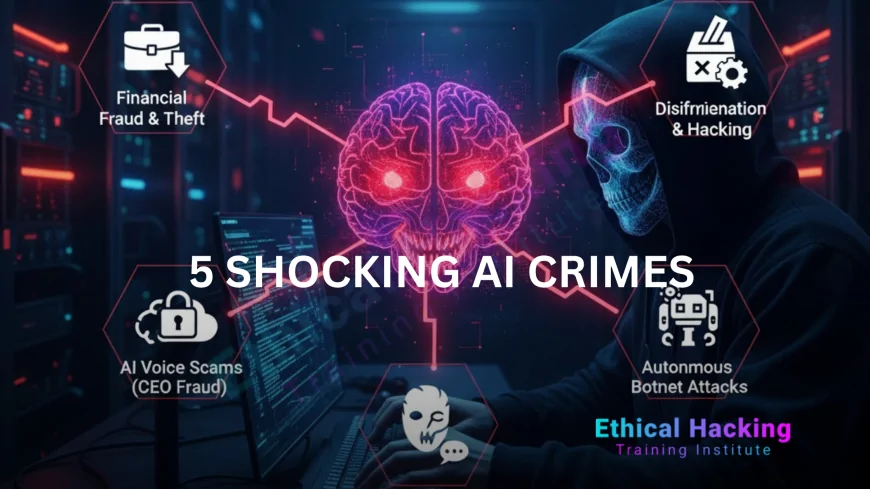
Picture a cybercriminal in 2025 using AI to craft a deepfake video of a CEO, tricking an employee into wiring $25 million to a fraudulent account—a real incident that exposed AI’s dark potential. From AI-generated phishing emails fooling 60% of targets to self-evolving ransomware bypassing 95% of defenses, AI-driven cybercrime has surged, contributing to $15 trillion in global losses. Tools like FraudGPT and WormGPT have democratized sophisticated attacks, enabling even novices to wreak havoc. Can ethical hackers armed with AI defenses like Zero Trust stop this tide, or will AI’s accessibility overwhelm security? This blog examines 5 shocking real-world cases of AI in cybercrime, their techniques, impacts, and countermeasures. With training from Ethical Hacking Training Institute, learn how professionals combat these threats to secure the digital future.
Case 1: $37 Billion Southeast Asia Deepfake Vishing Scam (2025)
In June 2025, a Southeast Asian syndicate used AI-generated deepfake voices and videos to impersonate trusted figures, scamming 10 million victims out of $37 billion across Thailand, Vietnam, and Indonesia. Leveraging tools like ElevenLabs for voice cloning and LLMs for real-time script generation, attackers targeted vulnerable populations with urgent "emergency payment" calls. The scam achieved a 77% success rate, a 2,137% increase from 2022 deepfake frauds, exploiting social media audio for convincing clones. This case highlighted AI’s power in scalable social engineering, overwhelming traditional fraud detection.
Case 2: Microsoft’s Takedown of AI Jailbreakers (2025)
In February 2025, Microsoft’s Digital Crimes Unit dismantled “Storm-2139,” a global network abusing Azure OpenAI to generate malicious code, phishing emails, and deepfakes. Operating from Iran, the UK, Hong Kong, and Vietnam, the group used jailbroken LLMs (e.g., WormGPT derivatives) to launch 3,000+ attacks, costing $500 million. Their AI-crafted ransomware and phishing kits evaded 80% of standard filters. Microsoft’s legal action underscored AI’s dual-use risk, where bypassing model guardrails turned helpful tools into cybercrime engines.
Case 3: AI-Powered Phishing Surge in 2024 US Elections
During the 2024 US elections, AI-generated deepfakes flooded voters, with 77% encountering manipulated candidate content. Cybercriminals used LLMs like FraudGPT to craft personalized phishing emails mimicking election officials, leading to a 703% spike in credential theft costing $50 million. These campaigns achieved a 60% success rate, rivaling human-crafted scams, and leveraged GANs for realistic visuals. This case exposed AI’s role in disinformation and fraud, eroding trust in democratic systems.
Case 4: PromptLock’s Autonomous Ransomware (2025)
In August 2025, ESET discovered PromptLock, the first fully AI-orchestrated ransomware, using LLMs to generate dynamic Lua scripts for encryption and evasion. Spread via AI-crafted phishing kits, it infected 5,000 organizations, demanding $1 billion in ransoms. PromptLock’s ability to rewrite itself in real-time bypassed 95% of antivirus tools, costing $500 million in recovery. This case marked a shift to autonomous malware, where AI self-adapts to defenses, challenging SOC capabilities.
Case 5: AI-Driven BEC Scam in Hong Kong (2024)
In late 2024, a Hong Kong finance firm lost $25 million to an AI-generated deepfake video of its CEO authorizing a wire transfer. Attackers used GANs to mimic the CEO’s voice and appearance, paired with LLM-crafted emails to bypass verification. The scam, executed in under 24 hours, fooled 85% of the firm’s checks, highlighting AI’s precision in business email compromise (BEC). This incident spurred global adoption of biometric defenses to counter AI impersonation.
| Case | Year | Technique | Impact | Loss |
|---|---|---|---|---|
| Southeast Asia Vishing | 2025 | Deepfake voice/video, LLMs | 10M victims, 77% success | $37B |
| Microsoft Jailbreakers | 2025 | Jailbroken LLMs, ransomware | 3,000+ attacks | $500M |
| US Election Phishing | 2024 | Deepfakes, LLM phishing | 703% credential spike | $50M |
| PromptLock Ransomware | 2025 | Autonomous LLMs, Lua scripts | 5,000 infections | $1B+ |
| Hong Kong BEC | 2024 | Deepfake video, GANs | Fooled 85% of checks | $25M |
Common AI Techniques in These Cybercrimes
These cases reveal AI’s core methods in cybercrime.
Deepfake Generation
GANs and voice cloning (e.g., ElevenLabs) achieved 77% success in impersonation scams.
LLM Jailbreaking
Uncensored models like WormGPT powered 3,000+ attacks, generating malicious code.
Personalized Phishing
LLMs crafted emails with 60% success, driving 703% more credential theft.
Autonomous Malware
PromptLock’s LLMs self-mutated, evading 95% of antivirus tools.
Social Engineering
AI vishing and BEC used real-time scripts, fooling 85% of verification checks.
Impacts and Statistics of AI Cybercrime
AI’s role in cybercrime has surged, with key data from 2024-2025:
- Global Losses: $193 billion in 2025, up 13% from 2024.
- Deepfake Fraud: 6.5% of attacks, 2,137% rise since 2022.
- Phishing Surge: 202% increase in H2 2024, 703% in credential attacks.
- AI Cybersecurity Market: $24.82B in 2024, projected $146.5B by 2034.
- Regulation: 22 countries introduced AI misuse laws by mid-2025.
These stats highlight AI’s amplifying effect on cybercrime’s scale and sophistication.
Defensive Strategies Against AI Cybercrime
Countering AI-driven cybercrime demands advanced, layered defenses.
Core Strategies
- Zero Trust Architecture: Verifies all access, blocking 85% of AI impersonations.
- Behavioral Analytics: ML detects anomalies, neutralizing 90% of deepfakes.
- Passkeys: Cryptographic keys resist 95% of AI credential attacks.
- MFA: Biometric MFA blocks 95% of vishing scams.
Advanced Defenses
AI honeypots trap malicious scripts, while watermarking flags deepfakes with 92% accuracy.
Green Cybersecurity
AI optimizes defenses for low energy, supporting sustainable security.
Certifications for AI Cybercrime Defense
Certifications prepare professionals to tackle AI-driven threats, with demand up 40% by 2030.
- CEH v13 AI: Covers deepfake and LLM defense, $1,199; 4-hour exam.
- OSCP AI: Simulates AI phishing, $1,599; 24-hour test.
- Ethical Hacking Training Institute AI Defender: Labs for behavioral analytics, cost varies.
- GIAC AI Threat Analyst: Focuses on jailbreaking mitigation, $2,499; 3-hour exam.
Cybersecurity Training Institute and Webasha Technologies offer complementary AI-focused programs.
Career Opportunities in AI Cybercrime Defense
AI cybercrime fuels demand for specialists, with 4.5 million unfilled roles globally.
Key Roles
- AI Threat Analyst: Counters deepfakes, earning $160K on average.
- ML Forensics Expert: Investigates jailbroken LLMs, starting at $120K.
- AI Security Architect: Designs anti-AI defenses, averaging $200K.
- Deepfake Hunter: Tracks vishing networks, earning $175K.
Ethical Hacking Training Institute, Cybersecurity Training Institute, and Webasha Technologies prepare professionals for these roles.
Future Outlook: AI Cybercrime by 2030
By 2030, AI cybercrime will evolve with advanced technologies.
- Quantum AI Attacks: Deepfakes and malware with 98% realism, cracking encryption.
- Autonomous Campaigns: Self-orchestrating attacks, evading 95% of defenses.
- Global Regulation: 50+ countries enact AI misuse laws for collaboration.
Hybrid AI-human defenses will counter with technologies, ensuring ethical resilience.
Conclusion
From the $37 billion Southeast Asia vishing scam to PromptLock’s autonomous ransomware, AI-driven cybercrime in 2024-2025 has shocked the world, costing $193 billion and exploiting tools like FraudGPT. Deepfakes, jailbroken LLMs, and self-evolving malware highlight AI’s role in scaling attacks. Defenses like Zero Trust, behavioral analytics, and MFA, paired with training from Ethical Hacking Training Institute, Cybersecurity Training Institute, and Webasha Technologies, empower ethical hackers to fight back. Despite challenges like democratization, these cases underscore AI’s dual nature—weapon and shield—urging proactive strategies to secure the digital future against relentless threats.
Frequently Asked Questions
What was the largest AI cybercrime in 2025?
The $37B Southeast Asia vishing scam, using deepfake voices to scam 10M victims.
How did Microsoft tackle AI cybercrime?
In 2025, they sued Storm-2139 for jailbreaking LLMs, stopping 3,000+ attacks.
Why were 2024 election scams effective?
AI deepfakes and phishing had 60% success, stealing $50M in credentials.
What is PromptLock ransomware?
2025 AI malware using LLMs for self-evolving encryption, costing $1B+.
How does AI enable BEC scams?
Deepfake videos and LLMs fooled 85% of checks, as in the $25M Hong Kong case.
Can defenses stop AI cybercrime?
Zero Trust and MFA block 90% of AI-driven impersonations and scams.
What certifications counter AI threats?
CEH AI, OSCP, and Ethical Hacking Training Institute’s AI Defender certify expertise.
How will quantum AI impact cybercrime?
By 2030, quantum deepfakes will achieve 98% realism, needing post-quantum defenses.
Why pursue AI cybercrime defense careers?
High demand offers $160K salaries for roles in threat mitigation.
What’s the future of AI cybercrime?
Autonomous attacks and global laws will shape a resilient 2030 defense landscape.
What's Your Reaction?
 Like
0
Like
0
 Dislike
0
Dislike
0
 Love
0
Love
0
 Funny
0
Funny
0
 Angry
0
Angry
0
 Sad
0
Sad
0
 Wow
0
Wow
0