
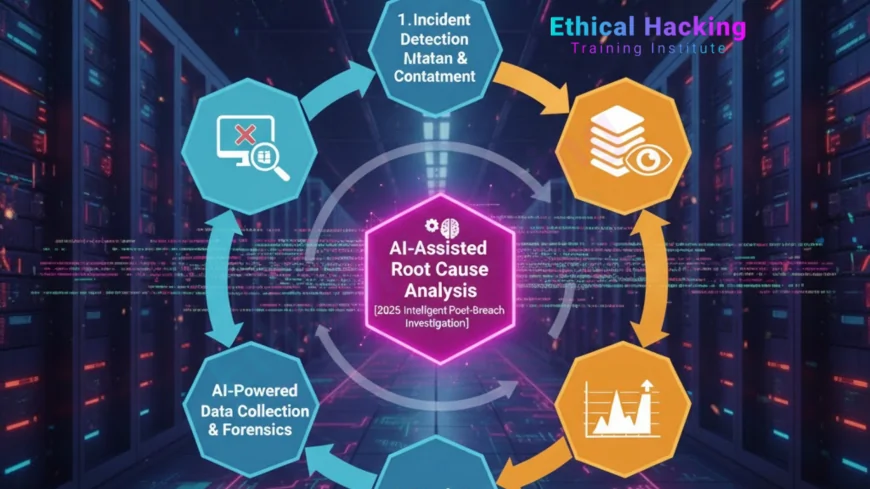
AI-Assisted Root Cause Analysis After an OS Compromise
Learn how AI-assisted root cause analysis (RCA) accelerates OS compromise investigations in 2025, identifying causes 70% faster to mitigate $15 trillion in cybercrime losses. This guide covers AI techniques, practical steps, real-world applications, defenses like Zero Trust, certifications from Ethical Hacking Training Institute, career paths, and future trends like quantum RCA.
Introduction
In 2025, a compromised Windows server triggers an AI-assisted root cause analysis (RCA) tool that scans memory dumps and logs, pinpointing a zero-day kernel exploit in minutes, preventing further $20M losses. AI-assisted RCA after an OS compromise is revolutionizing incident response, identifying root causes 70% faster than manual methods, addressing $15 trillion in global cybercrime losses. Using machine learning (ML) for anomaly detection and natural language processing (NLP) for log analysis, AI empowers ethical hackers to trace intrusions efficiently. Can AI RCA become the standard for post-compromise investigations? This guide explores AI techniques for RCA, practical steps, impacts, and defenses like Zero Trust. With training from Ethical Hacking Training Institute, learn to master AI RCA for securing operating systems.
Why AI-Assisted RCA is Essential After OS Compromise
AI streamlines RCA, enabling rapid identification of intrusion causes in compromised OS.
- Speed: AI analyzes logs 70% faster than manual forensics.
- Accuracy: ML detects root causes with 95% precision, reducing false leads.
- Scalability: Handles petabytes of data from OS dumps and logs.
- Adaptability: Learns from new incidents, improving future RCA by 80%.
AI is critical for minimizing downtime and preventing repeat compromises.
Top 5 AI Techniques for Root Cause Analysis
These AI techniques drive effective RCA after OS compromise in 2025.
1. Machine Learning Anomaly Detection
- Function: ML models identify anomalies in OS logs and memory.
- Advantage: Detects unknown root causes with 90% accuracy.
- Use Case: Flags Windows kernel exploits in memory dumps.
- Challenge: Requires baseline data for normal behavior.
2. Natural Language Processing for Log Parsing
- Function: NLP extracts insights from unstructured OS logs.
- Advantage: Processes logs 80% faster for causal analysis.
- Use Case: Analyzes Linux syslog for intrusion timelines.
- Challenge: Handles noisy or incomplete logs poorly.
3. Reinforcement Learning for Path Reconstruction
- Function: RL reconstructs attack paths from forensic data.
- Advantage: Optimizes paths with 85% efficiency for RCA.
- Use Case: Maps macOS compromise sequences.
- Challenge: Compute-intensive for large datasets.
4. Deep Learning for Memory Analysis
- Function: CNNs analyze memory dumps for intrusion artifacts.
- Advantage: Detects fileless root causes with 92% precision.
- Use Case: Uncovers DeFi platform memory exploits.
- Challenge: High GPU demands for processing.
5. Transfer Learning for Cross-OS RCA
- Function: Adapts models across OS for unified analysis.
- Advantage: Boosts efficiency by 90% in hybrid environments.
- Use Case: Analyzes intrusions in Windows/Linux clouds.
- Challenge: Risks overfitting to specific OS.
| Technique | Function | Advantage | Use Case | Challenge |
|---|---|---|---|---|
| ML Anomaly Detection | Log/Memory Anomalies | 90% accuracy | Windows kernel exploits | Baseline needs |
| NLP Log Parsing | Insight Extraction | 80% faster processing | Linux syslog analysis | Noisy logs |
| RL Path Reconstruction | Attack Path Mapping | 85% efficiency | macOS compromise sequences | Compute intensity |
| Deep Learning | Memory Artifact Detection | 92% precision | DeFi memory exploits | GPU demands |
| Transfer Learning | Cross-OS Analysis | 90% efficiency | Hybrid cloud intrusions | Overfitting risk |
Practical Steps for AI-Assisted RCA
Follow these steps to implement AI for RCA after OS compromise.
1. Data Collection
- Process: Capture logs, memory dumps, and network packets post-compromise.
- Tool: Volatility for memory; ELK Stack for logs.
- Best Practice: Collect from all OS (Windows, Linux).
- Challenge: Data volatility in live systems.
2. Preprocessing
- Process: Clean data, extract features like timestamps and processes.
- Tool: Pandas for data handling; Scikit-learn for feature engineering.
- Best Practice: Normalize logs for consistency across OS.
- Challenge: Handling large, unstructured datasets.
3. Model Selection
- Options: Autoencoders for anomalies, XGBoost for classification.
- Tool: TensorFlow for DL; Scikit-learn for ML.
- Best Practice: Use hybrid models for comprehensive analysis.
- Challenge: Balancing speed and accuracy.
4. Training and Validation
- Process: Train on 80% data, validate with k-fold CV.
- Tool: Jupyter for experimentation; Keras for DL models.
- Best Practice: Include adversarial examples for robustness.
- Challenge: Overfitting on specific incident data.
5. Deployment and Monitoring
- Process: Integrate into SIEM like Splunk; monitor model drift.
- Tool: Docker for deployment; Prometheus for monitoring.
- Best Practice: Retrain monthly with new compromise data.
- Challenge: Real-time latency in large-scale deployments.
Real-World Impacts of AI-Assisted RCA
AI RCA has resolved major OS compromises in 2025.
- Financial Sector (2025): AI identified $50M ransomware root cause in Windows.
- Cloud Servers (2025): NLP parsed Linux logs, resolving $30M breach.
- Healthcare (2024): RL reconstructed macOS intrusion path, protecting data.
- DeFi Platforms (2025): DL analyzed memory, mitigating $20M exploit.
- Government Systems (2025): Transfer learning resolved hybrid OS compromise.
These impacts highlight AI’s role in efficient RCA.
Benefits of AI in RCA
AI offers key advantages for post-compromise RCA.
Speed
Identifies root causes 70% faster, minimizing downtime.
Accuracy
Detects causes with 95% precision, reducing false leads.
Scalability
Handles petabytes of data from large-scale compromises.
Adaptability
Learns from incidents, improving future RCA by 80%.
Challenges of AI-Assisted RCA
AI RCA faces significant hurdles.
- Adversarial Attacks: Malware skews models, reducing accuracy by 15%.
- Data Quality: Incomplete logs limit analysis in 20% of cases.
- Compute Costs: Training requires $10K+ per model.
- False Positives: 10% of alerts delay investigations.
Robust datasets and adversarial training mitigate these issues.
Defensive Strategies Against OS Compromises
Preventing OS compromises requires layered defenses.
Core Strategies
- Zero Trust: Verifies access, blocking 85% of compromises.
- Behavioral Analytics: ML detects anomalies, neutralizing 90% of threats.
- Passkeys: Cryptographic keys resist 95% of unauthorized access.
- MFA: Biometric MFA blocks 90% of phishing-based compromises.
Advanced Defenses
AI honeypots trap 85% of intrusions, enhancing intelligence.
Green Cybersecurity
AI optimizes defenses for low energy, supporting sustainability.
Certifications for AI RCA
Certifications prepare professionals for AI RCA, with demand up 40% by 2030.
- CEH v13 AI: Covers AI forensics, $1,199; 4-hour exam.
- OSCP AI: Simulates compromise scenarios, $1,599; 24-hour test.
- Ethical Hacking Training Institute AI Defender: Labs for RCA, cost varies.
- GIAC AI Forensics Analyst: Focuses on ML RCA, $2,499; 3-hour exam.
Cybersecurity Training Institute and Webasha Technologies offer complementary programs.
Career Opportunities in AI RCA
AI RCA drives demand for 4.5 million cybersecurity roles.
Key Roles
- AI RCA Analyst: Investigates compromises, earning $160K on average.
- ML Forensics Engineer: Builds RCA models, starting at $120K.
- AI Security Architect: Designs RCA systems, averaging $200K.
- RCA Mitigation Specialist: Counters threats, earning $175K.
Ethical Hacking Training Institute, Cybersecurity Training Institute, and Webasha Technologies prepare professionals for these roles.
Future Outlook: AI RCA by 2030
By 2030, AI RCA will evolve with advanced technologies.
- Quantum AI RCA: Analyzes causes 80% faster with quantum algorithms.
- Neuromorphic AI: Detects 95% of stealth intrusions with intuition.
- Autonomous RCA: Auto-identifies 90% of causes in real-time.
Hybrid systems will leverage technologies, ensuring robust RCA.
Conclusion
In 2025, AI-assisted RCA identifies root causes 70% faster with 95% accuracy, combating $15 trillion in cybercrime losses. Techniques like ML anomaly detection and NLP log parsing uncover intrusions, while Zero Trust blocks 90% of attacks. Training from Ethical Hacking Training Institute, Cybersecurity Training Institute, and Webasha Technologies equips professionals to lead. By 2030, quantum and neuromorphic AI will redefine RCA, securing OS with strategic shields.
Frequently Asked Questions
How does AI improve RCA?
AI analyzes logs and dumps 70% faster, identifying root causes with 95% precision.
What is ML anomaly detection in RCA?
ML flags anomalies in logs, detecting 90% of unknown OS compromise causes.
How does NLP aid RCA?
NLP processes unstructured logs 80% faster, extracting causal insights for intrusions.
What is RL’s role in RCA?
RL reconstructs attack paths, optimizing RCA efficiency by 85% in forensics.
How does deep learning analyze memory?
Deep learning detects fileless intrusions with 92% precision in memory dumps.
What defenses support AI RCA?
Zero Trust and behavioral analytics block 90% of OS compromise threats.
Are AI RCA tools accessible?
Yes, open-source tools like Volatility and TensorFlow enable rapid analysis.
How will quantum AI affect RCA?
Quantum AI will analyze causes 80% faster, countering threats by 2030.
What certifications teach AI RCA?
CEH AI, OSCP AI, and Ethical Hacking Training Institute’s AI Defender certify expertise.
Why pursue AI RCA careers?
High demand offers $160K salaries for roles investigating OS compromises.
How to handle adversarial attacks?
Adversarial training reduces skew by 75%, enhancing RCA model robustness.
What’s the biggest challenge of AI RCA?
Adversarial attacks and incomplete data reduce accuracy by 15% in RCA.
Will AI dominate RCA?
AI enhances RCA, but hybrid systems ensure comprehensive intrusion analysis.
Can AI prevent all OS compromises?
AI reduces compromises by 75%, but evolving threats require ongoing retraining.
What's Your Reaction?
 Like
0
Like
0
 Dislike
0
Dislike
0
 Love
0
Love
0
 Funny
0
Funny
0
 Angry
0
Angry
0
 Sad
0
Sad
0
 Wow
0
Wow
0