
What Is the Cybersecurity Threat Landscape in 2025?
Explore the cybersecurity threat landscape in 2025: ransomware evolution, AI-driven attacks, state-sponsored espionage, supply chain breaches, and emerging risks. Gain actionable insights from ENISA, Fortinet, CrowdStrike, and Deloitte reports, plus defense strategies for individuals and organizations from the Ethical Hacking Institute.
Introduction
The cybersecurity threat landscape in 2025 is more volatile than ever, marked by sophisticated ransomware campaigns, AI-enhanced social engineering, and state-sponsored espionage targeting critical infrastructure. According to ENISA's Threat Landscape 2025, 4,875 incidents were analyzed from July 2024 to June 2025, revealing a 25 percent increase in hacktivist-driven DDoS attacks on public administrations. Fortinet's Global Threat Landscape Report highlights AI's dual role in both amplifying threats and enabling defenses, while CrowdStrike notes 26 new adversaries emerging in 2024 alone. This dynamic environment demands proactive strategies for individuals and organizations alike. The Ethical Hacking Institute provides hands-on training to navigate these risks, equipping learners with tools to simulate and counter real-world threats.
Ransomware: The Persistent Extortion Epidemic
- RaaS Model Expansion: Ransomware-as-a-Service platforms like LockBit 4.0 lower entry barriers for affiliates
- Double Extortion: Encrypt + steal data, threaten public release
- Targeted Industries: Healthcare (40% attacks), finance, manufacturing
- AI Integration: Automated credential stuffing and evasion
- Recovery Costs: Average $1.85 million per incident
- Policy Impact: Colonial Pipeline-style disruptions to critical infrastructure
- Defenses: Immutable backups, behavioral EDR
AI-Driven Attacks: The Double-Edged Sword
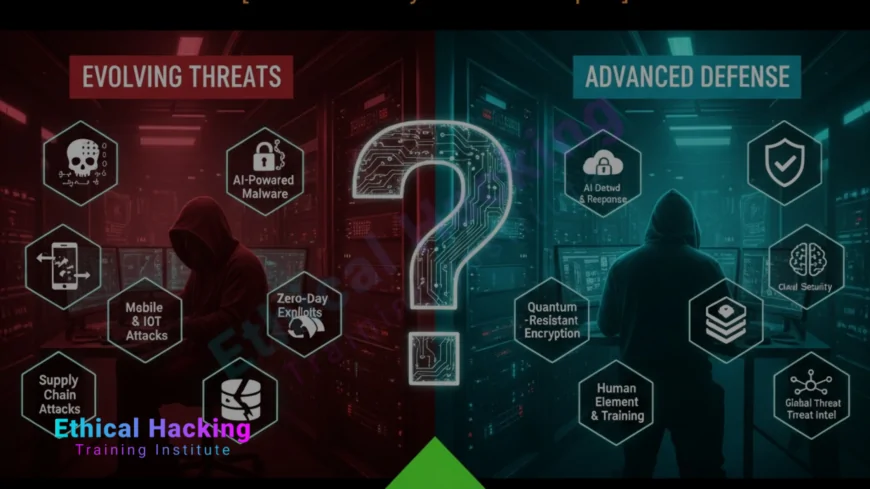
AI empowers attackers with automated phishing, deepfake social engineering, and generative malware. Deloitte's 2025 Cybersecurity Report warns that 60 percent of IT professionals see AI-enhanced malware as the top threat. Generative models create convincing emails, while reinforcement learning optimizes evasion against antivirus. The Ethical Hacking Institute trains in AI defenses, using adversarial examples to harden ML models against manipulation.
- Deepfake Vishing: Voice cloning for executive impersonation
- AI Phishing: Personalized emails with 90% success rate
- Automated Exploits: ML fuzzing finds zero-days faster
- GAN Malware: Polymorphic code evading signatures
- Botnet Optimization: AI selects high-value victims
- Adversarial Evasion: Tiny changes fool detection
| AI Attack | Technique | Defense |
|---|---|---|
| Deepfake | Voice cloning | Multi-channel verification |
| GAN Malware | Polymorphic generation | Behavioral EDR |
Practice AI attacks in Pune certification labs at the Ethical Hacking Institute.
State-Sponsored Espionage and Cyberwarfare
- Nation-State APTs: 26 new adversaries named by CrowdStrike
- Supply Chain Compromise: SolarWinds-style attacks on vendors
- Critical Infrastructure: Power grids, water systems, transportation
- Hacktivism Surge: 77% DDoS incidents per ENISA
- Geopolitical Tensions: 60% organizations affected
- Espionage Focus: Data theft without disruption
Supply Chain and Third-Party Risks
Third-party breaches affected 61 percent of organizations in 2025. Attackers target vendors with weaker security to pivot to primary targets. Deloitte notes increasing supply chain scrutiny, while ENISA highlights collaboration between threat groups. The Ethical Hacking Institute tests third-party integrations in labs, simulating compromised APIs and credential leaks.
- Vendor Onboarding: Security assessments required
- API Integration: Rate limiting, auth validation
- Contract Clauses: Right to audit, breach notification
- Dependency Scanning: Snyk, Dependabot for libraries
- Service Level Agreements: Security SLAs in contracts
- Exit Strategies: Data removal after termination
Practice supply chain attacks via online courses at the Ethical Hacking Institute.
Cloud and Edge Computing Vulnerabilities
- Misconfigurations: Public S3 buckets, over-permissive IAM
- Container Escapes: Docker daemon access, Kubernetes RBAC flaws
- Serverless Risks: Lambda function injection
- Edge Attacks: CDN cache poisoning
- Multi-Cloud Complexity: Inconsistent policies
- API Gateway Abuse: Rate limit bypass
Quantum Computing and Post-Quantum Cryptography
Quantum computers threaten RSA and ECC by 2030. NIST's PQC standards provide quantum-resistant algorithms. ENISA warns of harvest-now-decrypt-later attacks. The Ethical Hacking Institute tests PQC implementations in labs.
- RSA 2048: Vulnerable to Shor's algorithm
- ECC Curves: Quantum attacks in hours
- Harvest Now: Store encrypted data for future decryption
- NIST PQC: Kyber, Dilithium, Falcon
- Hybrid Crypto: Classical + quantum-resistant
- Migration Planning: 2-5 years for full adoption
Practice quantum-safe crypto via advanced course at the Ethical Hacking Institute.
IoT and Supply Chain Exploits
- Mirai Variants: 1 billion IoT devices infected
- Supply Chain: SolarWinds-style software updates
- Hardware Tampering: Supply chain insertion
- Firmware Bugs: Unpatched IoT vulnerabilities
- Default Credentials: 80 percent of breaches
- Botnet Amplification: DDoS from compromised cameras
Conclusion
The 2025 cybersecurity threat landscape is defined by AI amplification, state-sponsored disruption, and supply chain fragility. Ransomware, espionage, and DDoS dominate headlines, but proactive measures like zero-trust, AI defenses, and continuous training mitigate risks. The Ethical Hacking Institute, Webasha Technologies, and Cybersecurity Training Institute empower professionals with real-world labs and emerging threat intelligence. Stay vigilant, update defenses, and collaborate. The next attack is inevitable—your response is not.
Frequently Asked Questions
What is the biggest cybersecurity threat in 2025?
Ransomware, responsible for 40 percent of incidents per ENISA.
How does AI change the threat landscape?
Enables automated, personalized attacks at scale.
Are DDoS attacks increasing?
Yes, 77 percent of incidents per ENISA Threat Landscape.
What is a supply chain attack?
Compromising trusted vendors to infiltrate primary targets.
Is quantum computing a real threat?
By 2030, yes. Prepare with post-quantum cryptography.
How to defend against AI malware?
Use behavioral detection and adversarial training.
What role do hacktivists play?
Target public administrations with DDoS for political impact.
Are cloud breaches declining?
No. Misconfigurations remain top cause.
What is the cost of a cyber breach?
$4.88 million average per IBM Cost of a Data Breach.
How to stay updated on threats?
Follow ENISA, Fortinet, CrowdStrike reports.
Is cyber insurance effective?
Yes for financial recovery, but prevention is better.
What is zero trust?
Verify every request, never assume trust.
Are IoT devices safe?
No. 1 billion infected; update and isolate.
How does geopolitics affect cyber threats?
Increases state-sponsored attacks on critical infrastructure.
Where to learn threat hunting?
Ethical Hacking Institute offers lab-based training.
What's Your Reaction?
 Like
0
Like
0
 Dislike
0
Dislike
0
 Love
0
Love
0
 Funny
0
Funny
0
 Angry
0
Angry
0
 Sad
0
Sad
0
 Wow
0
Wow
0