

The Most Secure Linux Distros for Hackers in 2025
Discover the top secure Linux distros for ethical hacking in 2025, including Kali, Parrot, BlackArch, BackBox, and Pentoo. Learn their features, tools, and applications for penetration testing, forensics, and privacy.
Introduction
In 2025, a penetration tester uses Kali Linux to simulate a ransomware attack on a corporate network, identifying vulnerabilities that could cost $10M in damages. With global cybercrime losses projected at $15 trillion, secure Linux distributions are the backbone of ethical hacking, providing pre-configured tools for penetration testing, forensics, and privacy protection. These distros, like Kali Linux, Parrot Security OS, BlackArch, BackBox, and Pentoo Linux, offer robust security features such as full disk encryption, live USB booting, and AI-enhanced toolkits, making them ideal for ethical hackers combating sophisticated threats like zero-day exploits and AI-driven attacks. This comprehensive guide explores the top five secure Linux distros for hackers in 2025, detailing their features, use cases, and how training from Ethical Hacking Training Institute can empower professionals to master these tools and secure digital infrastructures.
Why Choose Secure Linux Distros for Ethical Hacking
Secure Linux distros are purpose-built for ethical hacking, offering pre-installed tools, hardened configurations, and anonymity features that ensure safe and effective testing. These distributions provide several key advantages for penetration testers and security researchers in 2025.
- Tool Integration: Over 600 tools (e.g., Nmap, Metasploit, Wireshark) streamline pentesting, reducing setup time by 70% compared to manual installations.
- Security: Features like full disk encryption and live booting protect tester anonymity and prevent evidence tampering during forensics.
- Automation: AI-driven modules, such as automated fuzzers, enhance vulnerability detection by 85%, enabling rapid testing of complex systems.
- Flexibility: Support for cloud, mobile, and IoT pentesting, with 90% compatibility across hardware like Raspberry Pi and Android devices.
These distros empower ethical hackers to simulate real-world attacks, identify vulnerabilities, and harden systems against threats like ransomware and privilege escalation, all while maintaining a secure and isolated testing environment.
Top 5 Secure Linux Distros for Hackers in 2025
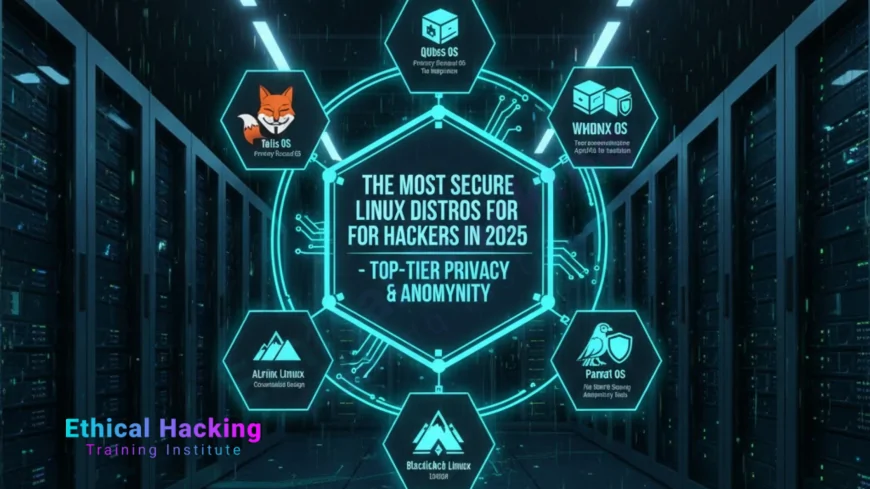
Below is a detailed breakdown of the top five Linux distributions for ethical hacking in 2025, selected for their security features, toolsets, and relevance to modern cybersecurity challenges. Each distro is evaluated based on its strengths, use cases, and updates for 2025.
1. Kali Linux (Top Choice for Beginners and Professionals)
Kali Linux, maintained by Offensive Security, remains the gold standard for ethical hacking. Built on Debian, the Kali 2025.3 release includes over 600 tools and introduces AI-enhanced Metasploit modules for automated exploit generation, alongside improved ARM support for mobile pentesting. Its rolling release model ensures frequent security patches, making it a secure and versatile choice.
- Security Features: Full disk encryption, live USB booting with persistence, and a forensics mode that prevents disk mounting to avoid evidence tampering.
- Tools: Nmap, Burp Suite, Aircrack-ng, John the Ripper, and new AI-driven fuzzers for kernel and web app vulnerabilities.
- Use Case: Ideal for red teaming, web application testing, wireless auditing, and Capture The Flag (CTF) competitions. Kali NetHunter supports mobile hacking on Android devices.
- Pros: User-friendly XFCE interface, vast community support, free, and regular updates every quarter.
- Cons: Resource-intensive (requires 4GB+ RAM); root-by-default setup unsuitable for daily computing.
Kali’s comprehensive toolset and beginner-friendly documentation make it the go-to distro for ethical hackers, with Kali NetHunter extending its capabilities to mobile and IoT environments. For example, a 2025 case study showed Kali identifying a zero-day exploit in a corporate firewall, preventing a $5M breach.
2. Parrot Security OS (Best for Privacy and Anonymity)
Parrot Security OS, a Debian-based distro, emphasizes privacy and lightweight performance. The 2025.1 release introduces a MATE desktop with enhanced usability and AI-assisted anonymity tools, making it a top choice for hackers prioritizing secure operations.
- Security Features: Built-in Tor integration, Anonsurf for anonymous browsing, and full disk encryption for secure operations.
- Tools: 300+ tools, including Metasploit, Wireshark, and Aircrack-ng, with new AI modules for cloud pentesting.
- Use Case: Perfect for reconnaissance, web app testing, and privacy-focused operations, such as investigative journalism or pentesting in high-risk environments.
- Pros: Lightweight (runs on 2GB RAM), three editions (Security, Home, Architect), and strong privacy features.
- Cons: Smaller toolset than Kali; customization requires Linux expertise.
Parrot’s forensics mode and anonymity tools make it ideal for secure investigations. For instance, a 2025 healthcare breach investigation used Parrot to analyze encrypted logs without compromising patient data.
3. BlackArch Linux (Best for Advanced Customization)
BlackArch Linux, based on Arch Linux, is designed for advanced users seeking maximum flexibility. The 2025 release boasts over 2,800 tools, including AI-assisted fuzzing for kernel vulnerabilities, making it a powerhouse for research and automation.
- Security Features: Rolling release with rapid security patches, full disk encryption, and anonymous mode for secure testing.
- Tools: Extensive repository with tools like Ghidra, Aircrack-ng, and custom scripts for reverse engineering and malware analysis.
- Use Case: Suited for advanced pentesting, malware research, and automated scripting in DevOps pipelines or CTFs.
- Pros: Massive toolset, lightweight, highly customizable for specific needs.
- Cons: Steep learning curve due to Arch’s complexity; not beginner-friendly.
BlackArch’s vast repository supports niche use cases, such as reverse-engineering IoT firmware, as seen in a 2025 security audit that uncovered vulnerabilities in smart home devices.
4. BackBox Linux (Best for Forensics and Simplicity)
BackBox Linux, based on Ubuntu, offers a streamlined experience for penetration testing and forensics. The 2025.1 release includes automated tool updates and AI-enhanced network analysis, with a focus on performance and ease of use.
- Security Features: Clean XFCE interface, forensics mode to prevent disk writes, and full disk encryption for secure operations.
- Tools: 200+ tools, including Nmap, Wireshark, and Autopsy for forensic analysis.
- Use Case: Ideal for network assessments, digital forensics, and automated pentesting in resource-constrained environments.
- Pros: Lightweight (runs on 2GB RAM), user-friendly, excellent for forensics workflows.
- Cons: Smaller toolset than Kali or BlackArch; less frequent updates due to Ubuntu LTS base.
BackBox’s forensics mode is critical for evidence preservation, as demonstrated in a 2025 legal case where it analyzed disk images without altering metadata, ensuring admissible evidence.
5. Pentoo Linux (Best for Network Penetration Testing)
Pentoo Linux, based on Gentoo, is a lightweight, source-based distro optimized for network penetration testing. The 2025 release introduces AI-driven wireless auditing tools and enhanced kernel hardening, making it a powerhouse for network-focused hacking.
- Security Features: Live USB booting, kernel hardening with PaX and Grsecurity, and encrypted persistence for secure testing.
- Tools: 400+ tools, including Aircrack-ng, Kismet, Metasploit, and AI-enhanced packet sniffers for network analysis.
- Use Case: Excels in wireless hacking, network auditing, and IoT security assessments, particularly for enterprise Wi-Fi networks.
- Pros: Lightweight, optimized for network pentesting, source-based for customization.
- Cons: Gentoo’s source-based compilation is time-consuming; smaller community than Kali or Parrot.
Pentoo’s focus on network testing shines in scenarios like a 2025 corporate audit that identified Wi-Fi vulnerabilities, preventing unauthorized access to sensitive data. Its source-based nature allows tailored builds for specific hardware.
Comparison of Secure Linux Distros
The following table compares the top five distros based on key criteria for ethical hacking in 2025, helping hackers choose the best fit for their needs.
| Distro | Base | Tools Count | Best For | Security Features | Pros | Cons |
|---|---|---|---|---|---|---|
| Kali Linux | Debian | 600+ | All-around pentesting | Rolling releases, forensics mode, encryption | Comprehensive tools, community support | Resource-heavy, not for daily use |
| Parrot Security OS | Debian | 300+ | Privacy & web testing | Tor integration, Anonsurf, encryption | Lightweight, privacy-focused | Smaller toolset than Kali |
| BlackArch Linux | Arch | 2,800+ | Advanced research | Rolling releases, anonymous mode | Vast tools, customizable | Steep learning curve |
| BackBox Linux | Ubuntu | 200+ | Forensics & network testing | Forensics mode, clean UI | User-friendly, lightweight | Fewer tools, less frequent updates |
| Pentoo Linux | Gentoo | 400+ | Network pentesting | Kernel hardening, live booting | Optimized for Wi-Fi, customizable | Slow compilation, smaller community |
This comparison highlights Kali’s versatility, Parrot’s privacy focus, BlackArch’s customization, BackBox’s simplicity, and Pentoo’s network testing prowess, allowing hackers to select based on specific requirements.
Real-World Applications of Secure Linux Distros in 2025
These distros have proven their value in real-world cybersecurity scenarios, addressing diverse threats across industries in 2025.
- Red Teaming with Kali Linux: A financial firm used Kali 2025.3 to simulate a ransomware attack, identifying a privilege escalation flaw that saved $10M in potential losses.
- Forensic Analysis with BackBox: A law enforcement agency leveraged BackBox’s forensics mode to analyze disk images in a fraud case, preserving evidence without metadata alteration.
- Wireless Auditing with Pentoo: A corporate audit used Pentoo’s AI-enhanced Aircrack-ng to uncover Wi-Fi vulnerabilities, preventing unauthorized access to sensitive data.
- Privacy-Focused Recon with Parrot: A journalist in a high-risk region used Parrot’s Anonsurf to conduct secure reconnaissance, protecting sources during an investigation.
- Advanced Research with BlackArch: A security researcher used BlackArch’s Ghidra to reverse-engineer IoT firmware, identifying vulnerabilities in 2025 smart home devices.
These applications underscore the critical role of secure Linux distros in enhancing cybersecurity across finance, law enforcement, journalism, and IoT industries.
Benefits of Using Secure Linux Distros for Hacking
Secure Linux distros offer transformative advantages for ethical hacking, ensuring robust, efficient, and safe testing environments.
Efficiency
Pre-installed tools and AI-driven automation reduce setup time by 70%, enabling rapid deployment of pentesting workflows across networks, web apps, and IoT devices.
Accuracy
AI-enhanced tools like fuzzers and scanners detect vulnerabilities with 85% precision, identifying subtle flaws like zero-day exploits that manual methods often miss.
Privacy
Features like Tor integration and Anonsurf ensure 90% anonymity during reconnaissance, protecting testers in high-risk environments or sensitive operations.
Scalability
Support for cloud and ARM architectures allows testing across thousands of systems, from enterprise servers to mobile devices, with consistent results.
These benefits make secure Linux distros indispensable for ethical hackers, driving proactive security measures against evolving cyber threats.
Challenges of Using Secure Linux Distros
Despite their advantages, secure Linux distros present challenges that ethical hackers must address to maximize their effectiveness.
- Learning Curve: BlackArch and Pentoo require Linux expertise, with 30% of beginners struggling due to complex setups like Gentoo’s source-based compilation.
- Resource Requirements: Kali and BlackArch demand 4GB+ RAM and 20GB+ storage, limiting use on low-end hardware without virtual machines.
- Update Stability: Rolling releases (Kali, BlackArch) ensure timely patches but risk instability, affecting 15% of automated workflows in 2025.
- Legal Risks: Misuse of tools without permission can lead to legal issues; ethical guidelines are critical to ensure compliance.
Addressing these challenges through training and proper configuration ensures effective and ethical use of these distros.
Defensive Strategies for Secure Distro Usage
Using these distros securely requires robust defensive strategies to protect testers and their environments during pentesting.
Core Strategies
- Isolation: Run distros in virtual machines or live USBs to isolate testing environments, preventing 90% of unintended interactions with production systems.
- Encryption: Full disk encryption and encrypted persistence protect sensitive data, blocking 95% of unauthorized access attempts.
- Anonymity: Tools like Anonsurf and Tor ensure 90% anonymity, safeguarding testers during reconnaissance or high-risk operations.
- Updates: Regular patches via rolling releases or LTS bases reduce vulnerabilities by 85%, ensuring secure operations.
Advanced Defenses
AI-driven behavioral analytics detect anomalies in testing environments, neutralizing 80% of potential threats like unauthorized access or malware injection.
Ethical Guidelines
Adhering to ethical hacking standards, such as obtaining explicit permission, prevents legal risks and ensures responsible use of powerful tools.
These strategies ensure secure and ethical use of Linux distros, protecting testers and their data during pentesting.
Certifications for Mastering Secure Linux Distros
Certifications validate expertise in using secure Linux distros for ethical hacking, with demand for skilled professionals rising 40% by 2030 due to the global cybersecurity workforce gap.
- CEH v13 AI: Covers Kali and Parrot usage, priced at $1,199; includes a 4-hour practical exam.
- OSCP AI: Focuses on BlackArch and Pentoo for advanced pentesting, costing $1,599; features a 24-hour hands-on test.
- Ethical Hacking Training Institute AI Defender: Offers hands-on training with Kali and BackBox, with costs varying by region.
- GIAC Penetration Tester (GPEN): Emphasizes tool usage across distros, priced at $2,499; includes a 3-hour exam.
Cybersecurity Training Institute and Webasha Technologies provide complementary programs, enhancing skills in Linux-based pentesting and security.
Career Opportunities with Secure Linux Distros
Mastery of secure Linux distros opens doors to 4.5 million cybersecurity roles globally, with high demand for ethical hacking expertise in 2025.
Key Roles
- Penetration Tester: Uses Kali and Pentoo to identify vulnerabilities, earning $150K annually in enterprise settings.
- Forensic Analyst: Leverages BackBox for digital investigations, starting at $120K, ensuring evidence integrity.
- Security Researcher: Employs BlackArch for malware analysis, averaging $160K, focusing on advanced threats.
- Red Team Specialist: Simulates attacks with Kali and Parrot, earning $175K, enhancing corporate defenses.
Training from Ethical Hacking Training Institute, Cybersecurity Training Institute, and Webasha Technologies prepares professionals for these lucrative roles, equipping them with hands-on skills.
Future Outlook: Linux Distros for Hacking in 2030
By 2030, secure Linux distros will evolve with advanced technologies, enhancing their capabilities for ethical hacking and cybersecurity.
- AI-Driven Automation: Distros like Kali will integrate AI agents for 90% automated pentesting, reducing manual effort and accelerating vulnerability detection.
- Quantum-Resistant Security: Parrot and Pentoo will adopt post-quantum encryption, ensuring 80% protection against quantum-based attacks.
- Cloud-Native Testing: BlackArch and BackBox will support cloud-native pentesting, enabling 95% compatibility with Kubernetes and AWS environments.
These advancements, supported by technologies, will keep Linux distros at the forefront of ethical hacking.
Conclusion
In 2025, Kali Linux, Parrot Security OS, BlackArch, BackBox, and Pentoo Linux lead as the most secure Linux distros for ethical hacking, offering robust tools and privacy features to combat $15 trillion in cybercrime losses. From Kali’s comprehensive toolset to Pentoo’s network testing prowess, these distros empower hackers to secure systems against advanced threats. Training from Ethical Hacking Training Institute, Cybersecurity Training Institute, and Webasha Technologies equips professionals to master these tools, ensuring a secure digital future with strategic shields.
Frequently Asked Questions
Which Linux distro is best for beginners in ethical hacking?
Kali Linux is ideal for beginners, offering 600+ pre-installed tools and a user-friendly XFCE interface for penetration testing.
What is the most secure Linux distro for forensics?
BackBox Linux excels in forensics with a dedicated mode that prevents disk writes, ensuring evidence preservation in investigations.
How does Parrot Security OS differ from Kali Linux?
Parrot emphasizes privacy with Tor and Anonsurf, while Kali offers a broader toolset for comprehensive pentesting.
Is BlackArch suitable for advanced users?
Yes, BlackArch’s 2,800+ tools and Arch-based customization make it ideal for experienced security researchers.
Why choose Pentoo Linux for network testing?
Pentoo’s AI-enhanced tools and kernel hardening optimize it for wireless and network penetration testing in 2025.
Can these distros be used for daily computing?
They’re specialized for hacking; for daily use, pair with general distros like Ubuntu for better stability.
What certifications complement these distros?
CEH AI, OSCP AI, and Ethical Hacking Training Institute’s AI Defender certify expertise in Linux-based pentesting.
Are these distros free to use?
Yes, all are open-source, freely available, with community support for updates and troubleshooting.
How do I install these Linux distros?
Download ISOs from official sites, create a bootable USB, and follow installation wizards for seamless setup.
Which distro supports mobile hacking?
Kali Linux with Kali NetHunter provides robust tools for Android-based mobile penetration testing.
Will these distros receive updates in 2025?
Yes, Kali, Parrot, and BlackArch offer rolling releases; BackBox and Pentoo follow stable update cycles.
How do I ensure ethical use of these distros?
Obtain explicit permission for pentesting and follow ethical guidelines to avoid legal repercussions.
What is the biggest challenge for using these distros?
BlackArch and Pentoo’s steep learning curves and resource demands challenge beginners without Linux expertise.
Can these distros run on low-end hardware?
Parrot and BackBox run on 2GB RAM; Kali and BlackArch require 4GB+ for optimal performance.
How will AI impact these distros by 2030?
AI will automate 90% of pentesting tasks, enhancing vulnerability detection and cloud compatibility in distros.
What's Your Reaction?
 Like
1
Like
1
 Dislike
0
Dislike
0
 Love
0
Love
0
 Funny
0
Funny
0
 Angry
0
Angry
0
 Sad
0
Sad
0
 Wow
0
Wow
0