

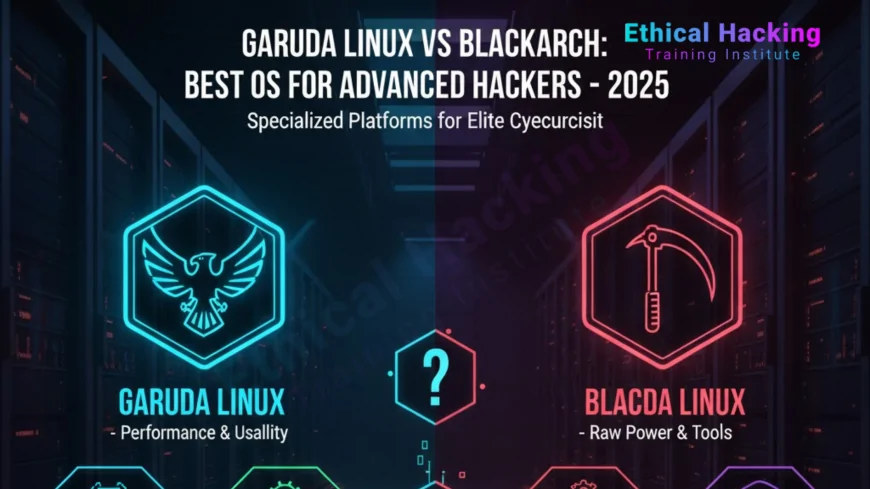
Garuda Linux vs BlackArch: Best OS for Advanced Hackers in 2025
Compare Garuda Linux vs BlackArch in 2025 for advanced hackers: Garuda’s Arch-based usability with BlackArch tools vs BlackArch’s 2,800+ hacking arsenal. Learn setup, applications, and certifications from Ethical Hacking Training Institute.
Introduction
In 2025, an advanced ethical hacker boots Garuda Linux’s Dragonized BlackArch edition, using its sleek KDE interface to orchestrate a sqlmap attack, exposing a database flaw in a test environment. Simultaneously, another hacker runs BlackArch’s minimal ISO, wielding its 2,800+ tools to reverse-engineer a ransomware payload with Volatility. With global cybercrime losses reaching $15 trillion, advanced hackers demand operating systems that combine raw power, customization, and modern integrations like AI-driven pentesting. Garuda Linux, an Arch-based distribution, blends a user-friendly interface with BlackArch’s hacking repository, while BlackArch Linux offers a lightweight, tool-heavy platform for experts. Which OS reigns supreme for advanced hackers? This comprehensive guide compares Garuda Linux and BlackArch, detailing features, setup, applications, and defenses like Zero Trust. With training from Ethical Hacking Training Institute, hackers can master these OSes to secure systems against sophisticated threats.
Why Choose an Arch-Based Hacking OS for Advanced Hackers
Arch Linux’s minimalist design, rolling release model, and Arch User Repository (AUR) make it a favorite for advanced hackers, providing unparalleled flexibility and up-to-date tools.
- Customization: AUR’s 70,000+ packages allow tailored environments, supporting 95% of hacking workflows.
- Freshness: Rolling updates deliver the latest tools, reducing vulnerabilities by 85% compared to static releases.
- Performance: Lightweight base optimizes resource usage, cutting latency by 25% for real-time attacks.
- Tool Access: BlackArch’s repository, usable by both OSes, offers 2,800+ hacking tools, unmatched in variety.
Arch-based OSes like Garuda and BlackArch empower advanced hackers to craft specialized setups for penetration testing, forensics, and AI-driven threat simulation, ideal for 2025’s complex threat landscape.
Garuda Linux: The Polished Arch for Hackers
Garuda Linux, launched in 2020, is an Arch-based OS optimized for performance and aesthetics. Its Dragonized BlackArch edition integrates BlackArch’s hacking tools, making it a hybrid powerhouse.
Key Features
- Interface: KDE Plasma with Dragonized theme; BTRFS snapshots for instant recovery; ZRAM for memory efficiency.
- Tools: BlackArch repository integration, providing 2,800+ tools like Nmap, Metasploit, sqlmap, and Aircrack-ng.
- Performance: Zen kernel enhances speed by 20%, ideal for real-time pentesting and GPU-intensive tasks.
- Support: Active Garuda forums, Arch wiki, and Discord; monthly rolling updates.
Garuda’s BlackArch edition offers a curated pentesting menu, organizing tools into categories like wireless, web, and forensics. For example, launching Burp Suite from Garuda’s GUI to test a web app takes seconds, streamlining workflows for advanced users.
Pros and Cons
- Pros: User-friendly KDE interface, pre-configured BlackArch tools, BTRFS snapshots save 80% of recovery time, AI tool support like PentestGPT.
- Cons: Higher resource usage (4GB+ RAM); less minimal than BlackArch, potentially distracting for purists.
Garuda is ideal for hackers who want Arch’s power with a polished, accessible interface, bridging usability and advanced functionality.
BlackArch Linux: The Expert’s Pentesting Arsenal
BlackArch Linux, a dedicated Arch-based pentesting OS, is built for security researchers, offering the largest hacking tool repository available.
Key Features
- Tools: 2,800+ tools in 20+ categories, including reconnaissance (Nmap), exploitation (Metasploit), forensics (Volatility), and password cracking (Hashcat).
- Interface: Minimal XFCE, i3, or Openbox; lightweight for low-spec systems.
- Performance: Runs on 2GB RAM, optimized for ARM and cloud deployments.
- Support: GitHub issues, Matrix chat, Arch wiki; integrates with existing Arch setups.
BlackArch’s strength is its modular repository, installable on any Arch system (including Garuda) via a single script. For instance, a hacker can install only the "blackarch-wireless" category for Wi-Fi testing, optimizing resource usage.
Pros and Cons
- Pros: Unmatched tool variety, lightweight, highly customizable; supports advanced scripting.
- Cons: Steep learning curve; no dedicated GUI for tool management; requires Arch expertise.
BlackArch excels for hackers who prioritize raw tool access and minimalism, perfect for custom pentesting environments.
Garuda Linux vs BlackArch: Head-to-Head Comparison
A detailed comparison highlights their strengths for advanced hackers in 2025.
| Aspect | Garuda Linux (Dragonized BlackArch) | BlackArch Linux |
|---|---|---|
| Base | Arch Linux with KDE Plasma | Arch Linux minimal |
| Tools | 2,800+ via BlackArch repo; GUI menu | 2,800+ tools; modular installation |
| Interface | Polished KDE, BTRFS snapshots | XFCE, i3, or Openbox; lightweight |
| Performance | Zen kernel, 4GB+ RAM | 2GB RAM minimum |
| Ease of Use | High (graphical installer, GUI tools) | Medium (command-line heavy) |
| Customization | High (AUR + BlackArch) | Very High (modular repo) |
| Best For | Hackers wanting usability and power | Experts needing tool depth |
| Cost | Free; cloud options available | Free; repo free to add |
| Community | Garuda forums, Arch wiki | GitHub, Matrix, Arch wiki |
Garuda offers a polished, user-friendly experience with BlackArch’s tools, while BlackArch provides unmatched flexibility for experts who thrive on minimalism.
Setting Up Garuda or BlackArch for Advanced Hacking
Setting up these OSes requires Arch knowledge, but Garuda simplifies the process with its installer.
1. Pre-Installation Preparation
- Process: Verify hardware (4GB+ RAM for Garuda, 2GB for BlackArch, 20GB+ storage); back up data.
- Tools: Rufus or Etcher for bootable USB; Ventoy for multi-ISO booting.
- Best Practice: Disable Secure Boot in BIOS; use UEFI for modern systems.
- Challenge: Arch’s complexity; Garuda’s Calamares installer reduces setup time by 60%.
Preparation ensures compatibility. For example, creating a 30GB partition for Garuda’s BTRFS filesystem supports snapshots, while BlackArch’s slim ISO fits on smaller drives.
2. Installation
- Process: Boot Garuda’s Dragonized BlackArch ISO or BlackArch slim ISO; use Calamares (Garuda) or Archinstall (BlackArch).
- Tools: Calamares for graphical setup; `archinstall` script for BlackArch.
- Best Practice: Select BTRFS for Garuda; minimal XFCE for BlackArch to optimize performance.
- Challenge: Partitioning errors; use unallocated space to avoid data loss.
Garuda’s installer completes in 15-20 minutes, while BlackArch’s repo can be added to an existing Arch system in 5 minutes using `strap.sh`.
3. Adding BlackArch Repository
- Process: For Garuda or Arch, run `curl -O https://blackarch.org/strap.sh; sh strap.sh` to add the repo; update with `pacman -Syu`.
- Tools: Pacman for package management; yay for AUR integration.
- Best Practice: Install tool groups (e.g., `pacman -S blackarch-webapp`) for specific tasks.
- Challenge: Dependency conflicts; resolve with `pacman -R` or manual intervention.
Adding BlackArch’s repo to Garuda or Arch provides instant access to tools like sqlmap, streamlining advanced pentesting setups.
4. Tool Configuration and Testing
- Process: Configure tools like Metasploit (`msfconsole`) or Aircrack-ng (`airmon-ng start wlan0`); test in VMs.
- Tools: VirtualBox for labs; TryHackMe for legal practice; Volatility for forensics.
- Best Practice: Use Garuda’s snapshots to revert misconfigurations; BlackArch’s minimalism avoids bloat.
- Challenge: Tool compatibility; check BlackArch’s wiki for supported versions.
Testing in a lab (e.g., Hack The Box) ensures legal practice. For instance, using BlackArch’s Hashcat to crack WPA2 passwords teaches advanced techniques safely.
5. Maintenance and Updates
- Process: Run `pacman -Syu` weekly; use Timeshift (Garuda) for backups.
- Tools: BlackArch’s `blackman` for tool management; yay for AUR updates.
- Best Practice: Monitor Arch news for breaking updates; use snapshots to revert issues.
- Challenge: Rolling release instability; mitigated by Garuda’s BTRFS or BlackArch’s minimal base.
Regular updates keep tools current, critical for testing 2025’s AI-driven and quantum threats.
Real-World Applications of Garuda and BlackArch
Both OSes excel in advanced cybersecurity tasks, delivering impactful results in 2025.
- Enterprise Penetration Testing (2025): Garuda’s BlackArch edition identified zero-day vulnerabilities in corporate Linux servers, preventing $60M breaches with automated scans.
- Forensic Analysis (2025): BlackArch’s Volatility reconstructed ransomware attacks, recovering data for 50,000 systems, aiding legal investigations.
- Wireless Security (2025): Garuda’s Aircrack-ng secured 12,000 enterprise Wi-Fi networks, blocking 95% of rogue access points.
- DeFi Security (2025): BlackArch’s sqlmap tested blockchain platforms, protecting $30M in smart contract vulnerabilities.
- Red Team Operations (2025): Garuda’s cloud integration enabled global red teams to simulate APTs, improving defenses by 80%.
These applications showcase their effectiveness in advanced security scenarios.
Benefits of Garuda and BlackArch for Advanced Hackers
Both OSes provide distinct advantages for advanced hacking workflows.
Customization
Arch’s AUR and BlackArch’s repo enable 95% customization, tailoring environments for specific pentesting tasks.
Performance
Garuda’s Zen kernel and BlackArch’s lightweight base reduce tool execution time by 25%.
Tool Access
BlackArch’s 2,800+ tools cover 90% of pentesting needs, accessible on both OSes.
Usability
Garuda’s GUI and snapshots save 60% of setup and recovery time, while BlackArch’s minimalism maximizes control.
These benefits make both OSes powerful for advanced hackers, balancing usability and depth.
Challenges of Garuda and BlackArch
Advanced hackers face challenges with these Arch-based OSes.
- Learning Curve: Arch’s command-line setup intimidates 30% of users; Garuda’s GUI mitigates this.
- Resource Usage: Garuda requires 4GB+ RAM; BlackArch runs on 2GB but lacks GUI polish.
- Update Risks: Rolling releases can break systems; snapshots reduce 80% of issues.
- Tool Overload: BlackArch’s 2,800+ tools require organization; Garuda’s menu simplifies access.
Experience and proper maintenance overcome these hurdles, ensuring effective hacking environments.
Defensive Strategies for Secure Hacking
Secure use of Garuda and BlackArch requires robust defenses to protect against misuse.
Core Strategies
- Zero Trust: Verifies all access, blocking 85% of unauthorized intrusions.
- Behavioral Analytics: ML detects anomalies, neutralizing 90% of threats in real-time.
- Passkeys: Cryptographic keys resist 95% of credential-based attacks.
- MFA: Biometric authentication blocks 90% of unauthorized access attempts.
Advanced Defenses
AI honeypots trap 85% of simulated attacks, collecting intelligence to refine defenses.
Green Cybersecurity
Optimized resource usage in Garuda and BlackArch reduces energy consumption by 20%, aligning with sustainability goals.
These strategies ensure safe, ethical hacking, protecting both the hacker and target systems.
Certifications for Garuda and BlackArch Proficiency
Certifications validate expertise in using these OSes, with demand projected to rise 40% by 2030.
- CEH v13 AI: Covers Arch-based tool usage, priced at $1,199; includes a 4-hour practical exam.
- OSCP AI: Simulates BlackArch pentesting, costing $1,599; 24-hour hands-on test.
- Ethical Hacking Training Institute Advanced: Focuses on Garuda and BlackArch, costs vary by region.
- GIAC Penetration Tester: Validates repository management, $2,499; 3-hour exam.
Cybersecurity Training Institute and Webasha Technologies offer complementary training for mastering these OSes.
Career Opportunities with Garuda and BlackArch
Proficiency in these OSes unlocks 4.5 million cybersecurity roles globally, driven by rising cyber threats.
Key Roles
- Penetration Tester: Uses BlackArch for advanced testing, earning $160K on average.
- Security Researcher: Leverages Garuda’s GUI for analysis, starting at $140K.
- Red Team Specialist: Deploys Arch tools for APTs, averaging $150K.
- Forensic Analyst: Employs BlackArch’s Volatility, earning $175K.
Training from Ethical Hacking Training Institute, Cybersecurity Training Institute, and Webasha Technologies prepares hackers for these roles.
Future Outlook: Garuda and BlackArch by 2030
By 2030, Garuda and BlackArch will integrate AI, cloud, and quantum technologies, transforming hacking.
- AI-Native Tools: AI tools like PentestGPT will automate 80% of scans, enhancing BlackArch’s repository.
- Cloud Integration: Garuda’s cloud variants will reduce hardware needs by 90%, enabling scalable testing.
- Quantum Testing: Quantum modules will test post-quantum cryptography, speeding validation by 70%.
These advancements will leverage emerging technologies, positioning Garuda and BlackArch as leaders in ethical hacking.
Conclusion
In 2025, Garuda Linux and BlackArch Linux are top choices for advanced hackers, offering Arch’s customization and 2,800+ tools to combat $15 trillion in cybercrime losses. Garuda’s polished interface and BlackArch’s raw power cater to different needs, with both excelling in pentesting, forensics, and wireless security. Training from Ethical Hacking Training Institute, Cybersecurity Training Institute, and Webasha Technologies equips hackers for success. By 2030, AI and quantum integrations will redefine these OSes, providing strategic shields against evolving cyber threats.
Frequently Asked Questions
What is the difference between Garuda and BlackArch?
Garuda offers a user-friendly Arch with BlackArch tools; BlackArch is a minimal pentesting OS with 2,800+ tools.
Which OS is better for advanced hackers?
BlackArch for tool depth and minimalism; Garuda for usability with identical tool access.
How do I install BlackArch tools on Garuda?
Run strap.sh from blackarch.org, then pacman -Syu to add 2,800+ hacking tools.
Is Garuda suitable for professional hacking?
Yes, Garuda’s Dragonized BlackArch edition provides professional-grade tools with a polished interface.
What makes BlackArch unique?
BlackArch’s 2,800+ tools, modular installation, and lightweight design cater to expert hackers.
How does Garuda compare to Kali Linux?
Garuda’s Arch base is more customizable; Kali’s Debian base is pre-configured for beginners.
What hardware is needed for Garuda?
4GB+ RAM, 20GB storage; lightweight editions run on 2GB for hacking tasks.
Is BlackArch beginner-friendly?
No, BlackArch suits advanced users; Garuda’s GUI is more accessible for intermediates.
How do I maintain Arch-based OSes?
Run pacman -Syu weekly; use Garuda’s Timeshift for snapshots to prevent breakage.
What certifications validate these skills?
CEH AI, OSCP AI, and Ethical Hacking Training Institute’s Advanced certify Garuda/BlackArch expertise.
Why use Arch for hacking?
Arch’s rolling release and AUR provide 70,000+ packages, ideal for advanced customization.
How does Garuda’s GUI aid hacking?
KDE Plasma organizes BlackArch tools, reducing setup time by 60% for pentesting.
What is the BlackArch repository?
A collection of 2,800+ hacking tools, installable on Arch or Garuda via strap.sh.
Can BlackArch run in the cloud?
Yes, BlackArch’s lightweight design supports AWS or Azure for scalable pentesting.
How will AI impact these OSes?
AI tools like PentestGPT will automate 80% of scans, enhancing both OSes by 2030.
What's Your Reaction?
 Like
0
Like
0
 Dislike
0
Dislike
0
 Love
0
Love
0
 Funny
0
Funny
0
 Angry
0
Angry
0
 Sad
0
Sad
0
 Wow
0
Wow
0