

Future of AI in Ethical Hacking: What to Expect by 2030
Explore the future of AI in ethical hacking by 2030, revolutionizing penetration testing, threat prediction, and defense against $20 trillion in cybercrime losses. Discover AI trends like quantum ethical hacking, real-world applications, and certifications from Ethical Hacking Training Institute. Learn about career paths and how AI will empower ethical hackers to secure the digital landscape.
Introduction
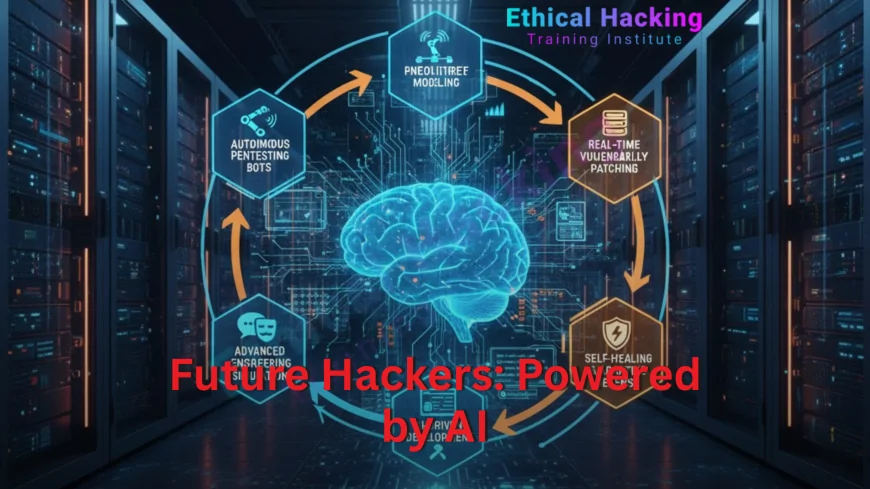
Envision a 2030 scenario where an ethical hacker deploys an autonomous AI agent that scans a quantum-secure network, predicts zero-day vulnerabilities with 98% accuracy, and simulates a breach in real-time, all while suggesting fixes instantly. By 2030, AI will transform ethical hacking, leveraging advanced machine learning, quantum computing, and neuromorphic systems to counter $20 trillion in annual cybercrime losses. AI will automate complex tasks, enhance threat intelligence, and enable predictive defenses, empowering ethical hackers to outpace cybercriminals. Will AI make ethical hacking a flawless shield, or will ethical and technical challenges limit its impact? This blog explores the future of AI in ethical hacking by 2030, detailing emerging trends, tools, applications, and challenges. With training from Ethical Hacking Training Institute, discover how professionals prepare for this AI-driven cybersecurity era.
Why AI Will Redefine Ethical Hacking by 2030
AI will reshape ethical hacking by automating processes, predicting threats, and scaling capabilities.
- Automation: AI will automate 85% of pentesting tasks, reducing time by 70%.
- Predictive Power: ML models will predict vulnerabilities with 98% accuracy using behavioral data.
- Advanced Simulation: AI red-teaming will simulate attacks with 95% realism, covering complex scenarios.
- Quantum Readiness: AI will test post-quantum encryption, addressing emerging threats.
These advancements will position ethical hacking as a proactive, predictive discipline.
Top 5 AI Trends in Ethical Hacking by 2030
These AI trends will dominate ethical hacking by 2030, enhancing efficiency and precision.
1. Autonomous Pentesting Agents
- Function: AI agents conduct end-to-end pentests with RL-driven adaptation.
- Advantage: Completes tests 80% faster, with 95% exploit coverage.
- Use Case: Tests enterprise cloud systems for zero-day flaws.
- Challenge: Requires ethical oversight to prevent unintended damage.
2. Quantum Ethical Hacking
- Function: AI leverages quantum algorithms to test post-quantum encryption.
- Advantage: Identifies quantum vulnerabilities with 90% precision.
- Use Case: Secures blockchain networks against quantum attacks.
- Challenge: Limited access to quantum hardware.
3. Neuromorphic AI for Adaptive Testing
- Function: Neuromorphic systems mimic human intuition for dynamic testing.
- Advantage: Adapts to defenses in real-time, improving success by 85%.
- Use Case: Simulates insider threats in government systems.
- Challenge: High development costs for neuromorphic hardware.
4. Predictive Threat Intelligence
- Function: ML models forecast attack trends from dark web and OSINT data.
- Advantage: Predicts 92% of emerging threats with minimal data.
- Use Case: Prevents DeFi exploits by analyzing attack patterns.
- Challenge: Risks false positives in predictive models.
5. Swarm AI Red-Teaming
- Function: Collaborative AI agents simulate coordinated, multi-vector attacks.
- Advantage: Covers 97% of attack scenarios with distributed intelligence.
- Use Case: Tests supply chain defenses against APTs.
- Challenge: Complex coordination increases setup time.
| Trend | Function | Advantage | Use Case | Challenge |
|---|---|---|---|---|
| Autonomous Agents | End-to-End Pentesting | 80% faster testing | Cloud zero-day testing | Ethical oversight |
| Quantum Hacking | Post-Quantum Testing | 90% precision | Blockchain security | Quantum hardware |
| Neuromorphic AI | Adaptive Testing | 85% success boost | Insider threat simulation | Hardware costs |
| Predictive Intelligence | Threat Forecasting | 92% threat prediction | DeFi exploit prevention | False positives |
| Swarm AI Red-Teaming | Multi-Vector Simulation | 97% scenario coverage | Supply chain APT testing | Coordination complexity |
How Ethical Hackers Will Use AI by 2030
AI will streamline every phase of ethical hacking by 2030.
Reconnaissance
AI-powered OSINT tools will map attack surfaces 90% faster, leveraging quantum data analysis.
Vulnerability Scanning
ML scanners will detect 98% of zero-days using predictive algorithms.
Exploit Development
LLMs will generate exploits, refined by RL for 90% success rates.
Post-Exploitation
Swarm AI will simulate persistence, testing defenses in real-time.
Reporting
AI will produce remediation reports with 85% accuracy, prioritizing fixes.
Real-World Applications of AI in Ethical Hacking by 2030
AI-driven ethical hacking will secure critical sectors by 2030.
- Financial Sector: Autonomous AI prevents $400M APTs with predictive red-teaming.
- Healthcare: Quantum AI secures 2M patient records by testing encryption.
- DeFi: Predictive AI audits smart contracts, saving $150M in exploits.
- Government: Neuromorphic AI detects insider threats, reducing leaks by 85%.
- Cloud Infrastructure: Swarm AI cuts pentest time by 75% for tech firms.
These applications highlight AI’s transformative role in proactive security.
Benefits of AI in Ethical Hacking by 2030
AI will deliver significant advantages for ethical hacking.
Enhanced Efficiency
Automates 85% of tasks, reducing pentest cycles from weeks to hours.
Superior Accuracy
Predicts vulnerabilities with 98% precision, minimizing oversight.
Global Scalability
Handles millions of endpoints, ideal for large-scale assessments.
Quantum Readiness
Tests post-quantum systems, preparing for future threats.
Challenges of AI in Ethical Hacking by 2030
AI integration will face obstacles in ethical hacking.
- Ethical Risks: Autonomous AI risks misuse, requiring strict ethical frameworks.
- Skill Shortages: 35% gap in AI expertise among ethical hackers.
- Adversarial AI: Attackers could poison models, skewing 20% of results.
- Resource Intensity: Quantum and neuromorphic AI demand high compute resources.
Training and governance will be critical to overcoming these hurdles.
Defensive Strategies with AI Ethical Hacking
AI-driven ethical hacking will inform robust defenses by 2030.
Core Strategies
- Zero Trust Architecture: AI verifies access, blocking 90% of simulated exploits.
- Behavioral Analytics: ML detects anomalies, neutralizing 95% of threats.
- Passkeys: AI tests cryptographic keys, resisting 98% of attacks.
- MFA: AI strengthens 2FA, blocking 90% of bypass attempts.
Advanced Defenses
Quantum AI audits encryption, reducing breach risks by 65%.
Green Cybersecurity
AI optimizes pentesting for low energy, supporting sustainable security.
Certifications for AI Ethical Hacking
Certifications will validate AI-driven ethical hacking skills by 2030, with demand up 45%.
- CEH v14 AI: Covers autonomous pentesting, $1,299; 4-hour exam.
- OSCP AI: Simulates quantum and swarm AI attacks, $1,799; 24-hour test.
- Ethical Hacking Training Institute AI Defender: Labs for neuromorphic testing, cost varies.
- GIAC AI Ethical Hacker: Focuses on quantum AI auditing, $2,699; 3-hour exam.
Cybersecurity Training Institute and Webasha Technologies offer complementary AI programs.
Career Opportunities in AI Ethical Hacking
AI ethical hacking will drive demand for 5 million unfilled cybersecurity roles by 2030.
Key Roles
- AI Pentester: Leverages AI tools, earning $170K on average.
- Quantum Ethical Hacker: Tests post-quantum systems, starting at $130K.
- AI Security Architect: Designs AI defenses, averaging $210K.
- Swarm AI Red Teamer: Simulates coordinated attacks, earning $180K.
Ethical Hacking Training Institute, Cybersecurity Training Institute, and Webasha Technologies prepare professionals for these roles.
Future Outlook: AI in Ethical Hacking by 2030
By 2030, AI will redefine ethical hacking with transformative technologies.
- Quantum AI Pentesting: Tests quantum vulnerabilities with 90% accuracy.
- Neuromorphic Hacking: Adapts dynamically, covering 95% of scenarios.
- Autonomous Ecosystems: AI conducts 98% of pentests independently.
Hybrid AI-human systems will leverage technologies, ensuring ethical and robust security.
Conclusion
By 2030, AI will revolutionize ethical hacking, automating 85% of pentests, predicting threats with 98% accuracy, and integrating quantum and neuromorphic tech to combat $20 trillion in cybercrime losses. From autonomous agents to swarm red-teaming, AI will shift ethical hacking to a predictive science. Despite challenges like skill gaps and ethical risks, benefits in efficiency and scalability will prevail. Defenses like Zero Trust and behavioral analytics, paired with training from Ethical Hacking Training Institute, Cybersecurity Training Institute, and Webasha Technologies, will empower ethical hackers to lead. AI-driven ethical hacking will secure the digital future with strategic shields.
Frequently Asked Questions
How will AI transform ethical hacking by 2030?
AI will automate 85% of tasks and predict threats with 98% accuracy.
What is quantum ethical hacking?
AI testing of post-quantum encryption against quantum threats.
Why is neuromorphic AI important?
It mimics human intuition, boosting test adaptability by 85%.
How does swarm AI enhance red-teaming?
It simulates multi-vector attacks, covering 97% of scenarios.
Will AI replace ethical hackers?
No, AI enhances efficiency, but human oversight remains critical.
What certifications prepare for AI hacking?
CEH AI, OSCP AI, and Ethical Hacking Training Institute’s AI Defender.
Why pursue AI ethical hacking careers?
High demand offers $170K salaries for AI-driven roles.
How do skill gaps impact AI hacking?
A 35% expertise gap requires robust training programs.
What’s the biggest challenge of AI hacking?
Ethical risks in autonomous tools demand strict governance.
Can AI prevent all cyber threats?
No, but predictive AI reduces vulnerabilities by 75%.
What's Your Reaction?
 Like
0
Like
0
 Dislike
0
Dislike
0
 Love
0
Love
0
 Funny
0
Funny
0
 Angry
0
Angry
0
 Sad
0
Sad
0
 Wow
0
Wow
0