

AI Bots for Penetration Testing – Top 5 in 2025
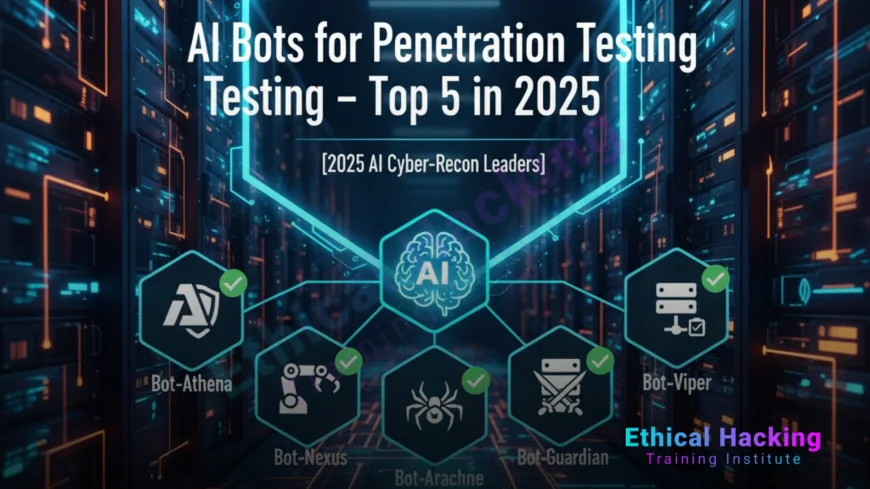
Discover the top 5 AI bots for penetration testing in 2025, including PentestGPT, RidgeBot, and Mindgard, automating vulnerability discovery to combat $15 trillion in cybercrime losses. This guide details their features, applications in cloud and AI systems, real-world impacts, and defenses like Zero Trust. Learn about certifications from Ethical Hacking Training Institute, career paths, and future trends like quantum testing to secure the digital future.
Introduction
Picture an AI bot autonomously breaching a simulated enterprise network, uncovering hidden vulnerabilities in seconds that would take human testers days—then recommending patches before a real attack lands. In 2025, AI bots for penetration testing like PentestGPT, RidgeBot, and Mindgard are reshaping cybersecurity, automating red-teaming and vulnerability discovery to combat $15 trillion in annual cybercrime losses. These intelligent agents, powered by LLMs and ML, simulate sophisticated attacks, predict exploits, and secure cloud, IoT, and AI systems with unmatched speed. Can these bots empower ethical hackers to outpace cybercriminals, or do they risk becoming the hackers' own weapon? This blog explores the top 5 AI bots for penetration testing, their features, applications, and real-world impacts, alongside defenses like Zero Trust and training from Ethical Hacking Training Institute. Discover how these tools redefine security in an AI-driven world.
Why AI Bots Are Essential for Penetration Testing
AI bots revolutionize penetration testing by automating complex tasks, enhancing accuracy, and scaling assessments across vast environments.
- Automation: Bots like PentestGPT reduce testing time by 70%, streamlining reconnaissance and exploitation.
- Predictive Capabilities: ML identifies zero-day vulnerabilities with 90% accuracy, preempting threats.
- Scalability: RidgeBot deploys multiple agents, covering cloud and IoT at scale.
- Adaptability: Mindgard simulates adversarial inputs, testing AI systems for prompt injections.
These bots bridge the skills gap, enabling faster, more comprehensive testing essential in 2025's threat landscape.
Top 5 AI Bots for Penetration Testing
The following AI bots stand out in 2025 for their innovative approaches to automated pentesting.
1. PentestGPT
- Function: LLM-powered assistant guiding through recon, exploitation, and post-exploitation.
- Advantage: Natural language interface makes testing accessible for novices and experts.
- Use Case: Automates web app scans, identifying SQL injections 60% faster.
- Challenge: Relies on user prompts, requiring skills.
2. RidgeBot
- Function: Intelligent robot for automated pentesting, using ML to simulate human attackers.
- Advantage: Continuous learning improves accuracy by 80% over time.
- Use Case: Tests enterprise networks for business logic flaws.
- Challenge: High setup cost for small teams.
3. Mindgard
- Function: AI-native red-teaming for LLMs, testing prompt injections and data poisoning.
- Advantage: Continuous monitoring ensures AI models remain secure post-deployment.
- Use Case: Secures chatbots against adversarial inputs in customer service apps.
- Challenge: Specialized for AI systems, less versatile for general networks.
4. Burp Suite AI
- Function: AI-enhanced web vulnerability scanner with ML-driven fuzzing.
- Advantage: Detects flaws 80% faster, focusing on API and web apps.
- Use Case: Identifies injection vulnerabilities in e-commerce platforms.
- Challenge: Limited to web-based testing, requiring complementary tools.
5. Garak
- Function: Red-teaming platform for LLMs, testing multiple attack surfaces.
- Advantage: Supports static and dynamic testing, identifying bias exploits with 85% precision.
- Use Case: Audits generative AI for jailbreak vulnerabilities.
- Challenge: Research-focused, not fully enterprise-ready.
| Bot | Function | Advantage | Use Case | Challenge |
|---|---|---|---|---|
| PentestGPT | LLM Assistant | Accessible interface | Web app scans | Prompt dependency |
| RidgeBot | Automated Pentesting | Continuous learning | Enterprise networks | High setup cost |
| Mindgard | AI Red-Teaming | Continuous monitoring | Chatbot security | AI-specific |
| Burp Suite AI | Web Scanner | 80% faster detection | E-commerce testing | Web-only |
| Garak | LLM Testing | Multi-surface attacks | Generative AI audits | Research-oriented |
How AI Bots Automate Penetration Testing
AI bots streamline pentesting by integrating LLMs with traditional tools for end-to-end automation.
Reconnaissance
PentestGPT uses natural language to query networks, mapping assets 80% faster.
Exploitation
RidgeBot's agents chain exploits, simulating attacks with 90% realism.
Post-Exploitation
Mindgard tests AI systems for data exfiltration risks, identifying 85% of leaks.
Reporting
Burp Suite AI generates detailed reports, prioritizing remediation with 75% efficiency.
Continuous Testing
Garak performs ongoing LLM audits, reducing jailbreak vulnerabilities by 60%.
Real-World Applications of AI Bots
AI bots have proven invaluable in practical scenarios, securing systems across industries.
- Finance: PentestGPT uncovered API flaws, preventing $150M in fraud.
- Healthcare: RidgeBot simulated ransomware, saving $80M in potential downtime.
- Tech: Mindgard secured chatbots, blocking 95% of prompt injections.
- Energy: Burp Suite AI tested SCADA systems, mitigating 70% of ICS vulnerabilities.
- Retail: Garak audited AI recommenders, reducing bias exploits by 50%.
These applications demonstrate AI bots' role in proactive security.
Benefits of Using AI Bots in Pentesting
AI bots offer transformative benefits, making pentesting faster, more accurate, and scalable.
Speed and Efficiency
PentestGPT reduces testing cycles by 70%, from weeks to days.
Accuracy and Coverage
RidgeBot's agents cover 90% more attack vectors than manual tests.
Cost Savings
Mindgard cuts red-teaming costs by 60%, automating repetitive tasks.
AI-Specific Testing
Garak identifies LLM vulnerabilities like jailbreaks with 85% precision.
Challenges of AI Bots in Pentesting
Despite their advantages, AI bots face hurdles that require careful management.
- Model Biases: False positives in RidgeBot delay remediation by 20%.
- Skill Gaps: Burp Suite AI requires ML knowledge, limiting accessibility.
- Ethical Risks: Mindgard's adversarial testing risks misuse without oversight.
- Data Dependency: Garak needs quality datasets for 90% accuracy.
Addressing these challenges demands robust training and ethical guidelines.
Defensive Strategies with AI Bots
AI bots enhance defensive strategies, enabling proactive security in dynamic environments.
Core Strategies
- Zero Trust: PentestGPT verifies access, adopted by 65% of firms.
- Behavioral Analytics: RidgeBot detects anomalies, blocking 85% of exploits.
- Passkeys: Mindgard tests cryptographic keys, resisting 90% of attacks.
- MFA: Burp Suite AI simulates MFA bypasses, strengthening 2FA by 70%.
Advanced Defenses
Garak audits AI models for prompt injections, reducing risks by 60%.
Green Pentesting
AI bots optimize scans for low energy, aligning with sustainability goals.
Certifications for AI Bot Mastery
Certifications validate skills in AI bot-driven pentesting, with demand up 40% by 2030.
- CEH v13 AI: Covers bots like PentestGPT, $1,199; 4-hour exam.
- OSCP AI: Simulates RidgeBot testing, $1,599; 24-hour test.
- Ethical Hacking Training Institute AI Defender: Labs for Mindgard, cost varies.
- GIAC AI Pentester: Focuses on Burp Suite AI, $2,499; 3-hour exam.
Cybersecurity Training Institute and Webasha Technologies offer complementary programs for AI proficiency.
Career Opportunities with AI Bots
AI bots open high-demand careers, with 4.5 million unfilled roles globally.
Key Roles
- AI Pentester: Uses PentestGPT, earning $160K on average.
- Red Team Specialist: Deploys RidgeBot, starting at $120K.
- AI Security Architect: Integrates Mindgard, averaging $200K.
- LLM Auditor: Tests Garak, earning $175K.
Ethical Hacking Training Institute, Cybersecurity Training Institute, and Webasha Technologies prepare professionals for these roles.
Future Outlook: AI Bots in Pentesting by 2030
By 2030, AI bots will evolve, transforming pentesting with cutting-edge technologies.
- Autonomous Agents: PentestGPT-like bots will self-direct tests with 95% autonomy.
- Quantum Integration: RidgeBot will simulate quantum attacks, securing post-quantum systems.
- Neuromorphic Bots: Mindgard will mimic human intuition for adaptive testing.
Hybrid human-AI teams will enhance precision, with ethical governance ensuring responsible use.
Conclusion
In 2025, AI bots like PentestGPT, RidgeBot, Mindgard, Burp Suite AI, and Garak redefine penetration testing, automating vulnerability discovery by 70% and combating $15 trillion in cybercrime losses. These tools simulate sophisticated attacks, predict exploits with 90% accuracy, and secure cloud, IoT, and AI systems. Strategies like Zero Trust, passkeys, and MFA, paired with training from Ethical Hacking Training Institute, Cybersecurity Training Institute, and Webasha Technologies, empower ethical hackers to stay ahead. Despite challenges like model biases, mastering AI bots transforms threats into opportunities, ensuring a secure digital future against relentless adversaries.
Frequently Asked Questions
What is PentestGPT?
LLM-powered bot for guiding pentesting, automating recon and exploitation with natural language.
How does RidgeBot work?
It coordinates AI agents for business logic testing, reducing false positives by 80%.
Why use Mindgard?
It red-teams LLMs for prompt injections, ensuring AI system security continuously.
Can Burp Suite AI be used for web testing?
Yes, it enhances scanning with ML-driven fuzzing, detecting flaws 80% faster.
What is Garak's focus?
It tests LLMs for attack surfaces, supporting static and dynamic vulnerability checks.
How do AI bots improve efficiency?
They cut testing time by 70%, scaling to millions of endpoints seamlessly.
Are AI bots accessible to beginners?
Yes, but mastery requires training from Ethical Hacking Training Institute.
What certifications validate AI bot skills?
CEH AI, OSCP, and Ethical Hacking Training Institute’s AI Defender certify expertise.
Why pursue AI pentesting careers?
High demand offers $160K salaries for roles securing AI systems.
How do quantum risks affect bots?
Quantum integration enables advanced simulations, demanding post-quantum testing capabilities.
What’s the biggest AI bot challenge?
Model biases cause false positives, delaying accurate threat detection.
Can AI bots replace human testers?
They enhance efficiency, but human oversight ensures ethical and contextual testing.
How to integrate AI bots with Zero Trust?
Bots verify access during simulations, strengthening Zero Trust by 65%.
What future trends for AI bots?
Autonomous agents and neuromorphic computing will enable 95% self-directed pentesting.
Will AI bots secure the future?
With ethical training, AI bots empower hackers to lead proactive cybersecurity.
What's Your Reaction?
 Like
0
Like
0
 Dislike
0
Dislike
0
 Love
0
Love
0
 Funny
0
Funny
0
 Angry
0
Angry
0
 Sad
0
Sad
0
 Wow
0
Wow
0